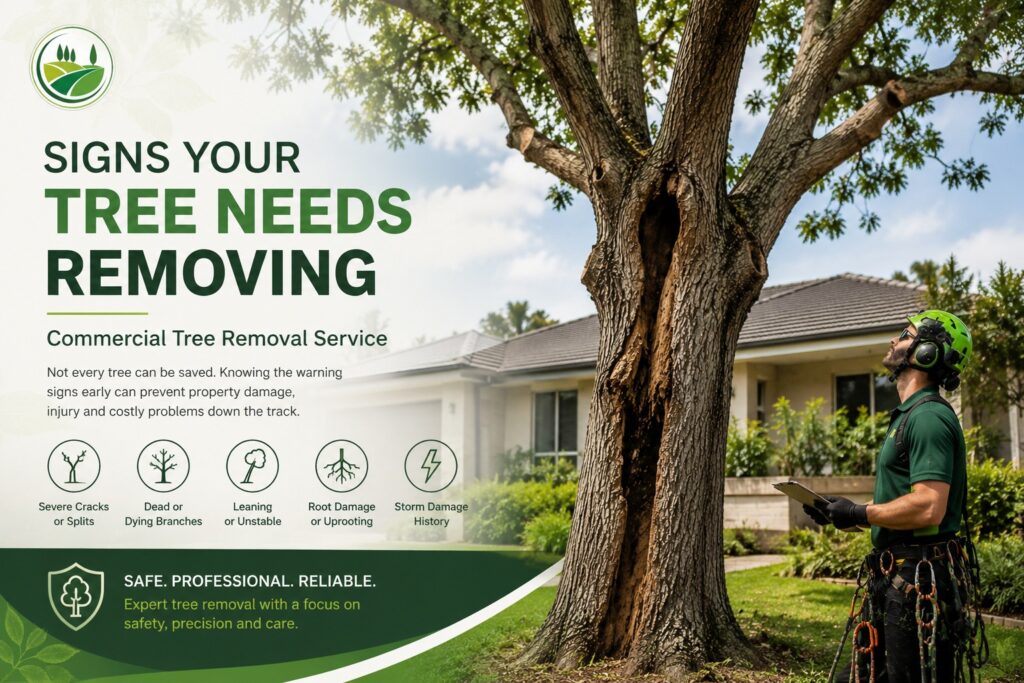
Signs Your Tree Needs Removing | commercial tree removal service
If your tree has developed major cracks, severe decay, extensive deadwood, serious root damage, or a dangerous lean, removal may be safer than trying to save it. The right decision is not always to remove a tree; sometimes professional pruning or treatment can solve the problem. The key is understanding whether the tree can still remain structurally safe.
At Eco Tree Services, we regularly assess trees across Brisbane and South East Queensland that homeowners are unsure about. Some trees look unhealthy but can be preserved with the right tree pruning and maintenance. Others have reached a point where keeping them creates a genuine risk to people, buildings, vehicles or surrounding trees.
Here are the signs I recommend looking for before deciding whether a tree needs to come down.
What are the main signs your tree needs removing?
Quick answer: The strongest warning signs include major trunk cracks, significant decay, severe leaning, extensive deadwood, damaged roots, serious disease, storm damage and structural instability. One minor issue does not automatically mean removal, but several warning signs together require professional assessment.
1. The trunk has large cracks or splits
Large vertical cracks, deep cavities and splits through the trunk can indicate serious structural weakness. This becomes particularly concerning when the damage extends deep into the trunk or appears around major branch unions.
A small surface defect does not necessarily mean the tree must be removed. However, a large crack combined with a heavy canopy, leaning trunk or other structural damage can increase the risk of branch or trunk failure.
2. The tree is leaning significantly
Trees do not always grow perfectly straight, and a naturally leaning tree can remain stable for many years. The concern is a new or rapidly increasing lean.
If you notice that the tree has recently changed position, the soil around the base has lifted, or roots are becoming exposed, I would not ignore it.
3. There is extensive deadwood
Dead branches are common in mature trees, but large amounts of deadwood throughout the canopy can indicate declining tree health.
Large dead branches also create a falling-object risk, particularly above driveways, roofs, paths and areas where people regularly walk.
4. The tree has severe decay or fungal growth
Decay can weaken the internal structure of a tree even when the outside still looks relatively healthy. Hollow sections, soft wood, cavities and persistent fungal growth around the base can all justify closer inspection.
The important point is that you cannot reliably determine the extent of internal decay just by looking at the bark.
5. The roots are damaged or exposed
Roots provide stability as well as water and nutrient uptake. Construction, excavation, soil disturbance, compaction and physical root damage can affect a tree’s ability to remain anchored.
If you can see significant root damage, soil lifting around the base or a change in the tree’s stability, get it assessed rather than assuming the problem will correct itself.
6. The tree has suffered major storm damage
Brisbane’s severe weather can turn an otherwise manageable tree problem into an immediate safety issue. Broken limbs, split trunks, hanging branches and partially uprooted trees should be treated seriously.
A tree that has been damaged by a storm may need pruning, stabilisation or complete removal depending on the extent of the structural damage.
7. The tree is interfering with important structures
Sometimes the problem is not that the tree is diseased. Its location may simply make it unsafe or unsuitable.
Examples include trees growing too close to:
- Houses and roofs
- Driveways and parked vehicles
- Fences
- Footpaths
- Other structures
- Utility infrastructure
- Areas with heavy pedestrian traffic
A professional assessment can determine whether targeted pruning solves the problem or whether removal is the safer long-term option.
Is a leaning tree always dangerous?
No, a leaning tree is not automatically dangerous. The important question is whether the lean is natural and stable or whether it has developed because of root, soil or structural failure.
A mature tree that has grown at an angle for decades may be structurally sound. A tree that suddenly starts leaning after heavy rain or strong winds is a different situation.
I pay particular attention to:
- Freshly exposed roots
- Cracked or lifted soil
- A recently changed angle
- Cracks in the trunk
- Split branch unions
- Soil movement around the base
If several of these signs appear together, don’t wait for the next storm to find out whether the tree is stable.
Can tree disease mean the tree needs to be removed?
Yes, advanced disease can make tree removal necessary, but disease alone does not automatically mean a tree should be removed. Some trees can recover or remain structurally safe when the underlying problem is identified early.
The decision depends on the type and severity of the disease, how much of the tree is affected and whether the tree has suffered structural deterioration.
For example, widespread canopy decline combined with decay at the trunk base is more concerning than a small area of discoloured leaves.
This is why I recommend an assessment before making a removal decision. The goal should be to preserve a healthy tree where possible and remove a hazardous tree when necessary.
When is tree pruning enough instead of removal?
Tree pruning may be enough when the main problem is limited to branches rather than the tree’s overall structural stability. Professional pruning can remove deadwood, reduce selected branches, improve clearance and manage an overgrown canopy.
For example, if a healthy tree has several dead branches hanging over a driveway, removing those branches may solve the immediate hazard without removing the entire tree.
This is where tree pruning and removal services need to work together. The correct solution depends on the condition of the whole tree, not simply how untidy it looks.
Pruning may be appropriate when:
- The trunk remains structurally sound.
- Root stability is not significantly compromised.
- Only selected branches are damaged.
- The tree has manageable canopy growth.
- The tree can remain safely positioned after pruning.
Removal may be more appropriate when:
- Major structural defects cannot be corrected.
- The trunk has extensive decay.
- Root damage has seriously affected stability.
- Storm damage has compromised the main structure.
- The tree presents an unacceptable ongoing hazard.
Can damaged roots make a tree unsafe?
Yes, significant root damage can reduce a tree’s stability and may contribute to failure. Roots anchor the tree in the ground, so damaging a substantial portion of the root system can have consequences that are not immediately visible.
This commonly becomes an issue after excavation, construction or landscaping work near established trees.
If you are planning building work near a mature tree, assess the tree before disturbing the surrounding soil. Once major roots have been damaged, simply deciding to “remove tree and roots” without professional assessment may create additional problems.
What should you do after storm damage?
Keep people away from the damaged area and arrange a professional tree assessment as soon as possible. Do not climb the tree, cut hanging branches yourself or operate equipment underneath unstable limbs.
After a major storm, I would first look for:
- Split or hanging branches
- Broken leaders
- Cracked trunks
- Uprooted trees
- Exposed or lifted roots
- Branches resting on roofs or structures
- Trees leaning toward buildings or access areas
If a tree has already fallen or is creating an immediate hazard, an emergency tree removal service may be required.
The safest approach is to control access to the area and let trained arborists determine how the damaged tree can be dismantled safely.
Should you remove a tree close to your house or power lines?
Not necessarily, but trees growing close to structures or power infrastructure require careful assessment. Proximity alone does not prove that removal is necessary.
A healthy tree may be safely managed through appropriate pruning. However, if the tree is unstable, heavily damaged or structurally compromised, its location increases the consequences of failure.
Never attempt to cut branches yourself when they are close to electrical infrastructure. This is a situation where professional assessment and appropriate safety procedures matter.
Not sure whether your tree needs pruning or removal?
A professional assessment can help identify structural problems, root damage, disease and other safety concerns before they become more serious.
Do you need professional advice before removing a tree?
Yes, professional assessment is the safest way to determine whether removal is actually necessary. A qualified arborist can assess the tree’s condition, structure, root environment, location and surrounding risks before recommending the appropriate work.
This prevents two common mistakes.
The first is removing a tree that could have been safely preserved through pruning or maintenance.
The second is keeping a tree that has already become structurally unsafe because it still appears healthy from a distance.
At Eco Tree Services, our approach is to assess the situation first and then recommend the most appropriate solution. We provide tree removal, pruning, stump grinding and storm-related tree services across Brisbane and South East Queensland.
What happens when a professional removes a tree?
Professional tree removal starts with an assessment and a safe removal plan, rather than simply cutting the tree at its base. The method depends on the tree’s size, condition, location and surrounding obstacles.
A typical removal may involve:
1. Site assessment
The arborist checks the tree, surrounding structures, access, ground conditions and potential hazards.
2. Removal planning
The team determines how branches and sections of the tree can be lowered safely without damaging nearby property.
3. Controlled dismantling
Large trees often need to be removed in sections rather than felled in one piece, particularly when buildings, fences or other obstacles are nearby.
4. Debris removal
Branches, timber and other debris are cleared from the work area.
5. Stump grinding
If you want the remaining stump removed below ground level, a tree stump removal service or stump grinding can be arranged as part of the job.
This complete approach is one reason I recommend using an experienced trees removal company rather than treating tree removal as a simple cutting job.
How can you decide whether your tree needs removing?
Look at the tree’s structure, roots, health, location and recent changes rather than relying on one visual symptom. Use this quick checklist as a starting point:
- Has the tree suddenly started leaning?
- Are there large cracks or cavities in the trunk?
- Is there extensive deadwood?
- Are major roots damaged or exposed?
- Is there significant decay?
- Has the tree suffered storm damage?
- Are large branches splitting or hanging?
- Is the tree threatening a building, driveway or other structure?
- Has its condition deteriorated noticeably?
- Could pruning realistically solve the problem?
If you answer yes to several of these questions, arrange a professional assessment before deciding what to do.
Why should you avoid DIY tree removal?
DIY tree removal can create serious safety and property risks, particularly with large, damaged or poorly positioned trees. A tree does not always fall in the direction you expect, and cutting one section can change the weight distribution of the remaining structure.
The risk increases when the tree is near a house, fence, vehicle, road or electrical infrastructure.
Professional arborists use appropriate equipment, planning and controlled removal techniques to manage these risks. Eco Tree Services is fully insured and provides qualified arborist services throughout Brisbane and South East Queensland.
Conclusion: When should you call an arborist?
You should call an arborist when a tree shows signs of structural instability, severe disease, major root damage, storm damage or significant decline. You do not have to decide by yourself whether the tree should be removed.
A professional assessment can determine whether pruning, ongoing maintenance or complete removal makes the most sense.
At Eco Tree Services, we help Brisbane homeowners, property managers, body corporates and commercial clients deal with unsafe, damaged and overgrown trees. Our services include tree removal, tree pruning and maintenance, stump grinding and emergency storm work.
If you are unsure about a tree on your property, getting it assessed early can help you avoid a much bigger problem later.
Suggested internal links
FAQs
What are the most common signs a tree needs removing?
Major trunk cracks, severe decay, significant leaning, extensive deadwood, serious root damage and major storm damage are some of the clearest warning signs. For example, a tree with newly developed lean and exposed roots after heavy rain deserves professional assessment rather than being left until the next storm.
Can a healthy-looking tree still need to be removed?
Yes, a tree can look healthy externally while having serious structural or root problems. Internal decay, damaged roots or weaknesses at major branch unions may not be obvious from the ground. This is why an arborist assessment can be more useful than judging the tree by its leaves alone.
Does a dead tree always need to be removed?
A dead tree often needs removal when it poses a risk to people or property. A completely dead tree has lost its ability to recover, and its branches and trunk can become increasingly brittle. If it stands beside a house, driveway or frequently used area, leaving it in place can create an avoidable hazard.
Is tree pruning better than tree removal?
Tree pruning is better when pruning can safely resolve the problem without compromising the tree’s structure. For example, removing a few large dead branches from an otherwise healthy tree may eliminate the hazard while allowing the tree to remain. Removal becomes more appropriate when the main structure or root stability is seriously compromised.
Can you remove the tree and roots at the same time?
The above-ground tree can be removed first, while the remaining stump and accessible root material can be dealt with separately. In most residential situations, stump grinding is a practical way to deal with the remaining stump. The extent of root removal depends on the site and what you plan to do with the area afterward.
When should I call an emergency tree removal service?
Call for emergency assistance when a tree or large branch creates an immediate safety hazard, particularly after a storm. A partially uprooted tree leaning toward a house, for example, should not be left until the next convenient appointment. Keep people away from the area and arrange professional assistance.
How do I choose a tree removal company?
Choose a company that has qualified arborists, appropriate insurance, relevant experience and a clear safety-first process. I would also look for a provider that can assess whether removal is actually necessary rather than automatically recommending removal for every problem.
Does tree removal include stump removal?
Not always; stump grinding or removal is often a separate service. If you want the area completely cleared after removing a tree, ask about stump grinding when requesting the quote so the scope of work is clear from the beginning.
Concerned About a Dangerous Tree?
Don’t wait for the next storm to find out whether a damaged or unstable tree is safe. Eco Tree Services can assess the tree and recommend whether pruning, maintenance or removal is the appropriate solution.
Contact Eco Tree Services for professional tree services in Brisbane and South East Queensland.