Is DIY Tree Removal Safe?
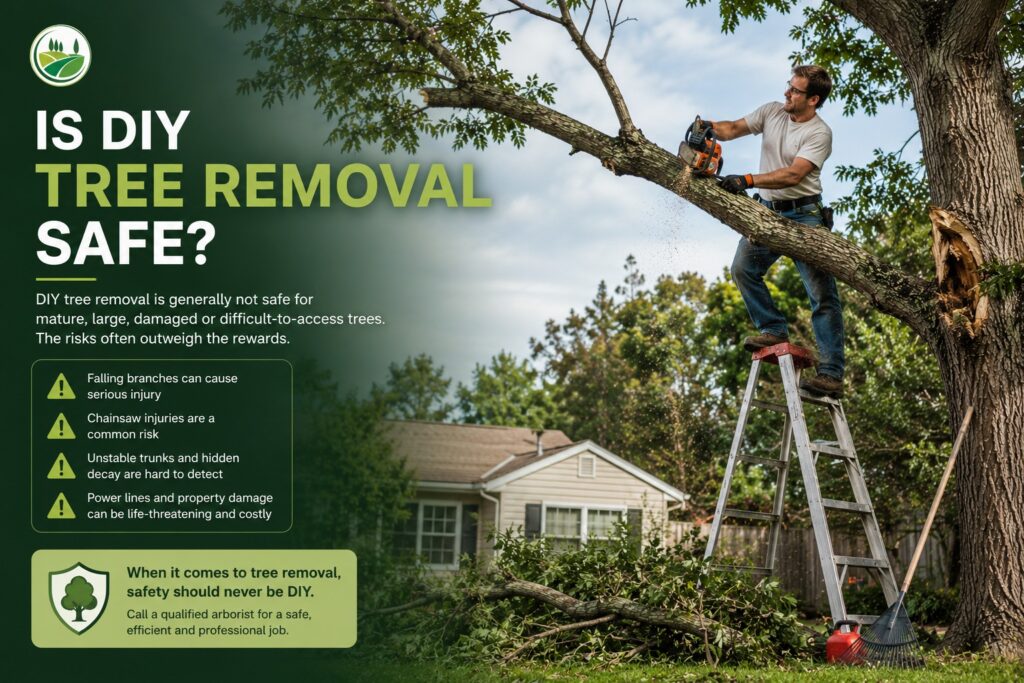
DIY tree removal is generally not safe for mature, large, damaged or difficult-to-access trees. Falling branches, chainsaw injuries, unstable trunks, hidden decay, power lines and property damage can make tree removal dangerous without professional training and equipment.
I understand why homeowners consider doing it themselves. Tree removal can look straightforward from the ground, especially when you see videos showing someone cutting a trunk and watching the tree fall.
The reality is very different.
Professional tree removal involves assessing the tree, understanding its structure, predicting how it may move, controlling falling sections, protecting surrounding property and using appropriate equipment. A mistake can result in serious injury, damage to your house or vehicle, contact with power infrastructure, or the unnecessary removal of a tree that could have been preserved.
At Eco Tree Services, I would always recommend assessing the tree first rather than treating removal as a simple cutting job.
Is DIY tree removal safe?
DIY tree removal is not considered safe for most mature, large, damaged or poorly positioned trees. The risks increase significantly when the tree is tall, close to a building, near power lines, leaning, diseased, storm-damaged or difficult to access.
A homeowner may have experience using a chainsaw, but chainsaw experience alone does not provide the arboricultural knowledge required to safely remove a tree.
You need to understand:
- Tree structure and natural lean
- Branch weight and distribution
- Wood condition and decay
- Root stability
- Wind conditions
- Falling zones
- Cutting and dismantling techniques
- Rigging and lowering
- Safe work areas
- Nearby electrical infrastructure
- Property and public safety
A professional assessment can also reveal that complete removal is unnecessary. Sometimes pruning, deadwood removal or another maintenance solution can address the problem.
DIY tree removal is risky because safely removing a tree requires more than a chainsaw. Tree structure, decay, weight, fall direction, equipment, surrounding hazards and site conditions all need to be assessed before work begins.
Why is DIY tree removal more dangerous than it looks?
Tree removal combines several hazards at the same time: heavy falling material, sharp equipment, height, unpredictable movement and surrounding property risks. A mistake in one part of the process can quickly create another hazard.
Falling branches and timber
A branch that looks manageable from the ground can be much heavier than expected. Once cut, it can swing, rotate or fall in an unexpected direction.
The risk becomes greater when branches are positioned over roofs, driveways, fences or areas where people walk.
Chainsaw injuries
Chainsaws are powerful cutting tools that require proper handling, maintenance and safety procedures. A kickback, loss of control or incorrect cutting position can cause serious injury.
Using a chainsaw safely is not simply about knowing how to start it.
Working at height
Large trees often require work well above ground level. Climbing with cutting equipment creates a completely different risk profile from pruning a small shrub from ground level.
Unpredictable tree movement
Wind, lean, branch weight, trunk defects and internal decay can all affect how a tree moves during removal.
A tree may not behave the way you expect from looking at it from the ground.
DIY removal combines falling objects, chainsaw hazards, working at height and unpredictable tree movement. The risk is not limited to cutting the trunk; the entire removal process can become hazardous.
Can a tree fall in an unexpected direction?
Yes, a tree can move or fall differently from what an inexperienced person expects. Natural lean, uneven weight distribution, wind, structural defects and decay can all affect how a tree behaves.
This is one of the biggest reasons I don’t recommend trying to fell a mature tree based solely on online instructions.
A tree can have:
- A natural lean
- Uneven branches
- A heavy canopy on one side
- Internal decay
- Cracks or weak unions
- Root instability
- Wind exposure
Even if you believe you have identified the direction of fall, the tree’s structure may respond differently once cutting begins.
This becomes particularly dangerous when the intended fall path contains a house, fence, car, pool, shed or neighbouring property.
Tree fall direction depends on more than the direction of the first cut. Lean, canopy weight, wind, decay and root stability can change how a tree moves and where it ultimately falls.
What happens if the tree is near power lines?
Do not attempt DIY tree removal near power lines. Trees and branches that contact electrical infrastructure can create an immediate electrocution, fire and power outage risk.
This is one situation where I would not recommend experimenting with DIY techniques at all.
Even if a branch appears to be several metres away from a power line, its movement during cutting can create a dangerous situation.
The same applies to:
- Trees leaning toward power lines
- Branches growing through utility lines
- Storm-damaged trees near electrical infrastructure
- Trees requiring equipment close to electrical assets
If you’re unsure about the clearance around a tree, stop and arrange professional advice.
Never attempt DIY tree removal around power lines. Electrical hazards can arise through direct contact or unexpected branch movement, making professional assessment essential.
Can hidden decay make DIY tree removal dangerous?
Yes, internal decay can make a tree behave unpredictably during removal even when the outside looks relatively healthy. Rot can weaken the trunk or branches from inside, reducing the structural strength you might expect from the visible wood.
This is particularly important with older or diseased trees.
You may notice:
- Cavities
- Fungal growth
- Cracked bark
- Dead branches
- Hollow-sounding sections
- Soft or damaged wood
- Sudden canopy decline
However, visible symptoms don’t always show the full extent of internal damage.
A tree that looks solid from the outside may have significant internal deterioration.
This is one reason professional assessment matters before deciding whether to remove a tree.
Internal decay can weaken a tree without making the problem obvious from the outside. Hidden structural defects can change how branches and trunks respond during removal.
What equipment does professional tree removal require?
Professional tree removal can require much more equipment than a chainsaw and ladder. The equipment depends on the tree, site and removal method.
Depending on the job, professional crews may use:
- Chainsaws
- Climbing equipment
- Harnesses
- Rigging systems
- Lowering equipment
- Wood chippers
- Stump grinders
- Ropes and friction devices
- Safety barriers
- Elevated work platforms
- Specialist lifting equipment
The important point is that equipment alone does not make tree removal safe.
The person operating it needs to understand how and when to use it.
For example, lowering a heavy branch over a roof requires planning and controlled rigging. Simply tying a rope around a branch does not make the process safe.
Professional tree removal may require climbing, rigging, lowering, cutting, chipping and specialised equipment. Safe operation depends on trained people using the right equipment for the specific tree and site.
Can DIY tree removal damage your house or property?
Yes, one incorrect cut can result in a tree or branch damaging a roof, vehicle, fence, pool, shed or neighbouring property.
Property damage is not limited to the main trunk.
A large branch can swing sideways while being cut. A falling section can bounce or roll. A trunk can split unexpectedly. A damaged tree may also have greater instability than you realise.
Before removal, professionals consider the surrounding drop zone and determine how sections can be controlled.
This is especially important in Brisbane homes where mature trees often grow close to:
- Houses
- Garages
- Driveways
- Swimming pools
- Boundary fences
- Neighbouring properties
- Footpaths
The potential cost of repairing property can quickly outweigh the money saved by attempting DIY removal.
DIY tree removal can cause costly property damage when branches or trunks fall unpredictably. The closer a tree is to buildings and other structures, the more important controlled professional removal becomes.
Could you remove a tree that actually needs pruning?
Yes, DIY removal can lead to unnecessary tree removal because homeowners may not know whether pruning could solve the problem.
For example, imagine a healthy tree with three dead branches hanging above your driveway.
The problem may look like “this tree needs to go.”
But the actual solution could be selective pruning and deadwood removal.
This is where tree pruning and removal services provide an advantage. A professional can assess the whole tree rather than making a removal decision based on one visible problem.
Pruning may be appropriate when:
- The tree is structurally sound.
- Only certain branches are damaged.
- The canopy has become overgrown.
- Clearance is the main issue.
- Deadwood creates the primary hazard.
Removal may be appropriate when:
- The trunk has severe structural decay.
- Root stability has been compromised.
- The tree has major structural defects.
- Storm damage has made the tree unsafe.
- The tree cannot be safely retained.
Not every problematic tree needs removal. Professional assessment can distinguish between a tree that needs targeted pruning and one where complete removal is the safer option.
Can DIY tree removal cause council or legal problems?
Yes, depending on the tree and property, removing a tree without checking applicable local requirements can create compliance problems. Tree protection rules can vary according to location, species, size, overlays and other property conditions.
Before removing an established tree, check the relevant Brisbane City Council requirements.
Don’t assume that because a tree is growing in your backyard, you can automatically remove it.
A professional tree service can also help you understand whether additional requirements need to be considered before work begins.
Tree removal can be subject to local vegetation protection and council requirements. Check the applicable Brisbane rules before removing a protected or potentially regulated tree.
Is DIY tree removal actually cheaper?
Not necessarily. DIY removal may avoid a professional service fee, but the total cost can become much higher if something goes wrong.
Consider the costs involved in a DIY project:
- Chainsaw or equipment hire
- Safety equipment
- Ropes and rigging
- Waste disposal
- Wood chipping
- Stump grinding
- Vehicle or trailer hire
- Potential property repairs
- Time spent cutting and cleaning
You also need to consider the value of your own time.
A professional crew can complete the job with equipment designed for tree work and handle the debris afterward.
That doesn’t mean you should automatically choose the most expensive provider. Look for a properly insured, experienced company that provides a clear scope of work.
An affordable tree removal service should offer value through safe work, appropriate equipment, efficient removal and transparent pricing, rather than simply offering the lowest number.
DIY tree removal is not automatically cheaper once equipment, disposal, time and potential property damage are considered. Compare the complete cost and risk rather than only the professional service fee.
Is there any tree work you can safely do yourself?
Some minor ground-level garden maintenance may be suitable for a homeowner, but larger cutting, climbing and tree removal should be left to trained professionals.
The distinction is important.
You may be comfortable with simple tasks such as removing small fallen twigs or maintaining plants at ground level.
That is very different from cutting large branches or attempting to fell a mature tree.
Stop and call a professional if:
- You need a ladder to reach the work.
- You need a chainsaw for a substantial branch or trunk.
- The tree is leaning.
- The tree has significant decay.
- Branches are above a structure.
- The tree is near power lines.
- The tree is storm damaged.
- The tree is large or mature.
- You need to climb the tree.
- You need to remove the stump or major roots.
Minor ground-level garden work may be manageable for homeowners, but climbing, substantial cutting and tree removal require professional assessment, training and equipment.
When should you call expert tree removal professionals?
Call an expert tree removal professional when the tree is large, unstable, damaged, near structures or utilities, or requires climbing or specialised equipment.
I would especially recommend professional assessment when you notice:
A significant lean
A new or worsening lean can indicate structural or root problems.
Large cracks
Major trunk or branch cracks can indicate structural weakness.
Extensive deadwood
Large dead branches can create falling-object hazards.
Root damage
Exposed, damaged or lifted roots may affect stability.
Storm damage
Broken branches, split trunks and partially uprooted trees require careful assessment.
Trees near buildings
The consequences of a falling branch or trunk become much greater when a house or vehicle is nearby.
This is where experienced Brisbane tree experts can assess the tree and recommend whether pruning, maintenance or removal is appropriate.
Professional tree removal is the safer option for large, unstable, damaged or difficult-to-access trees. An arborist can assess the tree first and determine the appropriate method.
What should you do if a tree becomes an emergency?
Keep people away from the area and arrange professional assistance if a tree has fallen, partially uprooted or created an immediate hazard.
After a storm, don’t assume that a damaged tree is safe simply because it is no longer moving.
Look for:
- Split trunks
- Hanging branches
- Uprooted roots
- Trees resting against structures
- Branches on roofs
- Trees leaning toward access areas
- Damage near electrical infrastructure
If the situation presents an immediate hazard, an emergency tree removal service may be required.
Do not climb a damaged tree or stand underneath suspended branches while deciding what to do.
Treat storm-damaged, partially uprooted or fallen trees as potential hazards. Restrict access to the area and arrange professional assistance rather than attempting emergency removal yourself.
What is the safer alternative to DIY tree removal?
The safer alternative is to have the tree assessed first and then use professional tree pruning, removal or stump services according to the condition of the tree.
A professional assessment can answer three important questions:
- Does the tree actually need removal?
- Can pruning or maintenance solve the problem?
- If removal is necessary, what is the safest way to complete it?
Once the tree is removed, you can also arrange a tree stump removal service or stump grinding if you need the remaining stump dealt with.
If your objective is to completely remove tree and roots, discuss the intended use of the area with the arborist. Complete root excavation is not always necessary or practical, and the right approach depends on what you plan to do next.
The safest approach is to assess the tree first, choose between pruning and removal based on its condition, and arrange stump or root work separately when required.
What should you compare when choosing a tree removal company?
Don’t compare tree removal companies on price alone; compare safety, experience, insurance, scope of work, equipment and cleanup.
Before hiring a provider, ask:
- Is the company appropriately insured?
- Does the team have relevant arboricultural experience?
- Will they assess the tree before removal?
- Is the removal method explained?
- Are branches and timber removed?
- Is cleanup included?
- Is stump grinding separate?
- Are there additional access or equipment charges?
- Will they identify relevant council requirements?
A professional trees removal company should be able to explain the job clearly before work begins.
If a quote is dramatically cheaper than every other quote, check what has been left out before assuming you have found the best deal.
Choose a tree removal company based on qualifications, insurance, safety procedures, equipment, scope and transparency rather than choosing the cheapest quote without checking what it includes.
What is the difference between tree maintenance and tree removal?
Tree maintenance aims to keep a tree healthy and structurally manageable, while tree removal eliminates the tree when it can no longer be safely retained.
This distinction can save homeowners money.
Regular pruning, inspections and maintenance may identify problems before they become major hazards.
For example, removing deadwood before storm season may be much more practical than dealing with a fallen branch after a storm.
When considering tree maintenance cost, look at it as part of long-term property care rather than an unnecessary expense.
A tree that receives appropriate maintenance can sometimes remain healthy and manageable for many years.
Tree maintenance focuses on preserving and managing healthy trees, while removal becomes appropriate when a tree is unsafe, severely damaged or cannot be retained responsibly.
DIY Tree Removal Safety Checklist
If you’re considering removing a tree yourself, use this checklist before doing anything. If any major risk is present, stop and arrange professional assessment.
Do not proceed with DIY removal if:
- The tree is large or mature.
- You need to climb it.
- You need a chainsaw at height.
- The tree is close to power lines.
- The tree is leaning significantly.
- The trunk has major cracks.
- The tree shows signs of decay.
- Roots are exposed or damaged.
- Branches hang over buildings.
- The tree has suffered storm damage.
- You need specialised rigging.
- The tree is in a restricted-access area.
- You are unsure about local tree regulations.
If several of these conditions apply, the potential risk is far greater than a normal garden-maintenance task.
Conclusion: Is DIY tree removal worth the risk?
For most mature or structurally significant trees, DIY removal is not worth the safety, property and financial risks. The money you might save on a professional removal can disappear quickly if a branch damages your roof, a tree falls in the wrong direction or someone gets injured.
The better approach is straightforward: assess the tree, determine whether pruning or removal is actually necessary, and use trained professionals for hazardous work.
At Eco Tree Services, we can help homeowners understand the condition of their trees and determine the appropriate solution, whether that means pruning, maintenance, removal, emergency work or stump grinding.
If you’re unsure whether your tree is safe, don’t start cutting it to find out.
FAQs
Is DIY tree removal safe?
DIY tree removal is generally not safe for mature, large, damaged or difficult-to-access trees. For example, a tree beside a house may require controlled dismantling rather than simply cutting through the trunk. The combination of height, weight, decay and surrounding structures makes professional assessment important.
Can I cut down a small tree myself?
Some very small, ground-level vegetation may be manageable, but size alone does not determine whether removal is safe. A small tree growing near power lines or a house can create more risk than a larger tree in an open area. If cutting requires climbing or substantial chainsaw work, professional help is the safer option.
Is it cheaper to remove a tree yourself?
DIY removal can appear cheaper, but it may not be cheaper once equipment, disposal, time and potential damage are considered. Hiring a chainsaw, trailer and other equipment can quickly add up, and one mistake that damages a roof or fence can cost considerably more than professional removal.
Can I remove a tree near power lines myself?
No, you should not attempt DIY tree removal near power lines. Even if the tree does not appear to touch the wires, branches can move unexpectedly during cutting. Electrical infrastructure creates a serious safety hazard that requires appropriate professional procedures.
Can a tree look healthy but still be dangerous?
Yes, a tree can look healthy externally while having internal decay or structural weaknesses. For example, the trunk may appear solid while internal rot has reduced its strength. A professional assessment can identify warning signs that are difficult for a homeowner to evaluate from the ground.
Should I prune a tree instead of removing it?
Pruning may be the better option when the tree is healthy and the problem involves specific branches rather than the entire structure. For example, a healthy tree with dead branches above a driveway may only need targeted pruning. A tree with severe trunk decay may require removal instead.
When should I call an emergency tree removal service?
Call for professional emergency assistance when a tree has fallen, partially uprooted or created an immediate hazard to people or property. A storm-damaged tree leaning against a house should not be treated as a normal DIY project because the damaged structure may move unexpectedly.
Does tree removal include stump and root removal?
Usually, standard tree removal does not include complete stump or root removal. The visible tree can be removed first, while stump grinding can deal with the remaining stump. If you need the roots removed because you’re planning construction or landscaping, discuss that requirement before work starts.
How do I find an expert tree removal company?
Look for an experienced, appropriately insured company that assesses the tree, explains the removal process and clearly defines what the quote includes. I would compare safety procedures, qualifications, equipment, cleanup and experience rather than choosing a provider purely because it advertises the lowest price.
How much does tree maintenance cost compared with removal?
Routine tree maintenance generally costs less than complete removal, although the exact price depends on the size and condition of the tree and the work required. Regular pruning and assessment can also identify problems earlier, potentially avoiding more expensive emergency work later.
What should I do if I’m unsure whether my tree needs removal?
Arrange a professional tree assessment before cutting anything. An arborist can determine whether the tree has a structural problem, whether pruning can address the risk or whether complete removal is the safer option.