Process of Large Tree Removal Explained | Tree Expert Tips
Large tree removal in Brisbane usually involves a professional site assessment, risk planning, controlled dismantling, removal of branches and trunk sections, green-waste handling, stump treatment and site cleanup. Depending on the tree’s size, condition, access and proximity to buildings or power lines, arborists may use climbing equipment, ropes and rigging, elevated work platforms, cranes or controlled felling techniques. The safest removal method is determined by the specific tree and site rather than its height alone.
When I talk to homeowners about large tree removal, one of the first things I explain is that every large tree presents a different set of challenges.
A 15-metre tree standing in an open backyard may be relatively straightforward compared with a 10-metre tree growing between a house, fence, driveway and power lines.
The tree’s height is only one part of the problem.
Access, trunk diameter, branch structure, lean, tree health, surrounding structures, ground conditions, nearby services and the amount of available space can all influence how an arborist approaches the job.
That is why professional large tree removal starts with planning rather than cutting.
At Eco Tree Services, we approach tree removal with safety, controlled dismantling and protection of your property as priorities. Our Brisbane arborists provide tree removal, pruning and stump grinding services for residential and commercial properties across Brisbane and South East Queensland.
What is the process of large tree removal?
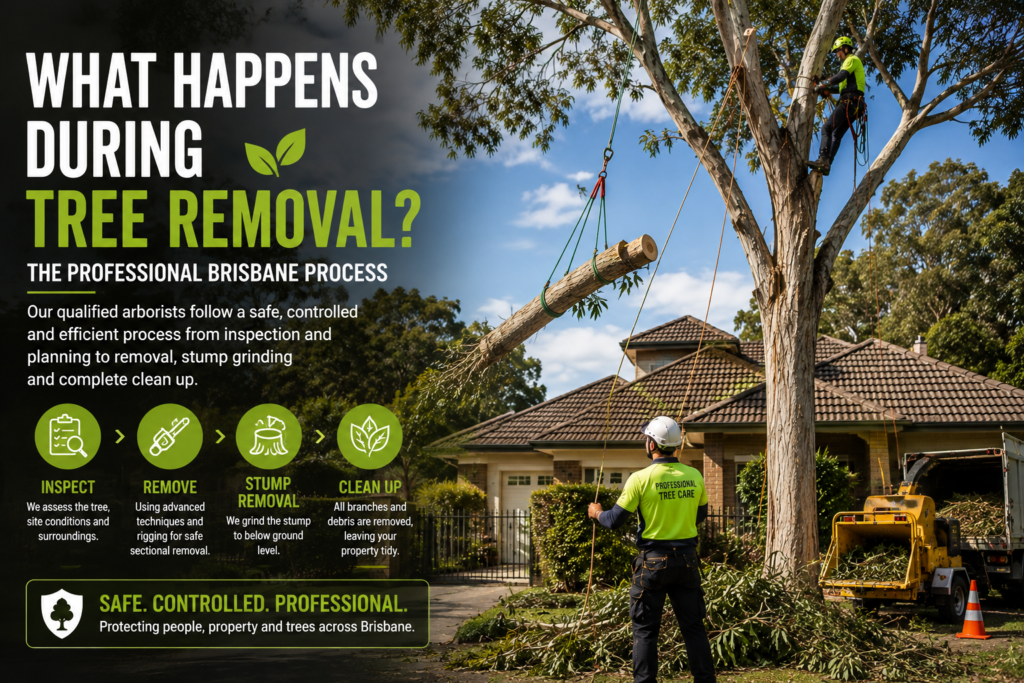
The large tree removal process normally involves site assessment, risk planning, selecting the removal method, preparing the work zone, dismantling the canopy, removing the trunk in controlled sections, processing the timber, addressing the stump and cleaning the site.
The exact process changes from tree to tree, but the basic sequence remains similar.
A professional removal may involve:
- Inspecting the tree and surrounding property.
- Identifying hazards and access limitations.
- Checking relevant tree protection or approval requirements.
- Selecting the safest removal method.
- Establishing an exclusion zone.
- Setting up climbing, rigging or mechanical equipment.
- Removing branches progressively.
- Cutting the trunk into manageable sections.
- Lowering heavy sections under control where required.
- Processing and removing timber and green waste.
- Grinding or removing the stump if requested.
- Cleaning the work area.
Large trees in urban environments often cannot simply be felled in one piece because there may not be enough space for the tree to fall safely. Professional crews can instead dismantle the tree piece by piece using ropes, pulleys and rigging systems.
Skimmable takeaway: Large tree removal is a planned sequence of assessment, preparation, controlled dismantling, trunk removal, waste handling, stump treatment and site cleanup.
Why does a large tree need a professional assessment first?
A professional assessment identifies the tree’s condition, structural risks, surroundings and access requirements before anyone starts cutting.
This is one of the most important steps because a large tree can behave differently from what it looks like from the ground.
An arborist looks at the trunk, major limbs, canopy, root area and overall structure.
I also look at what surrounds the tree.
For example:
- Is the tree leaning?
- Is the trunk hollow or decayed?
- Are there dead or broken branches?
- Is the canopy heavily weighted on one side?
- Is the tree growing near a house?
- Are there fences or sheds underneath the canopy?
- Can machinery reach the site?
- Are there overhead power lines?
- Is there enough room to lower branches safely?
- Is the ground suitable for equipment?
A healthy-looking tree can still present structural challenges.
A tree with significant decay, storm damage or an unstable root system may require a completely different removal strategy from a healthy tree of similar height.
Eco Tree Services states that its arborists assess trees and surrounding conditions as part of its professional tree-care approach.
Skimmable takeaway: Before large tree removal begins, an arborist assesses tree health, structure, hazards, access, surrounding property and the safest way to dismantle the tree.
Not Sure Whether Your Tree Needs Removing?
Every large tree is different. If you’re concerned about a large, damaged, leaning or difficult-to-access tree in Brisbane, Eco Tree Services can assess the tree and surrounding property and explain the most appropriate removal option.
Contact Eco Tree Services for a professional tree assessment and free quote.
How do arborists assess the site before removing a large tree?
Arborists assess both the tree and the area around it because the safest removal method depends heavily on the site’s layout.
A site assessment is not just about measuring tree height.
I need to understand where every major section of the tree could go during removal.
Tree assessment
The arborist checks:
- Tree species and approximate size.
- Trunk condition.
- Major branch unions.
- Deadwood.
- Decay or cavities.
- Lean.
- Canopy weight distribution.
- Signs of disease or storm damage.
- Root-zone condition.
Property assessment
The surrounding area also matters.
The arborist identifies:
- Houses.
- Garages.
- Sheds.
- Fences.
- Driveways.
- Vehicles.
- Swimming pools.
- Gardens.
- Footpaths.
- Neighbouring properties.
- Power infrastructure.
Access assessment
Access can make a major difference to both the removal method and the final quote.
A large tree with open vehicle access may allow machinery to work efficiently.
A similar tree at the back of a narrow residential block may require climbers, ropes and manual handling because a crane or elevated work platform cannot reach the tree.
Skimmable takeaway: A large-tree assessment considers tree structure, property hazards and equipment access. The removal plan is built around these three factors.
How do arborists choose the right large tree removal method?
Arborists choose the removal method based on tree condition, size, available space, access, surrounding hazards and the equipment required to control each section safely.
There is no single technique that works for every large tree.
Sectional dismantling
Sectional dismantling is common when a tree is located close to buildings or other structures.
Instead of allowing the whole tree to fall, the arborist climbs or accesses the tree and removes manageable sections.
Ropes and rigging can then be used to lower branches and trunk sections where simply dropping them would create unnecessary risk. Large-tree removal companies commonly use this approach in confined residential spaces.
Controlled felling
If the site has sufficient clearance and the tree can safely fall into a predetermined area, controlled felling may be appropriate.
This is generally much less complicated than dismantling a tree beside a house.
However, the available landing zone needs to be large enough and free from hazards.
Crane-assisted removal
Some large or difficult trees require crane assistance.
A crane can lift heavy sections away from the tree and lower them into a designated area or directly onto transport equipment.
This can be useful when access, tree weight or surrounding structures make conventional lowering impractical.
EWP-assisted removal
An elevated work platform may be used when site access allows it and when the work requires a stable elevated working position.
The equipment selected should always match the site rather than being chosen simply because it is available.
Skimmable takeaway: Large trees may be removed through sectional dismantling, controlled felling, crane assistance or EWP-supported work. The arborist chooses the method according to site-specific risks and access.
How is the work area prepared before tree removal?
The work area is prepared by establishing an exclusion zone, identifying hazards, positioning equipment and keeping people and unnecessary property traffic away from the removal area.
This step may look simple, but it prevents many avoidable problems.
Before cutting starts, the crew needs to understand where branches, logs and equipment will move.
The ground crew may establish designated areas for:
- Branches.
- Timber sections.
- Wood chips.
- Machinery.
- Vehicles.
- Rigging equipment.
People who are not involved in the work should stay outside the exclusion zone.
This becomes especially important when large sections of timber are being lowered.
The ground crew also plays an important role.
Large tree removal is usually a coordinated operation rather than one person working alone. A Brisbane tree-removal provider notes that large removals commonly involve a qualified arborist, ground crew and machinery, with branches and trunk sections lowered under control.
Skimmable takeaway: Before cutting begins, arborists establish a controlled work zone, position equipment and coordinate the ground crew to keep people and property away from falling or moving material.
How do arborists safely remove branches from a large tree?
Arborists normally remove large branches progressively and use controlled lowering when branches cannot safely be dropped.
This is where the difference between professional tree work and DIY cutting becomes obvious.
A large branch can weigh hundreds of kilograms.
Even if the branch looks manageable from the ground, its weight and momentum can damage roofs, fences, vehicles and gardens.
The arborist first determines where the branch can safely go.
If there is enough clearance, smaller sections may be cut and allowed to fall into a controlled landing area.
If there is not enough clearance, the arborist can use ropes and rigging to lower the branch.
The ground crew manages the rope system and guides the material into the designated drop zone.
This process allows the crew to control the movement of heavy material instead of relying on gravity alone.
Skimmable takeaway: Large branches are removed in manageable sections, with ropes and rigging used to lower material when dropping it freely could damage property or create a safety hazard.
How is the trunk removed section by section?
Once the canopy has been reduced, the main trunk can be dismantled into controlled sections rather than allowing the entire trunk to fall.
This is particularly important when the tree stands near a building.
The arborist works progressively down the trunk.
Each section is assessed for:
- Weight.
- Length.
- Diameter.
- Landing area.
- Rigging requirements.
- Nearby hazards.
Smaller sections may be lowered directly.
Heavier sections may require more advanced rigging or mechanical assistance.
The goal is to keep each piece within the capacity of the equipment and the available landing area.
This is also why the size of a tree does not tell the whole story.
A tall tree in an open field can be easier to remove than a shorter tree surrounded by structures.
Skimmable takeaway: After the canopy is removed, the trunk is progressively reduced into manageable sections, with each piece controlled according to its size, weight and surroundings.
What equipment is used for large tree removal?
Large tree removal can involve climbing equipment, chainsaws, ropes, rigging systems, lowering devices, chippers, elevated work platforms, cranes and other specialised machinery depending on the site.
The equipment list varies considerably between jobs.
Common equipment may include:
Climbing equipment
Arborists use specialised climbing systems to access parts of the tree that cannot be reached from the ground.
Chainsaws
Different chainsaw configurations may be used for different cutting tasks, depending on the arborist’s position and the size of the material.
Ropes and rigging
Rigging systems allow branches and trunk sections to be controlled while they are being lowered.
Chippers
Branches can be processed into wood chips rather than being transported as loose material.
Stump grinders
A stump grinder can reduce the remaining stump below the required ground level after the tree has been removed.
Cranes
Cranes can assist with exceptionally heavy sections or difficult removals when site access allows.
Elevated work platforms
An EWP can provide elevated access where appropriate.
The key point is that equipment should support the removal plan.
Using more machinery does not automatically make a job safer.
Skimmable takeaway: Equipment for large tree removal can include climbing gear, chainsaws, rigging, lowering systems, chippers, stump grinders, cranes and EWPs. The arborist selects equipment according to the site’s specific requirements.
How do arborists protect houses, fences and other property?
Arborists protect surrounding property by planning the drop zones, controlling heavy sections, using appropriate rigging and keeping the removal path away from vulnerable structures wherever possible.
This is one of the biggest reasons homeowners should not treat large tree removal as a simple cutting job.
Imagine a large branch sitting directly above a tiled roof.
Cutting it and allowing it to fall could cause significant damage.
Instead, the arborist can remove the branch in smaller sections and lower those sections under control.
The same principle applies to:
- Glass windows.
- Solar panels.
- Fences.
- Vehicles.
- Driveways.
- Garden structures.
- Swimming pools.
- Neighbouring properties.
Property protection starts before the first cut.
The removal plan should already account for where each section will go.
Skimmable takeaway: Property protection comes from planning and control. Arborists use designated drop zones, sectional cutting and rigging to reduce the chance of branches or timber damaging surrounding structures.
What happens if the tree is close to power lines?
A tree near power lines requires additional hazard assessment and specialised safety planning; homeowners should never attempt to remove it themselves.
Power infrastructure changes the risk profile of a tree-removal job significantly.
Even branches that appear to be several metres away can create serious hazards when the tree moves, branches swing or equipment is positioned incorrectly.
The arborist needs to consider:
- Line location.
- Tree movement.
- Branch clearance.
- Equipment positioning.
- Access.
- Safe working distances.
- Relevant utility requirements.
If power lines are involved, tell the arborist before receiving a quote.
Do not assume that the removal is a normal backyard tree job.
Skimmable takeaway: Trees growing near power lines require additional safety planning and may require specialised utility procedures. Homeowners should keep clear and use qualified professionals.
How are large tree stumps and roots dealt with?
After the tree is removed, the stump can usually be ground down or removed depending on what you plan to do with the area.
Tree removal and stump removal are not always the same service.
If you leave the stump in place, it can become an obstacle for:
- Lawn maintenance.
- Landscaping.
- Replanting.
- Paving.
- Construction.
- Future garden work.
A tree stump removal service can grind the stump below the desired ground level, allowing the area to be reused.
The roots are different.
Complete root removal can require excavation and may not be necessary for every property.
If you plan to build, pave or install another structure where the tree stood, tell the arborist before work starts.
That allows the team to consider the final purpose of the site when planning stump and root work.
Skimmable takeaway: Stump grinding is commonly used after tree removal, while complete root removal depends on the property’s future use and the extent of excavation required.
Can pruning be a better option than removing a large tree?
Yes, professional pruning can sometimes resolve a tree’s problems without removing the entire tree.
Removal should not automatically be the first solution.
For example, a healthy tree may only have:
- Dead branches.
- Overextended limbs.
- Excessive canopy density.
- Branches growing toward a roof.
- Storm-damaged sections.
In these situations, a qualified tree pruning company may be able to reduce the risk while retaining the tree.
The decision depends on the tree’s health, structural condition, location and the reason the homeowner wants it removed.
A professional assessment can help answer a more important question:
Does this tree actually need to be removed?
Eco Tree Services provides professional tree pruning as part of its Brisbane tree-care services.
Skimmable takeaway: Not every large tree needs removal. Where the tree remains structurally sound, professional pruning and maintenance may address specific hazards while preserving the tree.
When does a large tree require emergency removal?
Emergency tree removal may be necessary when a tree has fallen, partially failed or created an immediate risk to people or property.
Storms can turn an otherwise manageable tree into an urgent hazard.
Examples include:
- A large limb has fallen onto a roof.
- The trunk has split.
- The tree is partially uprooted.
- A major branch is suspended above a house.
- The tree has fallen across an access route.
- Storm damage has left the tree structurally unstable.
Do not climb onto a damaged tree to try to solve the problem yourself.
A storm-damaged tree can have unpredictable weight distribution and hidden structural failures.
An emergency tree removal service can assess the situation and determine the safest way to make the property safe.
Skimmable takeaway: Emergency tree removal is appropriate when storm damage, structural failure or a fallen tree creates an immediate hazard. Damaged trees should be treated as unstable until professionally assessed.
What should you look for when hiring a large tree removal company?
Choose a tree removal company based on qualifications, insurance, safety procedures, experience with large trees, equipment and a clear written scope of work.
Price matters, but it should not be the only factor.
When comparing a trees removal company, I recommend asking:
Is the company insured?
Ask what insurance cover is available and whether it applies to the work being performed.
Does the team have relevant arboricultural qualifications?
Large and complex removals require technical knowledge, not just chainsaw experience.
Have they handled similar trees?
Ask whether they have experience with large trees in confined residential environments.
What removal method will they use?
A professional should be able to explain whether the tree will be dismantled, felled or removed using specialised machinery.
Is cleanup included?
Check whether the quote includes branches, logs, wood chips and general cleanup.
Is stump grinding included?
Don’t assume stump work is automatically part of tree removal.
What happens if conditions change?
For complex jobs, ask how unexpected site conditions or additional equipment requirements will be handled.
A professional specialist tree removal service should be able to explain the job before starting it.
Skimmable takeaway: When choosing a large-tree removal company, compare qualifications, insurance, experience, equipment, removal method, cleanup and the exact scope of the quote rather than price alone.
What happens after the large tree is removed?
After the tree is dismantled, the crew processes the timber and branches, removes the waste included in the quote, deals with the stump if requested and leaves the work area as clean and usable as practical.
The final stage is often overlooked when homeowners compare quotes.
Ask what happens to:
- Large logs.
- Branches.
- Wood chips.
- Leaves.
- Stump material.
- Smaller debris.
Some timber may be chipped, while larger sections may be cut into manageable pieces or removed from the property.
If you want to remove tree and roots, make this clear before the work begins because root excavation is different from standard tree removal.
Likewise, if you want to retain some timber for firewood, mulch or another purpose, tell the crew before the job starts.
Skimmable takeaway: Post-removal work includes timber processing, green-waste handling, stump treatment and site cleanup. Confirm exactly what is included before approving the quote.
What is the large tree removal process step by step?
The large tree removal process can be summarised as assessment, planning, preparation, controlled dismantling, trunk removal, waste processing, stump treatment and cleanup.
Step 1: Inspect the tree
The arborist assesses tree condition, structure and potential hazards.
Step 2: Inspect the site
The crew identifies houses, fences, power lines, vehicles, access points and suitable drop zones.
Step 3: Select the removal method
The arborist decides whether to use sectional dismantling, controlled felling, climbing, rigging, EWP or crane assistance.
Step 4: Prepare the work zone
The crew establishes an exclusion area and positions equipment.
Step 5: Remove the canopy
Branches are cut progressively and lowered or dropped into controlled areas.
Step 6: Dismantle the trunk
The trunk is reduced into manageable sections.
Step 7: Process the material
Branches may be chipped and larger timber removed or processed according to the agreed scope.
Step 8: Remove or grind the stump
Stump grinding or other removal can be completed if requested.
Step 9: Clean the property
The crew clears the agreed waste and leaves the work area ready for its next use.
This process is what separates planned professional removal from simply cutting down a tree.
Skimmable takeaway: A professional large-tree removal follows a defined sequence from assessment and risk planning through controlled dismantling, waste management, stump treatment and cleanup.
What tree expert tips can help homeowners prepare for large tree removal?
The best way to prepare is to give the arborist accurate information, clear access and a clear understanding of what you want left or removed.
Before the crew arrives:
- Move vehicles away from the work zone.
- Keep children and pets away from the area.
- Unlock gates and provide agreed access.
- Tell the arborist about underground services you know about.
- Mention nearby power lines.
- Tell the team whether you want the stump removed.
- Decide whether you want logs or mulch retained.
- Remove fragile outdoor items.
- Inform neighbours if access or temporary restrictions may affect them.
If the tree is near a shared boundary, discuss this before the job begins.
Good preparation can save time and prevent misunderstandings.
Skimmable takeaway: Homeowners can make large tree removal easier by clearing access, securing the property, communicating site hazards and confirming exactly what should happen to the tree, stump and waste.
Conclusion: What is the safest way to remove a large tree?
The safest large tree removal process starts with professional assessment and ends with controlled dismantling, responsible waste handling and site cleanup.
Large trees require more than a chainsaw and a clear day.
The arborist needs to understand the tree, the site, the surrounding structures and the safest way to control every major section.
For some trees, that may mean sectional dismantling with ropes and rigging.
For others, it may involve an EWP, crane or controlled felling.
The right approach depends on the actual conditions at the property.
If you’re considering removing a large tree in Brisbane, don’t choose a contractor based only on the cheapest quote. Ask how they plan to remove the tree, how they will protect your property, what equipment they will use and what is included in the final price.
A qualified Brisbane tree expert can also determine whether removal is genuinely necessary or whether professional pruning and maintenance could solve the problem.
At Eco Tree Services, our focus is on safe, professional tree removal, pruning and stump grinding for Brisbane and South East Queensland properties.
Several factors influence the final tree removal cost in Brisbane, including tree size, access, hazards, equipment and the amount of labour required.
FAQs
How long does it take to remove a large tree?
A large tree can take several hours or longer depending on its size, access, removal method and site complexity. A large tree in an open area may be quicker to remove than a smaller tree surrounded by buildings, fences and power infrastructure. Your arborist should provide a realistic timeframe after assessing the site.
Can a large tree be removed without cutting it down all at once?
Yes. Large trees can often be dismantled progressively rather than felled in one piece. This is particularly useful in residential areas where there is not enough space for the complete tree to fall safely. Branches and trunk sections can be removed and lowered under control.
What is sectional tree dismantling?
Sectional dismantling means removing a tree piece by piece from the top down instead of allowing the entire tree to fall. For example, an arborist may remove the smaller branches first, then larger limbs and finally sections of the trunk. This gives the crew greater control around houses and other structures.
Can a crane be used to remove a large tree?
Yes, cranes can be used for some large or difficult tree removals when the site allows safe crane access. A crane can lift heavy branches or trunk sections and move them away from structures. The arborist needs to assess access, lifting requirements and ground conditions before recommending crane assistance.
Is large tree removal safe?
Professional large tree removal can be performed safely when qualified arborists use appropriate planning, equipment and controlled removal techniques. The risk increases significantly when homeowners attempt complex removals without the training or equipment needed to manage heavy branches and trunk sections.
Can I remove a large tree myself?
I do not recommend DIY removal of a large tree. Large branches and trunk sections can weigh far more than they appear, and the tree can move unpredictably because of its lean, structure or condition. A professional assessment is especially important when the tree is close to buildings, vehicles or power lines.
Does large tree removal include stump grinding?
Not necessarily. Stump grinding is often a separate service. If you want the remaining stump removed after the tree comes down, ask for stump grinding to be included in the quote so you know exactly what the final price covers.
Can arborists remove the roots as well?
Arborists can undertake certain root-removal work, but complete root removal is not always necessary or practical. If you’re planning construction, paving or landscaping where the tree stood, explain your plans before removal so the arborist can recommend the appropriate stump and root treatment.
What affects the cost of large tree removal in Brisbane?
Tree size, access, risk, tree condition, labour, equipment, waste volume and the surrounding property are major cost factors. A large tree behind a narrow house may cost more to remove than a taller tree in an open yard because the crew may need additional rigging, labour or machinery.
Is pruning cheaper than removing a large tree?
Pruning is often less extensive than complete removal, but it is only suitable when the tree can safely remain. If the tree has a manageable structural issue, dead branches or overextended limbs, professional pruning may address the problem. If the tree is structurally unsafe or otherwise unsuitable to retain, removal may be the better option.
When should I call an emergency tree removal service?
Call for professional emergency assistance when a tree has fallen, partially failed or created an immediate risk to people or property. Storm-damaged trees can contain unstable branches and hidden structural failures, so keep clear of the area and let qualified professionals assess the situation.
How do I choose a specialist tree removal service?
Look for qualifications, insurance, experience with large trees, appropriate equipment and a clear written quote. I would also ask how the team intends to remove the tree, protect surrounding property, process the waste and handle the stump.
Should I get multiple quotes for large tree removal?
Yes, comparing quotes can help you understand the scope and identify unusual pricing differences. However, don’t compare the final numbers alone. Check whether each quote includes rigging, machinery, ground crew, waste removal, stump grinding and cleanup.
What happens to the tree after it is removed?
Branches are commonly chipped or processed, while larger timber can be removed or retained according to the agreed scope. If you want to keep logs for firewood or use wood chips in your garden, tell the tree-removal team before the job starts.
Can pruning and tree removal services be combined?
Yes, a tree-care company can assess multiple trees and determine which need pruning and which require removal. For example, you may have one healthy tree that only needs canopy reduction and another structurally compromised tree that needs complete removal.
What should I do before the arborist arrives?
Clear access to the tree, move vehicles and outdoor items away from the work area, secure pets and children and tell the crew about any known hazards. If there are power lines, narrow access points or neighbouring structures nearby, mention them before work begins.
Are large trees harder to remove near houses?
Yes, proximity to buildings can make removal considerably more complex. An arborist may need to dismantle the tree in smaller sections and use rigging to lower branches rather than allowing them to fall freely.
What is the difference between tree removal and tree lopping?
Tree removal eliminates the tree, while pruning or lopping involves removing selected parts of the canopy. Professional pruning may be appropriate when a tree can safely remain, whereas removal is considered when the entire tree needs to come down.
Why should I use a professional tree removal company?
Professional removal provides the planning, equipment and technical control needed for large or difficult trees. A qualified crew can assess the tree, select an appropriate removal method and manage heavy branches and trunk sections while reducing risks to people and property.