Best Time of Year to Remove Trees in Brisbane
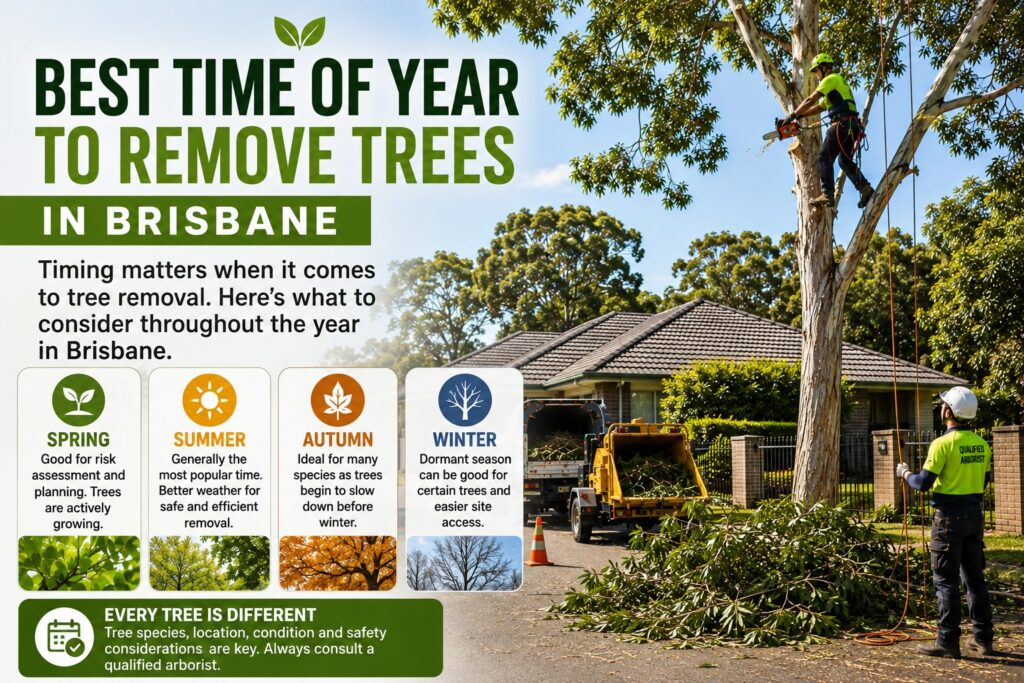
The best time of year to remove trees depends on the tree’s condition, location, weather and safety risk. In Brisbane, winter can provide favourable conditions for planned tree removal, but you should never delay removing a dangerous, unstable or storm-damaged tree simply because it is the wrong season.
At Eco Tree Services, one of the questions I hear is whether homeowners should wait until winter to remove a tree. The answer is not always straightforward. Seasonal conditions can make some jobs easier, but the condition of the tree and the risk it creates should always come first.
If a tree is structurally unstable, severely damaged, diseased or threatening your home, driveway, power infrastructure or another property, waiting for a particular season can increase the risk.
For planned removal, however, cooler and drier periods can often make access, site conditions and the physical removal process more manageable.
Is winter really the best time to remove a tree?
Winter is often a favourable time for planned tree removal, but it is not automatically the best time for every tree.
In colder climates, winter is commonly recommended because many deciduous trees are dormant and carry less foliage. That can make the tree lighter and easier to handle. The same principle does not apply as strongly to Brisbane because our climate is warmer and many commonly encountered trees remain evergreen.
For Brisbane homeowners, I look at the individual tree rather than simply saying, “Wait until winter.”
Winter can still offer advantages for planned work:
- Cooler working conditions for arborists.
- Potentially drier ground conditions during suitable weather.
- Less active growth for some species.
- Easier access to certain parts of the canopy.
- More comfortable conditions for longer or technically demanding removals.
But if the tree is already unsafe, seasonal convenience should never outweigh safety.
Skimable summary: Winter can be a good period for planned tree removal, but Brisbane’s climate means the tree species, weather, site access and condition matter more than the season alone.
What is the best season for tree removal in Brisbane?
For planned tree removal, the cooler months can be favourable, but every Brisbane season has situations where tree removal may be appropriate.
Winter
Winter is often a practical choice for non-urgent tree removal. Cooler temperatures can make physical work more manageable, and suitable dry weather can improve access to the property.
If you have a mature tree that you already know needs to come down but does not present an immediate hazard, winter may be a sensible time to schedule the work.
Spring
Spring can be suitable for tree removal when the tree has been assessed and removal is justified. However, spring also brings active growth and changing weather conditions.
If a tree has been declining through the previous season, spring is actually a useful time to have it assessed rather than automatically assuming it should be removed.
Sometimes what looks like a removal problem is actually a pruning or tree health issue.
Summer
Summer is Brisbane’s storm season, so I would not recommend delaying necessary work simply because summer is generally considered less convenient.
Storms can expose structural weaknesses very quickly. Broken limbs, split trunks, uprooted trees and dangerous leaning trees may require urgent attention.
This is where an experienced specialist tree removal service becomes particularly important.
Autumn
Autumn can be another suitable period for planned removal depending on the species, weather and site conditions.
If you are considering removing a tree before the wetter and stormier period, having the tree assessed during autumn can help you make a more informed decision.
Skimable summary: There is no universally perfect Brisbane tree-removal season. Winter can suit planned removals, while spring, summer and autumn can all be appropriate when the tree’s condition, weather and safety requirements justify the work.
When should you remove a tree regardless of the season?
You should remove a tree when its condition creates an unacceptable safety risk, regardless of whether it is summer, winter, spring or autumn.
This is the most important distinction homeowners need to understand.
I would not tell a customer to wait several months if a tree is already creating a serious hazard.
Signs that removal may need to happen sooner
Look for:
- A sudden or worsening lean.
- Major trunk cracks or splits.
- Significant decay or cavities.
- Extensive deadwood.
- Severe storm damage.
- Uprooted or seriously damaged roots.
- Large branches hanging over structures.
- A tree that has become unstable after heavy rain or wind.
- Serious disease or structural deterioration.
- A tree positioned where failure could seriously damage property or injure someone.
Eco Tree Services’ existing guide on Signs Your Tree Needs Removing explains why these warning signs matter and why assessment should come before making the removal decision.
For example, imagine a mature tree beside a Brisbane home that develops a significant lean after several days of heavy rain. Waiting until winter because someone says winter is the “best” season does not make sense. The risk has already changed.
Skimable summary: Dangerous, unstable, storm-damaged or severely diseased trees should be assessed and potentially removed as soon as reasonably possible. Safety takes priority over seasonal timing.
Does Brisbane weather affect the timing of tree removal?
Yes. Brisbane weather can affect when tree removal is safest and most practical, particularly during heavy rain, strong winds and storm conditions.
Weather matters because arborists need to control branches, equipment and heavy sections of timber safely.
Wet ground can affect access and machinery. Strong winds can make climbing and rigging more hazardous. Storm-damaged trees can also behave unpredictably because their structure may already be compromised.
This does not mean every wet day automatically cancels tree work. The decision depends on the conditions at the property and the complexity of the job.
For example, a small accessible tree may present very different risks from a large tree growing over a roof on a windy day.
At Eco Tree Services, we assess the conditions rather than treating the calendar as the deciding factor.
Skimable summary: Brisbane weather affects tree-removal safety because wind, rain, wet ground and storm damage can change access, tree stability and the way branches and timber must be controlled.
Should you wait for winter if a tree is already dangerous?
No. You should not wait for winter if a tree is already dangerous.
This is one of the biggest misconceptions around seasonal tree removal.
If a tree has major structural defects, serious storm damage, exposed roots or a dangerous lean toward a building, delaying the work can allow the risk to increase.
For example, if a large branch has split but remains attached above a driveway, the fact that it is currently summer does not make waiting several months safer.
The correct approach is to have the tree assessed and determine whether pruning, emergency work, stabilisation or complete removal is required.
Our How Arborists Remove Trees Safely explains how arborists assess the tree, identify hazards and choose an appropriate removal method before cutting begins.
Skimable summary: Never postpone necessary tree removal just to reach a preferred season. If the tree presents an immediate or developing hazard, professional assessment should happen promptly.
Is tree removal cheaper at certain times of the year?
Not necessarily. Tree removal cost is determined mainly by the tree and the complexity of the job, not simply by the season.
The factors I consider include:
- Tree height and size.
- Trunk diameter.
- Canopy spread.
- Tree condition.
- Location.
- Access.
- Nearby buildings and structures.
- Power infrastructure.
- Required equipment.
- Rigging and controlled lowering.
- Waste removal.
- Stump grinding.
- Emergency requirements.
A large tree in an open yard may be easier and less expensive to remove than a smaller tree positioned between a house, pool and boundary fence.
Our guide to How Much Does Tree Removal Cost in Brisbane explains why tree size alone does not determine the final price.
If you are comparing quotes, compare the scope of work rather than simply choosing the lowest number.
Skimable summary: Season is not usually the main factor controlling tree-removal cost. Tree size, condition, location, access, equipment, labour, disposal and stump work have a much greater impact.
How does tree condition affect the best removal time?
The worse the tree’s structural condition, the less important seasonal timing becomes.
A healthy tree that has simply become unsuitable for its location gives you more flexibility than a tree with advanced decay or major root damage.
For example, consider two trees:
Tree A: A mature but healthy tree that a homeowner wants removed because it is no longer suitable for a planned landscaping project.
Tree B: A mature tree with extensive decay, a new lean and exposed roots beside a house.
Tree A can potentially be scheduled around suitable weather and property access.
Tree B requires a much more urgent assessment.
This is also why I don’t recommend deciding on complete removal simply because a tree looks untidy. Our guide on Tree Pruning & Maintenance in Brisbane can address problems such as deadwood, overgrown branches, canopy density and clearance when the tree itself remains structurally suitable.
Skimable summary: Healthy trees needing planned removal offer more flexibility, while structurally compromised trees should be assessed promptly. Tree condition should determine urgency more than the calendar.
What should you do before scheduling tree removal?
Start with a professional assessment rather than choosing a removal date first.
Before booking the work, I recommend checking:
1. Does the tree actually need removal?
Some trees can be retained through appropriate pruning or maintenance.
2. Is the tree protected or subject to local requirements?
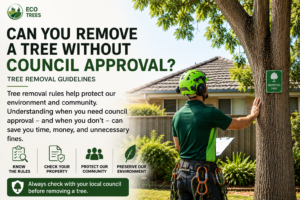
Check the relevant Brisbane requirements before removing an established tree.
3. What is around the tree?
Consider:
- Houses.
- Garages.
- Vehicles.
- Fences.
- Pools.
- Sheds.
- Footpaths.
- Neighbouring properties.
- Power infrastructure.
4. Is there enough site access?
Restricted access can change the equipment and removal method required.
5. Does the quote include cleanup?
Ask whether branches, timber and other debris will be removed.
6. Do you need stump grinding?
Tree removal and stump removal are not necessarily the same service. If you want the area cleared for landscaping or another use, discuss stump grinding when requesting the quote.
At Eco Tree Services, our approach is to assess the tree and property first, then recommend the safest practical solution.
Skimable summary: Before choosing a removal date, confirm that removal is necessary, check site and regulatory considerations, assess access and hazards, and clarify whether cleanup and stump grinding are included.
Do you actually need tree removal or would pruning be enough?
If the tree remains structurally sound and the problem is limited to selected branches, professional pruning may be enough.
This is where choosing the right arborist matters.
A good tree pruning company should not simply cut branches because they look inconvenient. The objective should be to address the actual problem while maintaining the tree’s structure and health where possible.
For example, if several dead branches extend above a driveway but the trunk and root system remain stable, targeted pruning may remove the hazard without removing the entire tree.
Our Tree Pruning & Maintenance Services includes services such as crown thinning, crown lifting, crown reduction and deadwood removal.
On the other hand, pruning may not solve a problem when the tree has severe structural decay, major root instability or extensive storm damage.
Skimable summary: Pruning is often appropriate when branch-level problems can be safely corrected. Complete removal becomes more appropriate when the tree’s overall structure, roots or stability have become unsafe.
Why should you use a specialist tree removal service?
Professional tree removal is about controlling risk, not simply cutting through a trunk.
A mature tree can weigh far more than it appears from the ground. Branches can swing, trunks can split and trees can move unpredictably when their structure or root system is compromised.
Our recent guide on How Arborists Remove Trees Safely explains why professional removal involves assessment, hazard identification, controlled dismantling, rigging, lowering, debris management and cleanup.
Depending on the property, an expert tree removal may involve:
- Climbing equipment.
- Chainsaws.
- Rigging systems.
- Controlled lowering.
- Wood chipping.
- Specialist access equipment.
- Stump grinding equipment.
This becomes especially important when trees are close to homes, vehicles, fences, pools or power infrastructure.
Our Is DIY Tree Removal Safe explains why mature, damaged or difficult-to-access trees should not be treated as a simple DIY cutting job.
Skimable summary: A specialist tree removal service assesses the tree, controls falling material, protects surrounding property and uses appropriate equipment and techniques for the specific site.
What happens to the tree after removal?
Tree removal does not necessarily mean the timber becomes waste; much of the material can be processed and reused.
At Eco Tree Services, timber may be chipped into mulch, while suitable logs can sometimes be used for timber products, firewood or other purposes.
Our article on Where Does the Tree Go After It Is Removed? explains some of the ways removed timber can be reused around Brisbane and South East Queensland.
For example, suitable timber may be milled for fencing, flooring or furniture, while branches can be processed into mulch.
This is one reason I prefer to think about the entire removal process, not just the moment the tree comes down.
Skimable summary: After removal, branches and timber can often be chipped, mulched, milled, reused or processed rather than simply treated as waste.
So, what is the best time of year to remove trees?
For planned tree removal in Brisbane, the cooler months can be a practical choice, but there is no single best season that applies to every tree.
The right timing depends on:
- Tree health.
- Structural stability.
- Weather.
- Ground conditions.
- Tree species.
- Location.
- Site access.
- Nearby structures.
- Power infrastructure.
- Urgency.
- Required removal method.
If the tree is healthy and the removal is planned, you have more flexibility to choose a suitable period with favourable weather and access.
If the tree is unstable, damaged or dangerous, the priority changes immediately.
At Eco Tree Services, I would rather assess the tree properly than give you a generic answer based only on the month of the year.
If you are unsure whether your tree needs pruning, maintenance or complete removal, an assessment can help you make the decision before the problem becomes more difficult or expensive.
Skimable summary: The best time of year to remove trees in Brisbane is the safest practical time for the specific tree and property. Winter can be favourable for planned work, but dangerous trees should be addressed regardless of season.
FAQs
What is the best time of year to remove trees?
Winter is often a good time for planned tree removal, but the safest timing depends on the tree, weather, location and urgency. For example, a healthy tree scheduled for landscaping work can usually be planned around suitable winter conditions, while a storm-damaged tree beside a house should be assessed immediately rather than left until winter.
Is winter the cheapest time to remove a tree?
Not necessarily. Tree-removal pricing depends more on size, condition, access, location, equipment and removal complexity than the season. For example, a small tree with clear access may cost less than a larger tree in winter that requires rigging beside a house.
Can trees be removed in summer in Brisbane?
Yes, trees can be removed in summer when weather and site conditions allow it. Summer can also bring storms and strong winds, which may create urgent tree-removal situations. For example, a split tree after a Brisbane storm may require immediate professional attention rather than waiting for cooler weather.
Should I wait until winter to remove a dangerous tree?
No. If a tree has become unstable, severely damaged or dangerous, delaying removal can increase the risk. For example, a tree that has developed a major lean toward a home after heavy rain should be assessed promptly regardless of the season.
Is autumn a good time to remove trees?
Autumn can be a suitable time for planned tree removal if weather, access and tree condition are favourable. It can also be a useful period to assess trees before Brisbane’s wetter and stormier conditions. For example, removing an unsuitable tree before it becomes a storm-related hazard can be a sensible preventative decision.
Is tree removal better than pruning?
Not always. Pruning is usually preferable when the tree remains structurally sound and the problem can be solved by removing selected branches. For example, dead branches over a driveway may require targeted pruning rather than complete tree removal.
When should I call an expert tree removal service?
Call an expert when a tree is unstable, severely damaged, diseased, heavily decayed, storm-damaged or positioned where failure could threaten people or property. For example, a mature tree with exposed roots and a new lean beside a house should be professionally assessed before anyone attempts to cut it.
Can tree and root removal be done at the same time?
The tree can be removed first, while the remaining stump and accessible root material can be dealt with separately. In many residential situations, stump grinding is the practical next step. For example, if you want to replant or landscape the area after removing a tree, removing or grinding the remaining stump can make the site easier to use.
How do I choose the best tree pruning service?
Choose a qualified arborist who assesses the tree before recommending pruning or removal. A good tree pruning company should consider tree health, structure, safety, location and the actual reason for the work. For example, if a healthy tree only has several hazardous branches, an experienced arborist should be able to explain why targeted pruning may be preferable to removing the whole tree.
Why should I hire Brisbane tree experts for tree removal?
Brisbane tree experts understand local tree species, weather conditions, property layouts and the practical challenges of removing trees in residential environments. For example, a mature tree growing beside a Brisbane home may require controlled dismantling and rigging rather than straightforward felling. Professional assessment helps determine the safest approach.