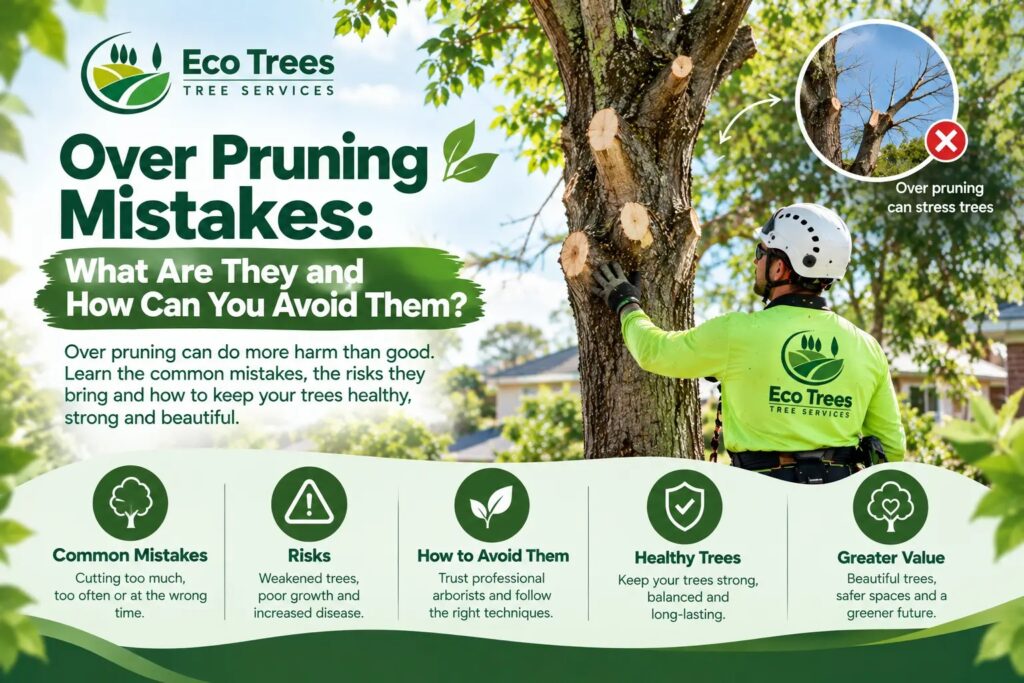
Over Pruning Mistakes: What Are They and How Can You Avoid Them?
Over-pruning is one of the easiest tree-care mistakes to make because removing a few extra branches can seem harmless. In reality, taking away too much healthy foliage can stress a tree, weaken its structure and trigger unwanted regrowth.
At Eco Tree Services, I see pruning as a management job rather than simply cutting branches. The goal is to remove what needs to go while keeping enough healthy canopy to support the tree’s growth and natural structure.
If you are unsure whether your tree needs a light trim, structural pruning or more substantial work, it is better to assess the tree before making multiple cuts. Good pruning should solve a problem without creating another one.
What Is Over-Pruning and Why Is It Harmful?
Skimable summary: Over-pruning happens when unnecessary or excessive branches and foliage are removed, leaving the tree with too little canopy or a compromised structure. The result can be stress, weak regrowth and reduced tree health.
Trees rely on their leaves to capture sunlight and produce the energy they need for growth. When too much foliage is removed at once, the tree loses part of its ability to support itself.
That does not mean pruning is bad for trees. Proper pruning can improve safety, remove dead or damaged branches, improve airflow and manage canopy structure. Our tree pruning and maintenance services in Brisbane are designed around those objectives.
The problem starts when pruning becomes excessive.
An over-pruned tree may respond by producing rapid new shoots. These shoots can be poorly attached, weakly structured and difficult to manage later.
Over-pruning can also expose previously shaded branches and areas of the tree to conditions they were not adapted to handle.
What Are the Most Common Over-Pruning Mistakes?
Skimable summary: The biggest over-pruning mistakes include removing too much canopy, topping trees, lion-tailing, making unnecessary cuts and pruning without considering the tree’s structure or health.
Here are the mistakes I would want homeowners to avoid:
1. Removing too much canopy at once
This is the most obvious over-pruning mistake.
A homeowner may look at an overgrown tree and think the solution is to remove a large amount of foliage in one visit. But the tree still needs that foliage for photosynthesis and growth.
A lighter, targeted approach is usually safer than trying to completely reshape the tree in one session.
2. Topping the tree
Topping involves cutting major branches back to arbitrary points, often to make a tree shorter.
It can leave large wounds and destroy the tree’s natural branch structure. Topping can also encourage rapid regrowth from below the cuts, creating multiple weak shoots.
Aussie Tree Solutions similarly identifies topping as one of the harmful pruning practices homeowners should avoid.
3. Lion-tailing the canopy
Lion-tailing involves removing too much inner and lower foliage while leaving foliage concentrated toward branch ends.
This can make the tree look strangely sparse and can alter the way the branches handle wind and weight.
The goal of pruning should not be to make every branch look perfectly clean. A healthy canopy needs appropriate distribution of foliage and branches.
4. Removing healthy branches simply because they look untidy
Not every branch that looks inconvenient needs to be removed.
Before cutting, ask:
- Is the branch dead?
- Is it damaged?
- Is it rubbing against another branch?
- Is it creating a genuine clearance or safety problem?
- Does removing it improve the tree’s structure?
- Is there a better pruning option?
If the answer to these questions is no, the branch may not need to be removed.
5. Making cuts without understanding branch structure
Where you cut matters.
Poor cuts can leave excessive stubs or damage the branch collar. They can create unnecessary wounds and affect how the tree responds.
Pruning should follow the tree’s natural branch structure rather than treating every branch like something that can simply be shortened wherever convenient.
6. Pruning for appearance alone
A tree does not need to look completely bare or symmetrical to be healthy.
I often recommend starting with the problem you are trying to solve. If the issue is deadwood, remove deadwood. If the issue is clearance, target the branches causing the obstruction. If the canopy is too dense, consider selective thinning rather than stripping the tree.
How Much of a Tree Can You Safely Prune at Once?
Skimable summary: There is no single pruning percentage that suits every tree. The appropriate amount depends on species, age, health, structure, previous pruning and the reason for the work.
You will often see general recommendations about removing no more than a certain percentage of the canopy. These can be useful as broad guidance, but I would not use one number as a universal rule for every tree.
A young, healthy tree and a mature tree under stress do not have the same pruning requirements.
The same applies to a tree that has already been heavily pruned. Removing another large portion of the canopy simply because the tree still looks uneven can make the situation worse.
My approach is to identify the objective first and then remove only what is necessary to achieve it.
This is one reason professional pruning is more than just tree trimming. It involves understanding the tree’s condition before deciding what to cut.
Is Tree Topping the Same as Over-Pruning?
Skimable summary: Tree topping is an extreme form of improper pruning that removes large sections of the canopy and disrupts natural tree structure. It should not be used as a routine way to control tree height.
Topping is one of the clearest examples of over-pruning.
Someone may believe that cutting the top of a tree will permanently make it shorter. Usually, the tree responds by producing vigorous new shoots below the cuts.
Those shoots can grow quickly and may have weaker attachments than naturally developed branches.
The result can be a tree that needs more corrective work later rather than less.
If height is genuinely becoming a problem, I would rather assess whether selective crown reduction or another appropriate pruning method can address the issue while retaining the tree’s structure.
Can Over-Pruning Kill a Tree?
Skimable summary: Severe over-pruning can seriously stress a tree and contribute to decline, although the outcome depends on the tree species, health, amount removed and environmental conditions.
Not every over-pruned tree will die.
Some trees recover surprisingly well. Others struggle, particularly when excessive pruning is combined with drought, disease, root damage, poor soil conditions or previous structural problems.
The warning signs can include:
- Reduced or slow new growth
- Excessive weak shoots
- Branch dieback
- Sparse foliage
- Poor flowering or fruiting
- Increasing pest or disease problems
- Declining overall vitality
The important point is that a tree does not necessarily show the full consequences of over-pruning immediately.
If you have already removed a significant amount of the canopy, I would avoid making additional cuts simply to try to improve its appearance. Give the tree time and have it assessed if you are concerned.
What Does an Over-Pruned Tree Look Like?
Skimable summary: An over-pruned tree often has an unusually thin canopy, large exposed limbs, excessive shoots, unnatural branch distribution or signs of declining growth.
There is no single appearance that confirms over-pruning, but several clues can indicate that too much has been removed.
You may notice:
A very sparse canopy
If large portions of the tree suddenly have little or no foliage, the tree may have lost more canopy than it can comfortably support.
Large exposed branches
Removing surrounding foliage can leave major limbs exposed and make the tree look unnaturally stripped.
Lots of new shoots
A flush of vigorous shoots below previous cuts can be a response to heavy pruning.
Dieback
If branches begin dying back after aggressive pruning, the tree may be experiencing significant stress.
An unnatural shape
A tree should not look like it has been cut into a fixed geometric shape simply because that was easier to achieve.
Natural structure matters.
If you are unsure whether what you are seeing is normal regrowth or evidence of previous poor pruning, our tree assessment and maintenance approach can help determine what should happen next.
What Mistakes Do Homeowners Make When Pruning Small Trees?
Skimable summary: Pruning small trees still requires care. Their smaller size does not make excessive cutting harmless, and early pruning decisions can influence future structure.
Pruning small trees can be appropriate when you understand what you are trying to achieve.
The common mistake is assuming that because you can reach the branches, you can safely remove as many as you want.
With pruning small trees, I recommend thinking about future structure rather than just today’s appearance.
For example, removing a developing branch because it looks slightly inconvenient may seem insignificant. But repeatedly removing developing branches can affect how the tree forms over time.
Another problem is using large or unsuitable equipment for a small job. A clean, controlled cut is preferable to tearing, crushing or making several unnecessary cuts.
If the tree is near your house, driveway, powerlines or another structure, the job can also become a safety issue regardless of the tree’s size.
How Can You Avoid Over-Pruning During Tree Pruning and Tree Trimming?
Skimable summary: Avoid over-pruning by defining the objective, removing problem branches selectively, reassessing the canopy as you work and preserving the tree’s natural structure.
Before making a cut, I recommend working through a simple process.
Start with the reason for pruning
Do you need to remove deadwood?
Improve clearance?
Reduce a specific hazard?
Improve airflow?
Manage a branch that is rubbing?
The answer determines what should be removed.
Remove obvious problem branches first
Dead, broken or damaged branches should usually be assessed before healthy structural branches.
Once those are dealt with, step back and reassess the tree.
Do not keep cutting because you have started
This is where many over-pruning mistakes happen.
You remove one branch, notice another branch that looks uneven, remove that one, then continue until a significant section of the canopy is gone.
Stop periodically and look at the entire tree.
Preserve the natural canopy
Good pruning should generally work with the tree’s existing structure rather than forcing it into an unnatural shape.
Think about future growth
A branch that looks small today may become an important structural limb later. Likewise, a poorly placed branch may become a bigger problem as the tree grows.
The best pruning decisions consider what the tree will look and function like in the future.
When Should You Stop DIY Pruning and Call a Tree Pruning Company?
Skimable summary: Professional help becomes important when pruning involves height, large branches, powerlines, difficult access, structural defects or substantial canopy reduction.
There is nothing wrong with maintaining small garden plants yourself.
The situation changes when you are dealing with mature trees, large branches or difficult access.
I would recommend getting a qualified tree pruning company involved when:
- Branches cannot be safely reached from the ground
- Large limbs need removal
- The tree is close to powerlines
- Branches are over a roof or occupied area
- The tree has significant structural defects
- The canopy requires substantial reduction
- You are unsure which branches should remain
- Previous pruning has already removed large sections of the canopy
Tree work can involve chainsaws, climbing, rigging and other specialist equipment. Eco Tree Services uses trained arborists and appropriate equipment for residential tree work, including technical climbing and tight-access situations.
How Can the Best Tree Pruning Service Prevent Over-Pruning?
Skimable summary: The best tree pruning service starts with assessment, identifies the actual problem and uses targeted pruning rather than removing branches simply to change the tree’s appearance.
When choosing a pruning company, I would not judge the service only by how quickly someone can make a tree look smaller.
Ask how they intend to approach the tree.
A professional should be able to explain:
- What needs to be removed
- Why those branches need removal
- How the pruning will affect the tree
- Whether reduction, thinning, lifting or deadwood removal is appropriate
- Whether the tree has structural concerns
- What should be left untouched
At Eco Tree Services, our pruning services include crown thinning, crown lifting, crown reduction and deadwood removal depending on the tree and the objective.
This is important because there is no benefit in solving a short-term appearance problem by creating a long-term tree health problem.
What Should You Do If You Have Already Over-Pruned a Tree?
Skimable summary: If you have already over-pruned a tree, stop making additional cuts, monitor its condition and seek professional advice if the canopy has been heavily reduced or the tree shows signs of stress.
The first thing I would do is stop pruning.
It can be tempting to keep cutting until the tree looks balanced again, but that can compound the original problem.
Instead, look for signs of recovery or decline.
Pay attention to:
- New leaf development
- Dieback
- Weak shoots
- Changes in flowering
- Pest activity
- Changes in overall canopy density
If the tree has lost a substantial amount of foliage or major limbs have been removed, an arborist can assess the remaining structure and advise you on the next step.
I would also avoid assuming that every pruning wound needs to be painted or sealed. The appropriate response depends on the situation, and unnecessary treatments should not replace proper assessment.
If the tree has suffered storm damage or significant branch failure, it is a different situation altogether. Eco Tree Services also provides emergency storm damage and tree clean-up services in Brisbane.
How Does Regular Maintenance Help Prevent Over-Pruning?
Skimable summary: Regular, targeted tree maintenance can reduce the need for drastic pruning because problems can be addressed before branches become large, hazardous or difficult to manage.
One of the easiest ways to avoid aggressive pruning is not to leave every tree until it becomes severely overgrown.
Regular maintenance gives you the opportunity to deal with smaller issues before they become major ones.
For example, removing selected deadwood or managing a problematic branch early may be much more straightforward than trying to correct a large structural problem years later.
This is also why I recommend thinking about tree care as an ongoing process rather than an occasional cosmetic job.
Our article on the real cost of ignoring tree maintenance during Queensland’s wet season explains why weak limbs and structural issues can become much more concerning when heavy rain and storms put additional stress on trees.
What Is the Biggest Lesson From These Over-Pruning Mistakes?
Skimable summary: The safest pruning approach is usually selective rather than aggressive. Remove what needs to be removed, preserve healthy structure and avoid cutting simply because a tree looks untidy.
The biggest mistake is treating pruning as a cutting exercise.
A tree is a living structure, and every major cut changes how that tree grows and responds.
If you are pruning a small tree and know exactly what you are trying to achieve, careful maintenance may be straightforward.
But when you are dealing with a mature tree, substantial canopy reduction, large branches, structural defects or difficult access, professional assessment is a much safer approach.
At Eco Tree Services, we focus on solving the actual tree problem rather than simply removing as many branches as possible.
If you’re unsure what your tree needs, contact Eco Tree Services for professional advice and a free quote.
Frequently Asked Questions About Over-Pruning Mistakes
Can over-pruning kill a tree?
Yes, severe over-pruning can contribute to serious tree decline and, in some cases, tree death. Removing too much foliage can place significant stress on a tree and reduce its ability to produce energy.
For example, a tree that has already been stressed by drought, disease or root damage may struggle more after heavy pruning. I would not make additional cuts just to improve its appearance without first assessing its condition.
How do I know if I have over-pruned my tree?
A very sparse canopy, excessive new shoots, exposed limbs, dieback and an unnatural shape can indicate over-pruning. However, one symptom alone does not always prove that a tree has been over-pruned.
I recommend looking at the amount of foliage removed, the size of the cuts and the tree’s condition before pruning. If you have removed a large amount of the canopy, stop cutting and monitor the tree or have an arborist assess it.
How much is too much when pruning a tree?
There is no single pruning amount that is safe for every tree. The appropriate level depends on the species, age, health, structure and purpose of pruning.
As a practical approach, I prefer targeted pruning over aggressive canopy reduction. If the job requires removing a substantial part of the tree, it should be assessed by someone who understands arboricultural pruning rather than relying on a fixed percentage alone.
Will an over-pruned tree grow back?
Many over-pruned trees will produce new growth, but regrowth does not necessarily mean the tree has recovered properly. Heavy pruning can trigger vigorous shoots that may have poor structural attachment.
I have seen why this matters when homeowners assume that new shoots automatically mean the tree is healthy again. The quality and location of that growth matter just as much as the fact that growth has returned.
Is topping an example of over-pruning?
Yes, tree topping is an extreme form of excessive and inappropriate pruning. It removes major sections of the canopy and can interfere with the tree’s natural structure.
If height is the concern, I recommend assessing whether selective crown reduction or another appropriate method can solve the problem without removing large sections of the tree.
Can small trees be over-pruned?
Yes, small trees can absolutely be over-pruned. Their smaller size does not mean they can tolerate unlimited cutting.
With pruning small trees, I recommend thinking about future structure as well as the immediate appearance. Removing developing branches unnecessarily can influence how the tree grows over the following years.
Should I prune a tree every year?
Not necessarily. A tree does not automatically need annual pruning simply because another year has passed.
The appropriate schedule depends on the tree’s species, age, health, location and purpose. Routine assessment is more useful than following an arbitrary calendar.
If you are unsure how frequently your tree needs attention, professional tree pruning and maintenance in Brisbane can help establish an appropriate approach.