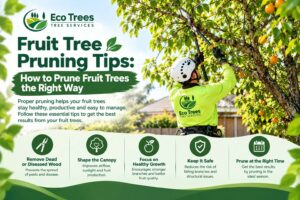
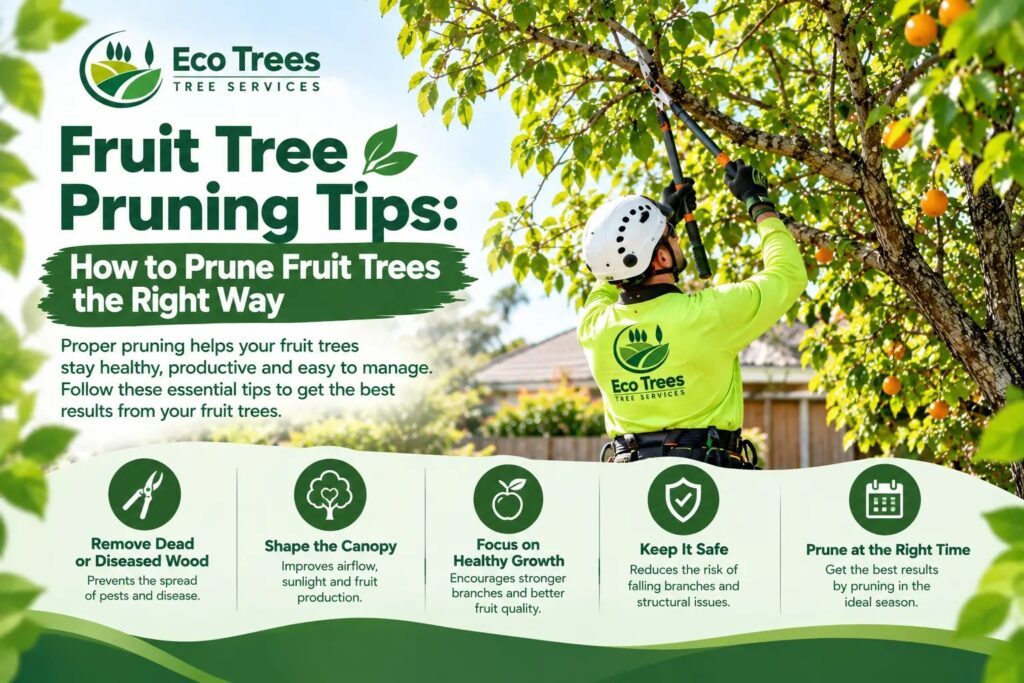
Fruit Tree Pruning Tips: How to Prune Fruit Trees the Right Way
The biggest mistake I see with fruit tree pruning is treating every fruit tree the same. The right cut, the right amount and the right timing depend on the tree species, its age, its condition and where it produces fruit.
Fruit tree pruning should have a purpose. You may want to remove dead or damaged branches, improve airflow, manage the canopy, control the tree’s size or encourage a stronger structure. But cutting branches simply because the tree looks overgrown can create new problems.
At Eco Tree Services, I approach fruit tree pruning by looking at the whole tree first. Before making a cut, I want to know what the tree is trying to do, where its healthy growth is developing and which branches are actually causing a problem.
That matters because different fruit trees produce fruit on different types of wood. For example, apples and pears can produce fruit on older spur wood, while peaches and nectarines rely heavily on younger fruiting wood. Removing the wrong branches can therefore remove next season’s potential fruit as well.
Why Do Fruit Trees Need Pruning?
Skimable summary: Fruit tree pruning can help manage tree health, structure, airflow, sunlight, safety and size. The goal is selective removal rather than cutting as much growth as possible.
A fruit tree does not need to be heavily pruned just because it produces fruit.
I prune with a specific objective in mind.
Common reasons include:
- Removing dead, diseased or damaged branches.
- Removing branches that rub or cross each other.
- Improving airflow through a dense canopy.
- Allowing appropriate light into the canopy.
- Managing branches growing toward buildings or access areas.
- Developing stronger branch structure in younger trees.
- Keeping the tree at a manageable size.
- Removing weak or poorly positioned growth.
Eco Tree Services uses techniques including crown thinning, crown lifting, crown reduction and deadwood removal as part of professional tree pruning and maintenance.
With fruit trees, however, there is another consideration: fruiting wood.
If you remove productive branches without understanding the species, you may solve an appearance problem while reducing the tree’s ability to produce fruit.
When Is the Best Time to Prune Fruit Trees?
Skimable summary: There is no single pruning month that works for every fruit tree. Pruning timing depends on species, climate, growth pattern and the purpose of the pruning.
This is one of the questions I would answer carefully because generic pruning calendars can be misleading.
The supplied references show why. STIHL Australia recommends different timing for pome and stone fruit, while Leaf, Root & Fruit also emphasises that timing should be based on the particular fruit tree and disease risk.
Pome fruit
Apples and pears are examples of pome fruit. Their pruning requirements differ from stone fruit, and established trees can often be managed through selective thinning and maintenance.
Stone fruit
Peaches, nectarines, cherries, apricots and some plums have different pruning considerations. STIHL’s Australian guidance recommends warmer-season pruning for stone fruit, while Arbor Pride highlights the importance of avoiding poorly timed cuts during cold conditions.
Brisbane conditions
In Brisbane, I would not automatically apply a pruning calendar designed for another climate.
Our warm conditions, rainfall patterns and fast-growing vegetation mean the condition of the tree matters just as much as the date.
If disease is a concern, timing becomes even more important. Leaf, Root & Fruit specifically warns that pruning at inappropriate times and poor tool hygiene can contribute to disease transmission between fruit trees.
So before pruning, identify the fruit tree first.
Then decide what type of pruning it actually needs.
What Branches Should You Remove First?
Skimable summary: Start with the obvious problem branches: dead, diseased, damaged, crossing, rubbing, inward-growing or structurally weak branches. Reassess the tree before making additional cuts.
I like to start with the three Ds: dead, diseased and damaged.
This gives you a much better starting point than immediately cutting healthy branches.
Dead branches
Deadwood should be removed when it creates a safety or tree-health concern.
Diseased branches
Diseased material may need careful removal, and tool hygiene matters when moving between trees. Clean, sharp tools reduce the chance of spreading problems from one tree to another.
Damaged branches
Storm-damaged or broken branches can create unstable points and should be assessed before they fail further.
Crossing and rubbing branches
Branches that repeatedly rub against each other can create wounds and structural problems.
Inward-growing branches
Branches growing into the centre of the canopy can create excessive density and reduce useful airflow and light penetration. Arbor Pride identifies these branches as candidates for removal because dense canopies can encourage disease and pest problems.
Water shoots and suckers
Strong vertical shoots can consume energy without necessarily contributing to the desired fruiting structure. They may need selective removal depending on the species and pruning objective.
After removing these problem branches, I step back.
That is important.
You may discover that the tree needs much less pruning than you initially thought.
How Should You Make Pruning Cuts?
Skimable summary: Use sharp, clean tools and make deliberate cuts that respect the branch collar or the position of the bud. Avoid leaving long stubs or tearing the bark.
A clean cut starts with the right tool.
For small branches, sharp secateurs may be enough. Larger branches require appropriate pruning saws and, in some situations, professional equipment.
Arbor Pride recommends sharp, sanitised tools and selective cuts, while STIHL similarly advises using sharp cutting equipment to avoid crushing or tearing branches.
Cut near the right point
When removing a branch completely, the branch collar is important. I do not recommend cutting blindly flush against the trunk because damaging the collar can create unnecessary problems.
When shortening a branch, the position of the bud can also influence the direction of new growth.
An outward-facing bud can be useful when you want new growth to develop away from the centre of the canopy. Arbor Pride and STIHL both discuss positioning cuts close to an appropriate bud.
Avoid leaving stubs
Long stubs can die back and create additional problems.
Take care with large branches
Do not try to drop a heavy limb with one uncontrolled cut.
Large branches should be managed in stages to reduce the chance of bark tearing or uncontrolled movement. STIHL specifically recommends staged removal for larger branches.
If the branch is large, high or positioned over a structure, I would bring in an arborist rather than turning a fruit-tree maintenance job into a safety problem.
How Much Should You Prune From a Fruit Tree?
Skimable summary: Prune only as much as the tree needs for the specific objective. Young trees can require formative work, while established trees generally need more restrained maintenance.
This is where homeowners can easily go too far.
You start by removing one dead branch. Then another branch looks uneven. Then you decide to open the canopy further. Before long, a significant portion of the tree is gone.
I recommend stopping and reassessing after major cuts.
The amount that is appropriate depends on:
- Species
- Tree age
- Tree health
- Existing structure
- Previous pruning
- Fruit-bearing wood
- Reason for pruning
- Current growing conditions
Leaf, Root & Fruit takes a particularly conservative view, recommending that established trees generally be pruned with restraint and suggesting less than 30% removal in a pruning session as a useful guide. That should not be treated as a universal rule for every species or situation, but it reinforces the principle that more pruning is not automatically better.
If a mature fruit tree requires major reduction, I would rather assess it professionally than use an arbitrary percentage.
Do Different Fruit Trees Need Different Pruning Methods?
Skimable summary: Yes. Fruit trees do not all produce fruit on the same type of wood, so pruning techniques should be adapted to the species.
This is probably the most important technical point in fruit tree pruning.
Apples and pears
Apples and pears can produce fruit on established spur wood. Leaf, Root & Fruit describes these as spur-bearing trees and notes that the spurs can remain productive for years.
That means indiscriminately removing older short fruiting spurs can work against your goal.
Peaches and nectarines
Peaches and nectarines produce fruit on younger growth. Removing too much of the previous season’s productive wood can therefore reduce fruiting potential.
Citrus
Citrus and other tip-bearing fruit trees have their own growth and fruiting characteristics. Leaf, Root & Fruit notes that citrus can produce much of its fruit toward the outer canopy, making canopy size and selective tip management important considerations.
Plums and cherries
These need species-specific treatment. STIHL recommends summer pruning for cherries after harvesting and also describes summer pruning for plums.
Figs
Figs also have their own pruning considerations. STIHL recommends early spring pruning for figs to help provide light and encourage strong new growth.
This is why I would not recommend searching for one generic “fruit tree pruning formula.”
Identify the tree first.
Then decide what the tree needs.
What Are the Most Common Fruit Tree Pruning Mistakes?
Skimable summary: The most common mistakes are pruning at the wrong time, removing productive wood, over-pruning, using dirty or dull tools, making poor cuts and treating every fruit tree species the same.
Pruning without identifying the species
This is where many problems begin.
If you do not know where the tree produces fruit, you do not know which branches you can safely remove.
Removing too much
Heavy pruning can trigger vigorous vegetative growth and reduce the balance you were trying to achieve.
Cutting off productive wood
This is especially important for species that fruit on particular ages or types of branches.
Using dirty tools
Tool hygiene matters because diseases can move between trees. Leaf, Root & Fruit specifically recommends sterilising tools between trees, especially where disease is present.
Leaving stubs
A stub can die back rather than forming a clean, healthy pruning point.
Topping the tree
Cutting major limbs back simply to make a fruit tree shorter can create excessive regrowth and compromise its natural structure.
Pruning because someone told you to
This sounds obvious, but it happens.
If the tree is healthy, productive and structurally sound, it may not need aggressive pruning simply because it has reached a certain age.
How Does Pruning Small Trees Differ From Mature Fruit Trees?
Skimable summary: Pruning small trees is often about developing a strong future structure, while mature fruit trees usually require more selective maintenance and less aggressive cutting.
Pruning small trees is an opportunity to influence their future shape.
Young fruit trees may need formative pruning to establish:
- Strong scaffold branches
- Suitable branch spacing
- Good branch angles
- A manageable canopy height
- A balanced central structure
Arbor Pride highlights the importance of training young fruit trees during their early development so they can establish stronger frameworks before carrying heavier fruit loads.
But small does not mean risk-free.
A small tree beside a house may be easy to reach, but cutting the wrong branches repeatedly can create structural problems as the tree matures.
For residential tree pruning, I prefer to think several years ahead rather than only making the tree look better today.
Can Tree Pruning and Tree Trimming Improve Fruit Production?
Skimable summary: Properly targeted pruning can improve canopy structure, light distribution and airflow, but pruning does not automatically increase fruit yield and excessive cutting can work against fruit production.
This is where expectations need to be realistic.
Pruning can help create conditions that support healthy fruit production. It can improve light penetration, manage canopy density and remove branches that are dead, damaged or poorly positioned.
STIHL states that appropriate annual pruning can help maintain tree health, canopy exposure and fruit quality, while Arbor Pride highlights airflow, sunlight and structural development as important considerations.
But I would not tell a homeowner:
“Prune more and you will get more fruit.”
That is too simplistic.
Leaf, Root & Fruit makes the important point that fruit trees do not necessarily need pruning simply to produce fruit. The reason for pruning should come from the tree’s actual needs.
The objective is a productive, healthy tree, not a heavily cut tree.
When Should You Hire a Tree Pruning Company?
Skimable summary: A tree pruning company becomes the safer option when fruit trees are large, branches are difficult to access, cuts involve heavy limbs, the tree is close to structures or powerlines, or you are unsure what should be removed.
A small backyard fruit tree can sometimes be maintained with basic equipment.
A mature tree is different.
I recommend professional help when:
- Branches are too high to reach safely from the ground.
- Large limbs need to be removed.
- The tree is close to your home.
- Branches extend over vehicles or walkways.
- Powerlines are nearby.
- The tree has storm damage.
- You are dealing with significant decay.
- Previous pruning has left the tree poorly structured.
- You cannot identify which branches are productive.
- You need substantial canopy reduction.
Eco Tree Services provides professional tree pruning and maintenance in Brisbane across Brisbane, North Brisbane, South Brisbane, Ipswich, Logan and Redlands. Our service includes crown thinning, crown lifting, crown reduction and deadwood removal.
I would rather assess a fruit tree properly than have a homeowner remove a major productive limb or put themselves at risk trying to reach it.
How Do You Choose the Best Tree Pruning Service?
Skimable summary: The best tree pruning service should assess the tree before cutting, understand pruning techniques, explain the work clearly and use appropriate safety practices and equipment.
I would look for more than a cheap quote.
Ask the company:
Do they assess the tree first?
A professional should understand what needs to be removed before starting.
Do they understand different pruning methods?
Crown thinning, crown lifting, crown reduction and deadwood removal are not interchangeable.
Are they appropriately trained and insured?
Tree work can involve chainsaws, climbing, rigging and heavy branches.
Do they explain what they are removing?
If someone immediately recommends cutting half the canopy without explaining why, I would ask more questions.
Do they consider the tree’s surroundings?
The location of the house, vehicles, fences, pathways and power infrastructure all matter.
At Eco Tree Services, our qualified arborists work with local Brisbane conditions and provide tree pruning and maintenance for residential and commercial properties.
What Should You Do After Pruning a Fruit Tree?
Skimable summary: After pruning, monitor the tree rather than immediately making additional cuts. Maintain appropriate watering and watch for new growth, disease symptoms or signs of stress.
Pruning is not the end of tree care.
After pruning, pay attention to how the tree responds.
Look for:
- Healthy new growth
- Unusual dieback
- Excessive water shoots
- Signs of disease
- Changes in canopy density
- Branch instability
Water management also matters, particularly when the tree is under environmental stress.
And if your fruit tree has suffered storm damage, do not treat it as a normal pruning job. Broken branches can become immediate hazards.
Eco Tree Services provides emergency storm damage and tree clean-up services in Brisbane for fallen trees, hazardous broken branches, tree stabilisation and debris removal.
Our guide on the real cost of ignoring tree maintenance during Queensland’s wet season also explains why weak limbs and neglected tree maintenance can become much bigger problems when Brisbane experiences heavy rain, strong winds and storms.
What Is the Best Approach to Fruit Tree Pruning?
Skimable summary: The best approach is species-specific, selective and purposeful: identify the tree, understand its fruiting habit, remove problem branches first and avoid unnecessary canopy reduction.
My basic approach is simple:
Identify first. Cut second.
I want to know:
- What species is the tree?
- Is it healthy?
- Where does it produce fruit?
- What problem am I trying to solve?
- Which branches actually need to go?
- What will the tree look like after the cuts?
- How will it respond over the next growing season?
That process prevents the most common mistake in fruit tree care: cutting first and trying to work out the consequences later.
If you have a small fruit tree that needs minor maintenance, careful pruning may be manageable.
If the tree is mature, difficult to access, structurally compromised or close to buildings and power infrastructure, professional assessment is the better approach.
At Eco Tree Services, we can assess the tree and recommend the appropriate pruning or maintenance solution for your property.
Frequently Asked Questions About Fruit Tree Pruning
When is the best time to prune fruit trees?
The best pruning time depends on the fruit tree species and the reason for pruning. Pome and stone fruit trees can have different recommended pruning windows, and Brisbane’s climate should also be considered.
For example, STIHL recommends different timing for pome and stone fruit, while other Australian guidance emphasises avoiding unsuitable weather and disease-prone periods for particular species.
How often should fruit trees be pruned?
Fruit trees do not all require the same pruning frequency. Some established trees need periodic maintenance, while young trees may require formative pruning as their structure develops.
I would rather assess the tree’s growth and fruiting behaviour than automatically cut it every year just because a calendar says so.
Does pruning increase fruit production?
Proper pruning can support healthy fruit production, but pruning more does not automatically produce more fruit. The objective is to create an appropriate balance of healthy growth, light, airflow and fruiting wood.
For example, removing dead or overcrowded branches can improve the canopy, but removing too much productive wood can reduce the tree’s ability to fruit.
Can I prune a fruit tree myself?
You can handle some small, accessible pruning jobs yourself, but larger trees and difficult branches should be assessed by a qualified arborist.
A pair of secateurs is one thing. A mature fruit tree with large branches over a roof is another. I would not recommend climbing or using heavy cutting equipment simply to save the cost of a professional assessment.
Should I remove dead branches from a fruit tree?
Yes, dead branches should generally be assessed and removed when they create a safety or tree-health concern.
Deadwood can become unstable, particularly as branches deteriorate. If a dead limb is large or positioned over a structure, professional removal is much safer.
Should I prune small fruit trees?
Yes, small fruit trees can benefit from selective formative pruning when there is a clear structural reason.
The early years are an opportunity to establish strong scaffold branches and a manageable structure. The mistake is treating pruning small trees as permission to remove any branch that looks inconvenient.
What happens if I over-prune a fruit tree?
Over-pruning can stress the tree, trigger excessive vegetative growth and remove productive fruiting wood.
This is particularly important with fruit trees because different species produce fruit on different types of branches. Removing the wrong growth can mean you have unintentionally removed next season’s fruiting potential.
Should fruit tree pruning tools be sterilised?
Yes, cleaning and sanitising pruning tools between trees can help reduce the risk of spreading disease.
This becomes particularly important when you are pruning multiple trees or working with a tree showing signs of disease. Good pruning hygiene is one of the simplest habits you can build into routine fruit tree maintenance.
Should I use wound sealant after pruning a fruit tree?
Routine wound sealing is generally not something I would recommend simply because a branch has been cut.
Leaf, Root & Fruit notes that traditional wound-sealing practices have largely fallen out of favour and that sealants can potentially trap pathogens rather than solve the underlying problem.
The better approach is to make appropriate pruning cuts in the first place and avoid unnecessary large wounds.