Tree Health Inspections: What Brisbane Homeowners Need to Know
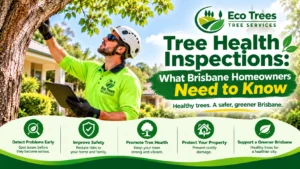
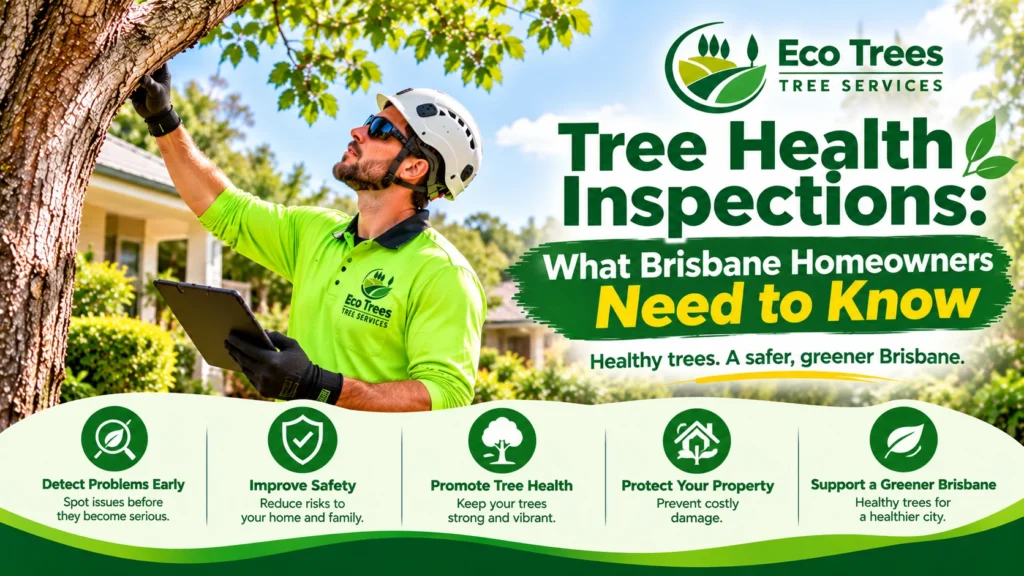
Tree health inspections help identify problems before they become serious. A tree can look green and healthy from the ground while already dealing with root damage, decay, disease, pests or structural problems that need attention.
At Eco Tree Services, I don’t recommend waiting until a large branch falls or a tree starts looking obviously unhealthy before getting it checked. A proper tree health inspection looks at the tree as a whole — its canopy, branches, trunk, root zone, soil and surrounding conditions — so we can understand what is actually happening rather than guessing from one visible symptom.
For Brisbane homeowners, this matters because our trees deal with heat, humidity, heavy rainfall, storms, changing soil conditions and rapid growth. These factors can affect tree health and stability in ways that are not always obvious.
A professional inspection can help answer the question homeowners usually have:
“Is my tree actually unhealthy, or is there something else causing it to look different?”
What Is a Tree Health Inspection and What Does It Check?
Skimable summary: A tree health inspection examines the canopy, foliage, branches, trunk, root collar, soil and surrounding environment to identify signs of decline, disease, pests, decay, structural weakness or environmental stress.
A tree health inspection is more than simply walking around the tree and looking at the leaves.
When I inspect a tree, I want to understand the condition of the entire tree and what may be causing any changes you have noticed.
The canopy and foliage
The canopy can tell us a lot about what is happening inside the tree.
I look for:
- thinning foliage
- unusual leaf colour
- reduced new growth
- dead branches
- uneven canopy development
- premature leaf drop
- branch dieback
- signs of pest activity
- fungal or disease symptoms
A small amount of leaf loss does not automatically mean a tree is dying. The important question is why the change is happening and whether it is getting worse.
The trunk and major branches
I also look at the trunk and main branch unions for visible cracks, cavities, decay, damaged bark and other structural abnormalities.
Some defects are obvious. Others require a much closer inspection.
The root zone
This is one of the areas homeowners often overlook.
Changes to the soil, drainage, paving, excavation, trenching or compaction can affect roots even when the canopy still looks reasonably healthy.
The root zone can therefore provide important clues about why a tree is declining.
The surrounding environment
A tree does not exist in isolation.
Construction, irrigation changes, landscaping, compacted soil, nearby structures and altered drainage can all influence tree health.
This is one reason I prefer looking at the entire site rather than diagnosing a tree based on one symptom.
Why Can a Tree Look Healthy but Still Need an Inspection?
Skimable summary: Trees can hide internal decay, root problems, structural defects and storm damage while maintaining healthy-looking foliage, so appearance alone cannot confirm overall tree health.
This is one of the biggest misconceptions I come across.
A tree with plenty of green leaves is not automatically a healthy tree.
The visible canopy is only one part of the picture.
For example, a tree may have:
- internal decay inside the trunk
- damage around the root system
- a compromised branch union
- soil compaction
- fungal activity
- pest damage
- storm-related fractures
and still maintain enough foliage to look normal from the ground.
Research from Brisbane tree-care sources similarly highlights that some structural and root problems may not be obvious to an untrained observer. Evergreen Tree Care notes that apparently satisfactory branches, unions or cavities can conceal more significant hazards, while Gabe’s Tree Services highlights hidden decay, unstable roots and internal structural problems as reasons professional inspections can be useful.
This is why I don’t use “the tree looks fine” as the final diagnosis.
What Are the Signs Your Tree Needs a Health Inspection?
Skimable summary: Thinning foliage, deadwood, dieback, fungal growth, cracks, unusual leaning, exposed roots and sudden changes after storms are practical warning signs that justify professional tree inspection.
You don’t need to wait until your tree becomes obviously dangerous.
I would recommend arranging an inspection if you notice a significant or unexplained change such as:
1. The canopy is becoming thinner
If you can suddenly see much more sky through a mature tree than you could previously, investigate why.
A thinning canopy can have multiple causes, including environmental stress, pests, disease or root problems.
2. Branches are dying back
Dead branches throughout the canopy or dieback beginning at branch tips can indicate that the tree is under stress.
3. You see fungi or mushrooms
Fungal growth around the base or trunk does not automatically mean the tree must be removed, but it deserves attention.
It can be associated with decay or problems affecting the root and trunk structure.
4. The tree has started leaning
A natural lean that has remained unchanged for years is different from a newly developing or worsening lean.
A recent change deserves professional assessment.
5. You notice cracks or splits
Cracks in major branches, branch unions or the trunk can indicate structural problems.
Don’t try to investigate a high branch yourself.
6. Roots are exposed or the soil has moved
After heavy rain or storms, look at the area around the tree base.
Exposed roots, soil movement or lifting can indicate changes in root stability.
7. The tree changed after a storm
This is particularly important in Brisbane.
A tree can survive a storm without immediately dropping a major branch, yet still have cracks or fractures that become a problem later. Eco Tree Services’ post-storm guidance explains that wind can create internal cracks and splits that are not necessarily obvious immediately after an event.
If you have noticed any of these warning signs, a qualified arborist in Brisbane can determine whether you are looking at normal seasonal change, manageable stress or a problem requiring further action.
Is a Tree Health Inspection the Same as a Tree Risk Assessment?
Skimable summary: A tree health inspection focuses on whether a tree is declining and why, while a tree risk assessment focuses on the likelihood and consequences of tree or branch failure; sometimes both assessments are appropriate.
No. They overlap, but they answer different questions.
A tree health inspection primarily asks:
Is this tree healthy, declining or stressed, and what is causing the problem?
A tree risk assessment asks:
How likely is the tree or a part of it to fail, what could it affect, and what should be done to manage that risk?
That distinction is important.
For example, a tree may be experiencing poor health because its root zone has been compacted. The health inspection identifies the problem and potential cause.
A separate risk assessment may be needed if the tree is also positioned above a house, driveway or frequently occupied area and there are concerns about structural failure.
A health assessment does not automatically mean tree removal. In many situations, the appropriate response can involve pruning, improving growing conditions, monitoring or addressing the underlying cause.
When Should Brisbane Homeowners Book a Tree Health Inspection?
Skimable summary: Book a tree health inspection when you notice unexplained decline, after significant storms, before major construction, around mature trees and whenever you are unsure whether a visible tree problem is serious.
There isn’t one date on the calendar that applies to every tree.
Instead, I recommend thinking about the condition of the tree and what has changed around it.
Before Brisbane’s storm season
This is one of the most practical times to inspect trees that are close to homes, sheds, driveways or other frequently occupied areas.
Eco Tree Services’ Brisbane tree-care checklist recommends addressing deadwood, canopy issues and branches over roofs, garages and powerlines before the high-risk storm period.
After a significant storm
Don’t assume a tree is fine simply because it is still standing.
Wind can create branch fractures, damaged unions and root disturbance that may not be immediately visible.
When the tree suddenly looks different
If a previously healthy tree begins losing leaves, producing deadwood or showing unusual growth patterns, investigate the cause rather than immediately assuming it needs removal.
After construction or excavation
If you’ve recently excavated, installed drainage, built a driveway, added paving or significantly changed the landscaping around an established tree, its root zone may have been affected.
When you’re responsible for multiple trees
Property managers, body corporates, commercial property owners and other site managers may benefit from documented inspections and maintenance planning rather than dealing with individual tree problems only after they become urgent.
What Happens During a Professional Tree Health Inspection?
Skimable summary: A professional inspection normally combines visual assessment of the canopy, trunk and roots with consideration of soil, site conditions, recent changes and symptoms before recommendations are made.
At Eco Tree Services, the objective is not to make the inspection complicated.
It is to understand what the tree is telling us.
The process can include:
Initial discussion
I’ll first want to know what you’ve noticed.
Has the tree changed recently? Did the problem appear after a storm? Has construction taken place nearby? Are leaves changing colour? Are branches dying?
Those details provide useful context.
Canopy inspection
I assess the overall canopy, foliage density, deadwood, branch condition and visible signs of pests or disease.
Trunk and branch assessment
The trunk, bark, major branches and branch unions are examined for visible defects and signs of structural deterioration.
Root-zone assessment
I look at the soil and root collar and consider issues such as compaction, drainage, soil disturbance, exposed roots and changes around the tree.
Recommendations
The final recommendation depends on what we actually find.
It could involve:
- monitoring
- corrective pruning
- deadwood removal
- addressing environmental conditions
- further investigation
- tree maintenance
- risk management
- removal where the tree genuinely cannot be retained safely
That last point matters.
An inspection should give you clarity, not automatically lead to a removal quote.
Can a Tree Health Inspection Prevent Tree Removal?
Skimable summary: Early inspection can sometimes identify manageable problems before they become severe, allowing pruning, improved growing conditions or monitoring to preserve a tree where safe and appropriate.
Yes, sometimes.
This is one of the reasons I prefer homeowners to investigate problems early.
A mature tree that looks unhealthy may still have a manageable issue.
For example, the problem may be associated with:
- soil compaction
- poor drainage
- root-zone disturbance
- inappropriate pruning
- pests
- disease
- deadwood
- storm damage
Correctly identifying the cause gives you more options.
Our tree pruning and maintenance services in Brisbane can help address appropriate structural and maintenance issues while supporting long-term tree health. tree pruning and maintenance services in Brisbane
However, I also believe in being honest when a tree cannot safely remain.
If an inspection identifies severe structural deterioration, major root compromise or another significant hazard, removal may become the responsible option.
The point of the inspection is to determine which situation you’re actually dealing with.
What Brisbane Tree Problems Should You Watch Before Storm Season?
Skimable summary: Brisbane homeowners should pay particular attention to leaning trees, dead or hanging branches, trunk cracks, fungal growth, exposed roots and soil movement before periods of heavy rain and strong winds.
Brisbane’s weather makes proactive tree care particularly important.
Eco Tree Services identifies new or worsening lean, cracks or splits, dead and hanging branches, fungal growth, exposed roots and soil upheaval as warning signs worth addressing before cyclone and storm conditions.
I recommend homeowners look at their trees before severe weather arrives rather than waiting until branches are already moving in the wind.
For a practical seasonal checklist, you can also read our Brisbane tree care checklist. Brisbane tree care checklist
And if your property has already experienced a significant storm, our post-storm tree check-up guide explains why a visual check from the ground may not reveal every problem. post-storm tree check-up guide
How Do You Choose a Qualified Arborist in Brisbane?
Skimable summary: Choose an arborist based on relevant qualifications, insurance, experience, clear inspection findings, written recommendations and transparent scope rather than price alone.
Searching for arborists in Brisbane will give you plenty of options.
The challenge is knowing which one is appropriate for your situation.
If you’re looking for a professional arborist in Brisbane, I recommend checking a few basics before booking.
Check qualifications
Ask who will actually perform the inspection and what qualifications they hold.
Eco Tree Services recommends looking for appropriately qualified arborists and notes that more complex tree-health or reporting work may require higher-level arboricultural expertise.
Check insurance
Professional tree work carries genuine risks.
Ask for evidence of appropriate insurance rather than assuming every arborists service provider has the same level of cover.
Ask what the inspection includes
A proper inspection should have a clear scope.
You should understand whether the assessment covers the canopy, trunk, branches, root zone and surrounding site conditions.
Ask what happens after the inspection
A good arborists company Brisbane homeowners can rely on should be able to explain what was found and what action, if any, is recommended.
Don’t choose purely on price
The cheapest inspection is not necessarily the most useful one.
You are paying for someone to identify a problem correctly and help you decide what to do next.
The same principle applies when comparing arborists in Australia generally: qualifications, scope, insurance and practical experience matter more than simply choosing the first low-cost quote.
For a more detailed checklist, read our guide to hiring a qualified arborist. hiring a qualified arborist
What Should You Do If Your Tree Already Looks Unhealthy?
Skimable summary: If a tree is showing significant decline, structural changes or storm damage, avoid guessing or attempting hazardous work yourself and arrange an appropriate professional assessment.
Don’t immediately reach for the chainsaw.
First, work out what is actually wrong.
If the problem is limited to dead or damaged branches, appropriate pruning may help.
If the issue is associated with disease, pests or growing conditions, addressing the underlying cause may be more important than cutting branches.
If the tree has serious structural problems, removal may need to be considered.
And if you’re unsure, an inspection gives you a much better starting point than guessing.
Our article on what’s killing your trees in Brisbane also covers several common causes of tree decline and why early identification matters. what’s killing your trees in Brisbane
I also don’t recommend climbing or attempting complicated tree work yourself, particularly when the tree is large, damaged, close to structures or affected by storm conditions.
FAQs About Tree Health Inspections
What is a tree health inspection?
A tree health inspection is a professional assessment of a tree’s overall condition, including its canopy, branches, trunk, root zone and surrounding environment.
The purpose is to identify signs of decline, disease, pests, decay, environmental stress or structural problems.
For example, if a Brisbane homeowner notices that one mature tree is suddenly losing foliage while the surrounding trees look normal, an inspection can help determine whether the issue is related to that particular tree’s roots, soil conditions, disease or another cause.
How often should trees have a health inspection?
The inspection frequency depends on the tree, its condition, location and surrounding risk factors.
A young, healthy tree in an uncomplicated location may not require the same level of attention as a large mature tree beside a house.
If you’ve noticed a change in the tree, experienced a significant storm or changed the soil or landscaping around it, don’t wait for the next scheduled inspection.
Can a tree health inspection identify disease?
A professional inspection can identify visible signs that may indicate disease, pest activity or other causes of decline, although some problems may require further investigation.
Leaf discolouration, abnormal growth, dieback, fungal growth and changes in canopy density can all provide useful clues.
The important part is not simply identifying a symptom. It is working out what may be causing it.
Can a sick tree be saved?
Yes, some unhealthy trees can recover when the underlying problem is identified and addressed early.
For example, a tree affected by environmental stress may respond differently from a tree with severe structural decay.
I’ve seen plenty of situations where homeowners assume that poor-looking foliage means the tree is finished. Sometimes the problem is much more manageable.
The assessment helps separate those situations.
Is a tree health inspection worth it?
A tree health inspection can be worthwhile when you are concerned about unexplained tree decline, storm damage, structural changes or the long-term health of a valuable mature tree.
The value comes from understanding the problem before making an expensive or irreversible decision.
If pruning can address the issue, you know what needs to be done. If the tree needs monitoring, you know what to watch. If removal is genuinely necessary, you have a clearer reason for that decision.
What is the difference between a tree health inspection and a tree risk assessment?
A tree health inspection focuses on the tree’s condition and why it may be declining, while a tree risk assessment focuses on the likelihood and consequences of tree or branch failure.
The two can overlap.
For example, a tree may have poor health and also present a structural risk because it stands over a frequently used driveway.
In that situation, understanding both the tree’s condition and the potential consequences of failure may be important.
Should trees be inspected after a storm?
Yes, particularly if the storm involved strong winds, heavy rain, broken branches, leaning or other visible changes.
A tree can remain standing while still having damaged branch unions, internal cracks or root disturbance.
Our post-storm check-up guide explains why some storm damage can remain hidden after the weather clears. post-storm check-up guide
Protect Your Trees Before a Small Problem Becomes a Big One
The best time to investigate a tree problem is before it becomes an emergency.
At Eco Tree Services, I don’t believe every unhealthy-looking tree needs to be removed, and I don’t believe every healthy-looking tree should simply be ignored.
The right approach is to assess what is actually happening.
A professional tree health inspection can help identify problems early, explain what is causing them and give you practical options for keeping the tree healthy and your property safe.
If you’ve noticed changes in a tree, are preparing for Brisbane’s storm season or simply want professional advice about a mature tree on your property, get in touch with Eco Tree Services for an assessment.
Don’t wait for a branch to fall before finding out what’s happening above and below your canopy.