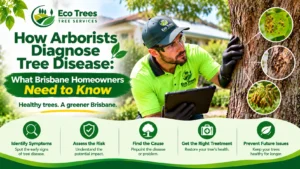
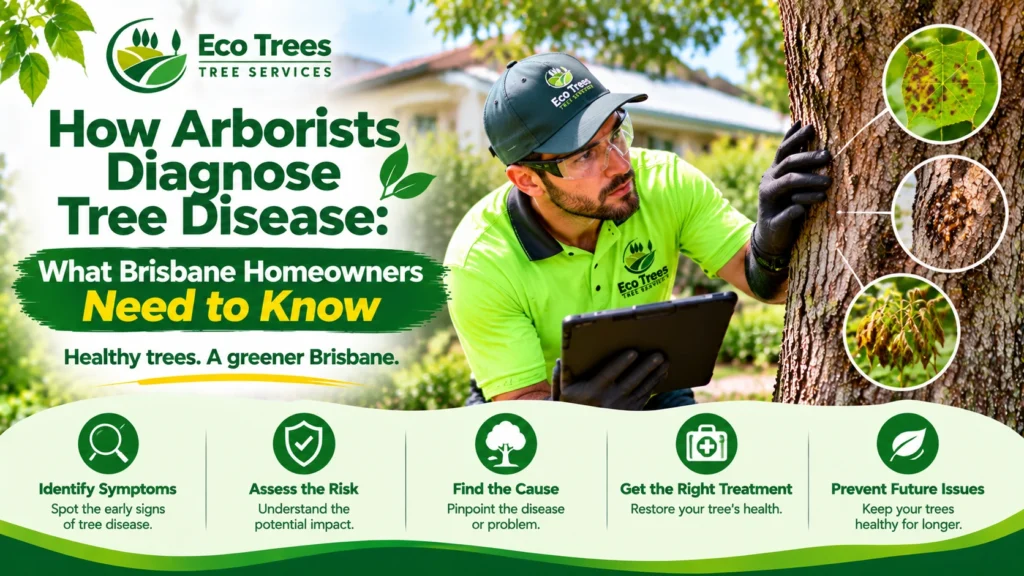
How Arborists Diagnose Tree Disease: What Brisbane Homeowners Need to Know
Arborists diagnose tree disease by looking at the whole tree, not just one damaged leaf or branch. They assess symptoms in the foliage, bark, trunk, branches, roots and soil, then consider pests, disease, weather and site conditions before recommending treatment.
At Eco Tree Services, one of the biggest mistakes I see homeowners make is assuming that a symptom automatically tells them what is wrong.
Brown leaves don’t always mean disease. Dead branches don’t always mean infection. Mushrooms don’t automatically mean the tree needs to be removed.
The same visible symptom can have several different causes.
That is why how arborists diagnose tree disease is really a process of elimination. I look at what has changed, where the symptoms are appearing, how quickly they are progressing and what is happening around the tree.
For Brisbane trees, this whole-tree approach matters even more because warm, humid conditions, heavy rain, storms, soil changes, pests and construction can all contribute to tree decline.
What Does an Arborist Look for When Diagnosing Tree Disease?
Skimable summary: Arborists diagnose tree disease by examining the canopy, leaves, branches, bark, trunk, roots, soil and surrounding environment, then comparing the symptoms with likely biological or environmental causes.
A proper diagnosis starts with observation.
Before thinking about treatment, I want to understand the pattern.
The canopy
I look at the overall density and structure of the canopy.
Is one section affected or is the whole tree declining?
Is the problem concentrated on newer growth or older branches?
Has the canopy suddenly become thinner?
These details help narrow down the possible causes.
The leaves
Leaves can provide some of the earliest visible clues.
I look for:
- unusual discolouration
- spots or blotches
- curling
- premature leaf drop
- unusual leaf size
- wilting
- scorch
- reduced foliage
- abnormal growth
But I don’t diagnose a disease based on leaf colour alone.
The surrounding evidence matters.
The branches
Dead branches, dieback and unusual growth patterns can indicate stress, disease, pests or structural problems.
The location and progression of the dieback can be just as important as the fact that it exists.
The trunk and bark
I check for cracks, lesions, cavities, fungal growth, damaged bark, insect entry points and other abnormalities.
The roots and soil
A tree’s problems can begin underground.
Root damage, compaction, poor drainage and changes to the soil can eventually show up as symptoms in the canopy.
The surrounding environment
I also consider what has happened around the tree.
Has someone recently excavated nearby?
Has the soil been compacted?
Has drainage changed?
Has the tree experienced a storm?
Have irrigation patterns changed?
This matters because a tree can look diseased when the real problem is environmental stress.
The supplied US Green Tree reference similarly describes diagnosis as a combination of education, experience, visual inspection, environmental assessment and, where appropriate, specialised tools rather than relying on one visible symptom.
Can Leaf Damage Tell an Arborist What Is Wrong?
Skimable summary: Leaf spots, discolouration, wilting, curling, premature leaf drop and canopy thinning can indicate disease, but the same symptoms can also result from pests, drought, soil problems, chemical damage or other environmental stress.
Leaves are often where homeowners notice the problem first.
You might see brown edges, yellowing leaves or dark spots and immediately think, “My tree has a disease.”
Sometimes you’re right.
But sometimes you’re not.
For example, leaf discolouration can be associated with disease, but it can also occur because the tree is experiencing environmental stress.
That is why I look at the pattern rather than one damaged leaf.
What patterns can tell us
If symptoms appear throughout the canopy, I consider different possibilities from a problem affecting one isolated branch.
If older leaves are affected but new growth looks normal, that gives different information from widespread damage across new and old growth.
Likewise, sudden leaf loss following extreme weather can point toward environmental stress rather than a straightforward infectious disease.
Eco Tree Services’ current guidance on tree diseases notes that discoloured, spotted or curled leaves can indicate leaf-related disease, while dieback can also result from pests, environmental stress or underlying disease.
This is why searching Google Images and trying to match a leaf to a disease is rarely enough for a reliable diagnosis.
How Do Arborists Examine the Trunk and Bark?
Skimable summary: Arborists inspect bark and trunk abnormalities such as cracks, cankers, fungal growth, cavities, insect entry points, damaged bark and unusual sap or residue because these can reveal disease, decay, pests or structural problems.
The trunk often tells a different part of the story from the leaves.
I look closely at the bark and major structural areas because changes there can indicate problems that aren’t obvious in the canopy.
Cracks and splits
Cracks can result from structural stress, mechanical damage, storms or other factors.
The location and severity matter.
Cankers and lesions
Abnormal dead or damaged areas on branches or trunks can be associated with disease or other forms of tissue damage.
Fungal growth
Fungal growth can be an important warning sign, particularly when it occurs around the base of the tree.
It doesn’t automatically mean the tree must come down, but it deserves investigation.
Insect activity
Small holes, sawdust-like material, residue or damaged bark can point toward pest activity.
Pests can also create entry points through which other problems develop.
Cavities and decay
Visible cavities may indicate internal deterioration.
However, the absence of an obvious cavity doesn’t prove that the inside of a trunk is sound.
That is where professional assessment becomes important.
Eco Tree Services also highlights fungal growth, cavities, cracks, deadwood and other defects as factors arborists assess when determining tree condition and structural concerns.
Why Do Arborists Check the Roots and Soil?
Skimable summary: Arborists inspect roots and soil because poor drainage, compaction, root damage, nutrient problems and construction activity can cause tree decline even when the visible symptoms appear in the canopy.
This is the part of diagnosis homeowners often don’t think about.
The tree’s roots are out of sight, but they have a huge influence on what happens above the ground.
Root damage
Roots can be damaged by:
- excavation
- trenching
- paving
- construction
- repeated vehicle traffic
- excessive soil compaction
- changes in drainage
The effects may not appear immediately.
A tree can continue looking reasonably normal for months or even longer before decline becomes obvious.
Eco Tree Services’ Brisbane tree-health guidance specifically identifies construction, trenching, paving, vehicle traffic and soil compaction as potential causes of root damage and gradual tree decline.
Soil compaction
Roots need suitable conditions for water and oxygen movement.
When soil becomes heavily compacted, root development and function can be restricted.
Poor drainage
Too much water around roots can create its own problems.
If soil remains excessively wet, root health can suffer and disease-related problems may become more likely.
Nutrient problems
Nutrient availability also affects growth.
If a tree is showing unexplained decline, looking at the soil can help determine whether the problem is actually coming from below the surface.
This is why a good tree disease diagnosis doesn’t stop at the leaves.
How Do Arborists Tell the Difference Between Disease, Pests and Environmental Stress?
Skimable summary: Arborists distinguish disease, pests and environmental stress by comparing symptoms, their distribution and progression with the tree species, site conditions, soil, weather history and evidence of insects or pathogens.
This is where professional experience becomes particularly valuable.
A tree can have more than one problem at the same time.
For example, environmental stress may weaken a tree, which then makes it more vulnerable to pests. Pest damage can then create opportunities for infection.
So asking, “Is this a pest or a disease?” can sometimes be the wrong question.
The better question is:
“What is causing this tree to decline, and what factors are contributing to it?”
Brisbane’s climate matters
Brisbane and South East Queensland provide conditions where moisture, warmth and humidity can contribute to fungal problems and pest activity.
Eco Tree Services specifically notes that Brisbane’s warm, humid climate can support pests and fungal diseases, particularly when trees are already stressed by drought or poor soil conditions.
This is also why timing matters.
Our Brisbane tree-care guidance recommends paying close attention to pests and fungal problems as warm, humid conditions increase, with examples including fungal disease on frangipani and sooty mould associated with pest activity.
A qualified arborist in Brisbane should therefore consider the local environment rather than treating every symptom as an isolated disease.
What Happens When a Visual Inspection Isn’t Enough?
Skimable summary: Visual inspection is the starting point, but some tree problems require additional investigation, such as soil testing or specialised assessment, when visible symptoms cannot establish the cause with enough confidence.
Most diagnoses start with a visual assessment.
That doesn’t mean every problem can be solved by looking at the tree from the ground.
The US Green Tree reference describes arborists using tools such as resistographs, increment borers and aerial inspection equipment in appropriate situations, alongside professional judgement.
The important point is that technology should support the diagnosis rather than replace it.
Depending on the problem, further investigation may help assess:
- soil conditions
- nutrient availability
- root problems
- internal structural condition
- difficult-to-see canopy defects
- suspected pest or disease activity
Not every tree needs advanced testing.
I don’t believe in using complicated equipment simply because it is available.
The assessment should determine whether additional investigation is actually useful.
Can Tree Disease Be Treated Without Removing the Tree?
Skimable summary: Tree disease does not automatically mean tree removal; depending on the cause and severity, treatment may involve pruning, improving soil conditions, managing pests, targeted treatment or ongoing monitoring.
This is probably the biggest concern homeowners have when they first notice something wrong.
They see dead branches or fungal growth and immediately think:
“Does this mean my tree has to come down?”
Not necessarily.
The first step is finding out what is actually wrong.
Treatment or management may involve:
Corrective pruning
If diseased, dead or damaged branches can be safely removed, pruning may form part of the management plan.
Eco Tree Services provides tree pruning and maintenance services in Brisbane that include deadwood removal, crown thinning, crown lifting and crown reduction where appropriate.
Improving growing conditions
If poor soil, compaction or water issues are contributing to decline, addressing those conditions may be more important than cutting branches.
Managing pests
If insects are contributing to the problem, the underlying pest issue needs to be addressed rather than simply removing damaged leaves.
Monitoring
Not every abnormality requires immediate intervention.
Sometimes the most sensible approach is to monitor how the tree changes over time.
Removal
There are situations where a tree has deteriorated to the point where safe retention is no longer appropriate.
But I don’t think removal should be the automatic response to every symptom.
The objective should be to understand the condition first and then choose the appropriate action.
What Are the Most Common Signs That a Brisbane Tree May Be Diseased?
Skimable summary: Common warning signs include unusual leaf discolouration, leaf spots, premature leaf drop, canopy thinning, branch dieback, fungal growth, unusual bark changes and unexplained decline.
You don’t need to diagnose the disease yourself.
You just need to recognise when something has changed.
Look out for:
- persistent leaf discolouration
- unusual spots or blotches
- premature leaf drop
- wilting
- thinning canopy
- dead or dying branches
- branch dieback
- fungal growth
- mushrooms around the base
- cracked or damaged bark
- unusual holes in the trunk
- unexplained changes after storms
Eco Tree Services’ recent disease guidance specifically identifies discoloured, spotted or curled leaves, fungal growth and dieback as signs that deserve attention.
If several of these signs appear together, I would not wait for the problem to become obvious across the entire tree.
How Can Brisbane Homeowners Choose the Right Arborist?
Skimable summary: Homeowners should look for appropriate arboricultural qualifications, insurance, relevant experience, clear inspection scope and written recommendations when choosing an arborist to diagnose tree disease.
There are plenty of people advertising tree services.
But diagnosing a tree problem is different from simply cutting branches.
If you’re searching for arborists in Brisbane or a professional arborist in Brisbane, I recommend checking the following before booking.
Qualifications
Ask about the qualifications of the person carrying out the assessment.
Eco Tree Services explains that arborists undertake formal training in arboriculture, including tree health, pests, diseases, Australian standards and safe tree work.
For more complex tree-health assessments and reports, Eco’s own arborist checklist recommends considering a company with higher-level arboricultural expertise.
Insurance
Tree work can be hazardous.
Ask for appropriate insurance documentation before work begins.
Relevant experience
Someone who primarily performs basic cutting may not be the right person to diagnose a complicated tree-health problem.
Look for experience with tree health, pests, disease and assessment.
Clear recommendations
A professional arborists service provider should explain what they found and what they recommend doing about it.
You shouldn’t have to accept a vague statement such as “the tree is sick” without understanding what that actually means.
A written scope
For larger or more involved work, make sure you understand exactly what has been recommended and why.
Eco Tree Services’ own checklist recommends checking qualifications, insurance, client feedback and obtaining a detailed written quote before engaging an arborist.
The same principles apply whether you’re comparing an arborists company Brisbane homeowners commonly use or looking more broadly at arborists in Australia.
The important thing is matching the arborist’s expertise to the problem you actually have.
What Should You Do If You Think Your Tree Has a Disease?
Skimable summary: If you suspect tree disease, document the changes, avoid guessing at treatment, arrange an appropriate professional assessment and address contributing environmental or structural problems early.
My advice is simple: don’t ignore the symptoms, but don’t panic either.
Take clear photographs of the leaves, branches and trunk.
Note when you first noticed the problem.
Think about what changed around the tree before the symptoms appeared.
For example:
- Was there a storm?
- Was there construction nearby?
- Did you change irrigation?
- Was the soil disturbed?
- Did the tree suddenly lose leaves?
- Did another tree nearby develop similar symptoms?
These details can help an arborist understand the bigger picture.
If the tree also has significant deadwood, cracks, leaning, exposed roots or storm damage, treat those as potential safety concerns rather than simply assuming they are signs of disease.
Our guide on what’s killing your trees in Brisbane covers several common causes of decline, including root damage, pests, disease, poor soil and storm damage.
And if the problem appeared following severe weather, our post-storm tree check-up guide explains why some damage can remain hidden after the storm has passed.
FAQs About How Arborists Diagnose Tree Disease
How do arborists diagnose tree disease?
Arborists diagnose tree disease by examining the entire tree and its environment, including the leaves, canopy, bark, branches, trunk, roots and soil.
They then compare the symptoms with possible causes such as disease, pests, environmental stress, root damage or poor growing conditions.
For example, if a Brisbane tree develops brown leaves, I wouldn’t immediately call it a fungal disease. I would look at the pattern of the damage and also consider soil moisture, recent weather, pests and root conditions.
Can an arborist tell if a tree is diseased just by looking at it?
A visual inspection can reveal important signs of disease, but some tree problems require further investigation before the cause can be confirmed.
Leaves, bark, dieback and fungal growth can provide strong clues.
However, symptoms can overlap between disease, pests and environmental stress. That’s why experienced arborists assess the whole tree rather than diagnosing from one symptom.
What are the most common signs of tree disease?
Common signs include leaf discolouration, spots, premature leaf drop, canopy thinning, dieback, fungal growth, abnormal bark changes and unusual growth.
I’ve also found that homeowners often notice a problem because “the tree just doesn’t look right” before they can identify a specific symptom.
That change is worth paying attention to.
Can tree disease be treated?
Some tree diseases and related health problems can be managed or treated, depending on the cause and severity.
The solution may involve pruning affected material, improving soil conditions, managing pests, targeted treatment or monitoring.
The important thing is identifying the cause first.
Does tree disease mean the tree needs to be removed?
No, tree disease does not automatically mean the tree needs to be removed.
Some trees can be managed successfully when problems are identified early.
Removal becomes a consideration when the tree has severe deterioration, significant structural problems or presents a level of risk that cannot be reasonably managed.
When should I call an arborist about a sick tree?
You should contact an arborist when symptoms persist, worsen or occur alongside significant deadwood, fungal growth, cracks, leaning, root damage or storm damage.
You don’t need to wait until half the canopy has died.
Early assessment can provide more options and may help prevent a manageable problem from becoming much harder to deal with.
Can pests cause symptoms that look like tree disease?
Yes, pest damage can produce symptoms that look similar to disease, and pests can also weaken trees and contribute to secondary problems.
Holes in bark, sawdust-like material, unusual residue, leaf damage and canopy decline can all provide clues.
This is one reason a professional diagnosis should consider both pests and disease instead of assuming one cause.
Should I prune a diseased tree myself?
I don’t recommend DIY pruning when the tree is large, diseased, structurally compromised, near powerlines or requires climbing.
Even if pruning is ultimately the correct treatment, the wrong cuts can create additional problems.
Eco Tree Services explains that tree pruning can become dangerous without appropriate training and equipment, particularly around large branches, height and powerlines.
Don’t Guess What Is Wrong With Your Tree
The most useful diagnosis starts with the whole tree, not the most obvious symptom.
At Eco Tree Services, I don’t want homeowners making decisions based on a photograph of one damaged leaf or a quick Google search.
A tree can decline because of disease, pests, soil problems, root damage, weather stress or several factors working together.
That is why a proper diagnosis looks at the tree, its symptoms and the environment around it.
If you’ve noticed unusual leaf loss, fungal growth, dieback, bark changes or another unexplained problem, getting the tree assessed early can give you a clearer path forward.
The goal isn’t automatically to prune or remove the tree.
The goal is to understand the problem first, then choose the right solution.