Best Time to Prune Trees in Brisbane: A Seasonal Guide
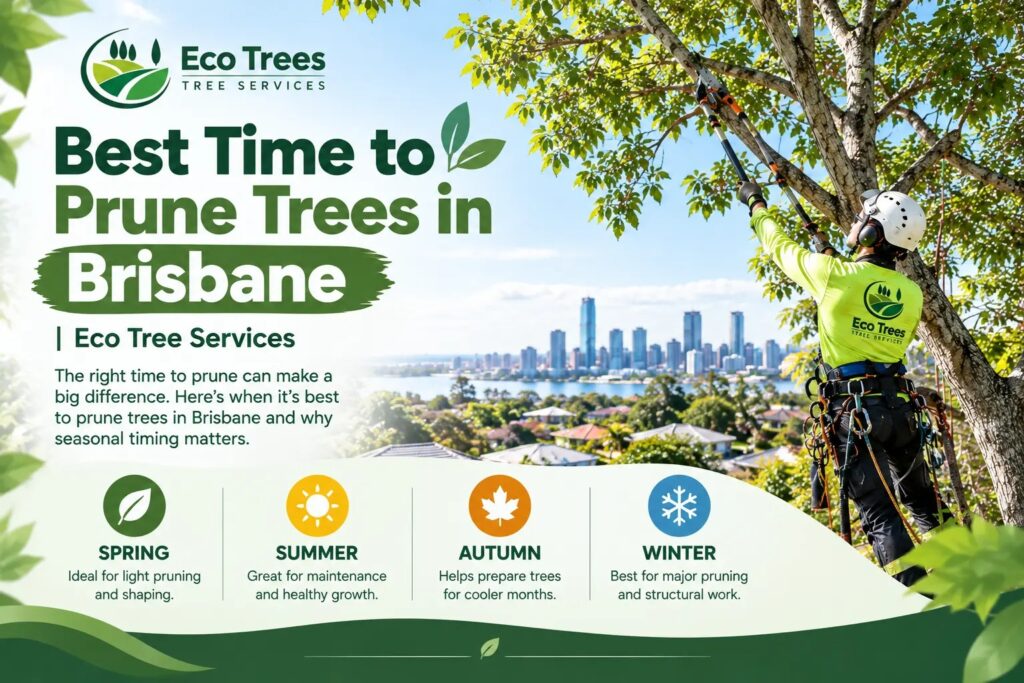
The best time to prune trees is not simply “winter”. It depends on the tree species, why you are pruning it, its current condition and Brisbane’s weather conditions. For most routine pruning, timing the work around the tree’s natural growth cycle can improve the result, while damaged or hazardous branches should be dealt with as soon as they become a safety concern.
At Eco Tree Services, this is one of the questions we hear regularly from Brisbane homeowners: “When should I actually prune my trees?”
The answer matters because pruning at the wrong time can encourage unwanted growth, interfere with flowering or place unnecessary stress on the tree. On the other hand, waiting for the “perfect” season when a branch is already damaged or dangerous is not a good idea.
Our approach is to look at the tree first, understand what you are trying to achieve and then decide when and how the pruning should happen.
What is the best time to prune trees in Brisbane?
For many trees, late winter or the cooler part of the year can be a good time for structural pruning, but there is no single pruning season that works for every tree. Flowering, fruiting, species characteristics, tree health, safety issues and the purpose of the pruning all influence the timing.
Brisbane also has a different growing environment from colder parts of Australia. Our subtropical climate means many trees continue growing for much of the year, so a simple “prune everything in winter” rule does not always work.
River City Trees similarly points out that the best pruning time depends on why the tree needs pruning, with different timing recommended for encouraging growth, limiting growth, flowering and repairing damage.
Skimable summary: The best time to prune trees in Brisbane depends on the tree and the purpose of pruning. Seasonal timing matters, but safety issues, deadwood and storm damage should not be left untreated simply because it is the “wrong” season.
Does the reason for pruning change the best timing?
Yes. The reason you are pruning is one of the biggest factors in deciding when the work should happen.
There is a major difference between pruning a young tree to establish good structure and removing a dangerous branch hanging over your driveway.
At Eco Tree Services, I would normally consider the objective first:
If the goal is healthy growth
Selective pruning can remove dead, damaged or poorly positioned branches while improving light and airflow through the canopy. The timing should support the tree’s natural growth cycle.
If the goal is structural pruning
You may want to improve branch spacing, remove competing growth or establish a better framework, particularly on younger trees.
If the goal is safety
Timing becomes less important than the hazard itself. A large broken branch over a roof should not be left in place for several months simply because winter would normally be a better pruning period.
If the goal is flowering
Timing should take the tree’s flowering cycle into account. Pruning immediately before flowering can remove buds that you actually wanted to keep.
Eco Tree Services uses techniques including crown thinning, crown lifting, crown reduction and deadwood removal depending on what the tree needs.
Skimable summary: Pruning for growth, structure, flowering and safety can require different timing. The right season cannot compensate for the wrong pruning objective.
When should you prune trees for healthy growth?
For many trees, late winter or the transition into spring can be suitable for structural pruning because it allows the tree to respond strongly when active growth begins.
This is particularly relevant to deciduous trees, which may have a clearer branch structure during their dormant period.
However, Brisbane’s climate means you should not automatically apply a southern Australian winter pruning calendar to every tree in your backyard.
I also look at the condition of the tree. If it is already stressed, diseased or damaged, heavy pruning may not be the right solution.
The goal should always be to remove what needs to go while retaining as much healthy canopy as possible.
This is why professional pruning is more than simply cutting branches back. The cuts need to make sense for the tree’s structure and future growth.
Skimable summary: Late winter can be useful for many types of structural pruning, but Brisbane’s subtropical climate and individual tree characteristics mean timing should be assessed rather than treated as a fixed rule.
When is the best time to prune flowering trees?
Flowering trees are generally best pruned after flowering when the objective is to preserve or encourage future flowering.
The exact timing depends on the species and whether it flowers on old or new growth.
River City Trees recommends pruning ornamental flowering trees after their flowers have faded and before new shoot growth begins.
This is an easy mistake for homeowners to make.
You see a flowering tree becoming overgrown and decide to prune it immediately. The problem is that you may remove branches carrying the next season’s flowering potential.
Instead, identify the tree first and understand its flowering cycle.
If you are unsure, this is a good situation to speak with a qualified arborist before making significant cuts.
Skimable summary: For flowering trees, pruning after flowering is often preferable because it reduces the chance of removing flower-producing growth. Species-specific timing still matters.
Can you prune trees in summer?
Yes, trees can be pruned in summer, but that does not mean every tree should receive heavy pruning during hot weather.
Summer pruning can make sense when you need to address specific dead, diseased, damaged or rubbing branches. It can also be appropriate for managing certain species and growth patterns.
The important distinction is between targeted pruning and aggressively reducing the canopy.
Heavy pruning during stressful conditions can expose previously shaded branches and foliage to stronger sunlight. River City Trees also warns against major summer pruning and recommends limiting work to necessary branches when the objective is to control growth.
For Brisbane homeowners, I would rather see a tree assessed properly than have someone remove a large percentage of its canopy simply because it has become too big.
Skimable summary: Summer pruning is possible, but avoid unnecessary heavy pruning during stressful conditions. Targeted removal of dead, damaged or hazardous branches may still be appropriate.
When should damaged or dangerous branches be pruned?
Damaged or dangerous branches should be assessed and dealt with as soon as reasonably possible, regardless of the season.
This is where the “best time to prune trees” question changes completely.
If a storm has split a major branch and it is hanging over your roof, waiting until winter is not a sensible option.
The same applies to:
- Broken branches
- Hanging limbs
- Dead branches over high-use areas
- Branches interfering with structures
- Branches creating clearance problems
- Damage following severe weather
- Unstable limbs near power infrastructure
Eco Tree Services recommends professional assessment where trees have damaged, unstable or hazardous branches, particularly where working at height or around power lines is involved.
Our recent guidance on tree maintenance during Queensland’s wet season also highlights why preventative pruning can help identify weak branches and reduce the risk of problems becoming expensive emergency work.
Skimable summary: Safety overrides seasonal pruning schedules. If a branch is damaged or presents an immediate hazard, arrange professional assessment rather than waiting for the traditionally preferred pruning season.
Is winter always the best time for tree pruning?
No. Winter can be a good pruning period for some trees, but it is not automatically the best time for every tree in Brisbane.
Winter pruning is often recommended because many deciduous trees are dormant, have less foliage and offer clearer visibility of their branch structure. River City Trees identifies late winter and very early spring as useful periods when the goal is to stimulate new growth.
But Brisbane has plenty of evergreen and subtropical species that behave differently.
This is why I would avoid giving homeowners a blanket instruction such as “prune everything in July.”
The right question is:
What tree is it, what are you trying to achieve and what condition is it currently in?
That gives you a much more useful answer.
If you want more practical seasonal advice, our guide on giving your trees attention before winter covers the importance of getting ahead of tree problems before seasonal conditions change.
Skimable summary: Winter is often useful for certain pruning jobs, particularly structural work on suitable trees, but it is not a universal rule for Brisbane trees.
What about pruning small trees?
Pruning small trees is often easier and safer when you establish the correct structure early rather than allowing problems to develop as the tree becomes larger.
This is where homeowners can make a big difference.
A young tree may look perfectly fine when it is two or three metres tall. But if two major branches eventually compete for the same space, the problem becomes much harder to manage when the tree reaches full size.
Early formative pruning can help establish:
- Better branch spacing
- Stronger structure
- Appropriate clearance
- A balanced canopy
- Better long-term shape
- Fewer major corrective cuts later
However, “small” does not automatically mean “safe to prune yourself.”
If the work involves climbing, chainsaws, significant branches or proximity to electrical infrastructure, the risk changes quickly.
Eco Tree Services provides residential tree pruning and maintenance across Brisbane, including work involving assessment, deadwood removal and tree safety management.
Skimable summary: Small trees benefit from early structural attention, but young or small trees still need correct pruning technique. Early intervention can prevent larger structural problems later.
Does tree pruning and tree trimming require different timing?
Yes, because tree pruning and tree trimming can describe different objectives even though homeowners often use the terms interchangeably.
Tree pruning generally focuses on the health, structure, safety and long-term development of the tree.
Tree trimming is often used more broadly to describe reducing or tidying unwanted growth.
For example, removing deadwood from a mature tree is different from reducing a hedge or selectively managing canopy growth.
At Eco Tree Services, we assess what the tree actually needs rather than treating every job as a simple trimming exercise.
Our tree pruning and maintenance services in Brisbane includes crown thinning, crown lifting, crown reduction and deadwood removal.
Skimable summary: Tree pruning and tree trimming are often used interchangeably, but the objective matters. Good pruning should consider tree health, structure, safety and future growth rather than simply making the canopy look smaller.
How often should Brisbane trees be pruned?
There is no universal pruning schedule for every Brisbane tree. The right frequency depends on species, age, growth rate, location, previous pruning and the reason for maintaining the tree.
A tree growing rapidly beside a roof may require more frequent attention than a mature tree with a stable structure in an open backyard.
I recommend homeowners watch for changes rather than relying solely on the calendar.
Look for:
- Dead or falling branches
- Growth toward roofs
- Branches touching structures
- Dense canopy
- Poor branch structure
- Branches rubbing against each other
- Growth toward power lines
- Storm damage
- Reduced clearance around paths or driveways
Our tree safety guide before cyclone season is particularly useful for Brisbane homeowners preparing for periods of severe weather.
Skimable summary: Pruning frequency depends on the individual tree and its environment. Instead of following a rigid annual schedule, monitor growth, structure, safety and seasonal weather risks.
When should you call a tree pruning company?
You should contact a tree pruning company when pruning involves large branches, significant height, difficult access, power lines, structural concerns or a tree that you cannot safely assess yourself.
There is also value in getting professional advice when you are unsure whether pruning will actually solve the problem.
For example, a homeowner might see a large branch growing toward a roof and assume the whole tree needs to be cut back heavily.
An arborist may determine that selective crown reduction or branch removal solves the clearance problem while preserving the healthy structure.
That is the difference between simply cutting a tree and managing it properly.
Eco Tree Services employs qualified arborists trained in arboriculture, including tree cutting for long-term growth and health, Australian standards, tree health, pests and diseases.
If you are looking for the best tree pruning service, I would focus less on whoever promises to cut the most branches and more on whether they understand how the tree should respond after pruning.
Skimable summary: Hire a professional tree pruning company when the work is hazardous, technically difficult or requires an understanding of tree structure. Good pruning should solve the problem without creating new ones.
How does Eco Tree Services approach seasonal tree pruning?
We start with the tree and the problem, not the calendar.
When we assess a tree, we consider its species, size, structure, health, location, surrounding property and the reason for pruning.
That helps us decide what work is appropriate and whether the timing is suitable.
For residential tree pruning, this can mean removing deadwood, improving clearance, reducing selected canopy growth or addressing branches that have become a safety concern.
We also consider Brisbane’s seasonal conditions. Queensland’s wet season and storm activity can expose weak branches and unstable trees, which is why preventative maintenance matters.
If a tree has a serious structural problem, pruning may not be enough. Our signs your tree needs removing explains some of the warning signs that can indicate removal is safer than continued maintenance.
Skimable summary: Eco Tree Services assesses the tree, its condition, location and pruning objective before recommending seasonal work. The aim is safe, practical pruning that supports long-term tree health.
So, when is the best time to prune trees?
The best time to prune trees is when the timing suits the species, the purpose of the work and the tree’s current condition. For many routine structural pruning jobs, late winter or the appropriate part of the cooler season can work well, while flowering trees may need pruning after flowering. Damaged or dangerous branches should be assessed promptly regardless of season.
For Brisbane homeowners, I would not rely on a generic pruning calendar.
Instead, ask three questions:
- Why does the tree need pruning?
- What type of tree is it?
- Is there an immediate safety issue?
Those three answers will usually tell you much more than simply looking at the month.
If you are unsure, getting the tree assessed before making major cuts is the safest option.
At Eco Tree Services, we provide professional tree pruning and maintenance across Brisbane and South East Queensland. If your tree is overgrown, damaged, blocking clearance or simply needs professional assessment, we can help determine the appropriate approach.
FAQs
What is the best month to prune trees in Brisbane?
There is no single best month for every Brisbane tree, but late winter can be suitable for many structural pruning jobs. The exact timing depends on the tree species, its growth cycle and why it needs pruning. For example, a flowering tree may need to be pruned after flowering rather than simply being pruned because it is winter.
Can trees be pruned in summer in Brisbane?
Yes, trees can be pruned in summer, but heavy pruning should not be carried out without considering the tree and weather conditions. Targeted removal of dead, damaged or hazardous branches may still be appropriate. For example, if a storm breaks a large branch over your driveway in January, you should not leave it there until winter simply because winter is traditionally associated with pruning.
Is winter the best time to prune all trees?
No, winter is not automatically the best time for all trees. Some trees respond well to winter or late-winter pruning, while flowering, evergreen and subtropical species may require different timing. In Brisbane, I recommend considering the tree species and the purpose of pruning before choosing a season.
When should flowering trees be pruned?
Many flowering trees are best pruned after they finish flowering. This reduces the chance of removing branches carrying flower buds. For example, if an ornamental tree has just finished flowering and needs shaping, that can often be a more suitable time than pruning immediately before its flowering period.
Is pruning small trees necessary?
Yes, pruning small trees can help establish better structure before the tree becomes large and difficult to manage. Early formative pruning can address competing branches, poor spacing and unwanted growth. For example, correcting a structural issue while a tree is young can prevent the need for much larger cuts when it reaches maturity.
Should dead branches be removed immediately?
Dead or dangerous branches should be assessed promptly, especially when they are large or positioned above people, buildings, vehicles or access areas. A small dead branch in an isolated part of the canopy may not create the same risk as a large dead limb hanging above a driveway. The location and size of the branch matter.
How often should residential trees be pruned?
Residential tree pruning should be based on the tree’s species, growth rate, condition and location rather than a fixed annual schedule. A fast-growing tree close to a roof may need attention more often than a mature tree growing safely in an open yard. Regular inspections can identify problems before they become major pruning jobs.
Should I prune a tree myself?
DIY pruning may be unsuitable when the tree is large, high, damaged or close to power lines or structures. For example, cutting a heavy branch from a ladder can change the branch’s balance unexpectedly and cause injury or property damage. Professional equipment and arboricultural knowledge become particularly important as the risk increases.
How do I choose a tree pruning company?
Choose a tree pruning company with qualified arborists, appropriate insurance, relevant experience and a clear safety process. I would also ask how they intend to solve the problem rather than simply asking how much of the tree they will cut. Good pruning should consider the tree’s health and future structure, not just its appearance.
Can pruning prevent tree removal?
Sometimes, yes. Professional pruning can resolve certain problems and allow a healthy tree to remain in place. For example, removing deadwood or selectively reducing branches may solve a clearance issue without removing the whole tree. However, severe decay, root instability or major structural defects may make removal the safer option.
When should I call an arborist after a storm?
Call an arborist as soon as possible when a storm leaves broken, hanging, split or unstable tree parts that could threaten people or property. For example, a partially uprooted tree leaning toward a house should not be climbed or cut by a homeowner. Keep people away from the area and arrange a professional assessment.