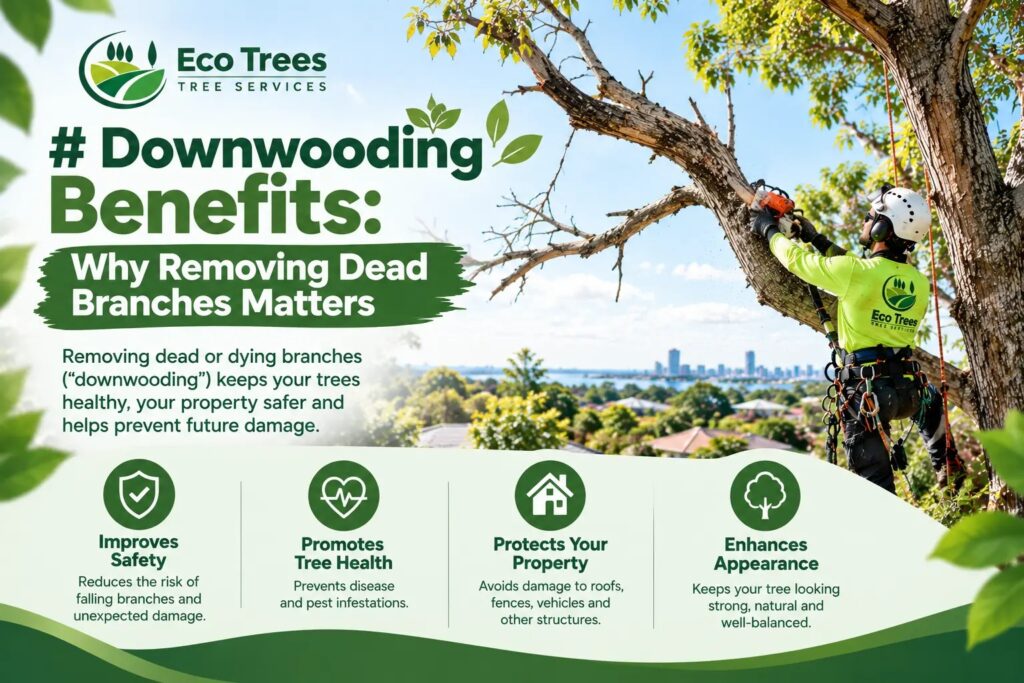
Downwooding Benefits: Why Removing Dead Branches Matters
The main benefit of downwooding, more commonly called deadwooding, is removing dead, dying or decaying branches that may become a safety hazard while helping you manage the condition and structure of your tree.
At Eco Tree Services, I see plenty of homeowners who assume a few dead branches are nothing to worry about. Sometimes they are not. But when deadwood is large, positioned over a roof, driveway, pathway or play area, or weakened further by Brisbane’s storms and strong winds, it deserves proper attention.
There is another important point that often gets missed: not every piece of dead wood needs to be removed simply because it is dead. In natural environments, dead wood can provide habitat for insects, fungi, birds and other wildlife. The decision is about where the deadwood is, how hazardous it is and what role it plays in the surrounding environment.
That is why I look at deadwooding as part of overall tree management rather than simply cutting off anything that looks brown.
What Is Downwooding and How Is It Different From Deadwooding?
Skimable summary: Downwooding is commonly used to describe the removal of dead or dying branches, but deadwooding is the more established arboricultural term. The work focuses specifically on dead, damaged or declining branches rather than reducing the entire tree.
If you searched for downwooding benefits, you may actually be looking for information about deadwooding.
In professional arboriculture, deadwooding means identifying and removing dead, dying or decaying branches from a tree. Eco Tree Services provides deadwooding as part of professional tree safety and maintenance work in Brisbane.
The purpose is not to reshape the entire tree.
Instead, I focus on branches that have become:
- Completely dead
- Severely damaged
- Broken or hanging
- Decayed
- Structurally weak
- Likely to become a falling-branch hazard
Our existing deadwooding service explains why removing dead branches can support tree safety and management.
The distinction matters because deadwooding is only one type of pruning. A tree may also need crown thinning, crown reduction, crown lifting or other forms of structural pruning depending on its condition.
What Are the Main Downwooding Benefits?
Skimable summary: The biggest downwooding benefits are improved safety, reduced risk from falling dead branches, better visibility of tree defects and more controlled tree maintenance.
When I assess a tree for deadwooding, I am not looking at appearance alone. I am considering the condition of the branches and what could happen if one fails.
The main benefits include:
1. Reduced risk from falling dead branches
Dead branches can become brittle as they deteriorate. Their failure can damage roofs, vehicles, fences, gardens or other property.
The risk becomes more important when the branch is positioned above an area people regularly use.
2. Better tree safety management
Removing hazardous deadwood can reduce the number of loose or unstable branches within the canopy.
It does not make a tree completely risk-free, but it can remove specific hazards that should not remain over a target area.
3. Easier identification of structural problems
Once an arborist looks closely through the canopy, they may identify other issues such as weak unions, cracks, decay or damaged limbs.
That can help determine whether the tree needs further pruning or a more detailed assessment.
4. Improved appearance
Dead branches can make an otherwise healthy tree look neglected.
Removing appropriate deadwood can clean up the canopy while maintaining the tree’s natural form.
5. Better long-term maintenance
Regular tree inspections and appropriate pruning allow problems to be identified before they become much harder to manage.
This is particularly useful for established trees around residential properties.
Does Removing Dead Wood Improve Tree Health?
Skimable summary: Deadwooding can support healthy tree management by removing dead or damaged branches, but it does not automatically make a sick tree healthy. The tree’s overall condition must be assessed first.
This is one of the biggest misconceptions I come across.
Removing dead branches is useful, but I would never tell a homeowner that deadwooding alone will cure an unhealthy tree.
A tree can have dead branches for many reasons, including natural ageing, storm damage, disease, pests, shading or structural decline.
The important question is why the branch died and whether there are other signs of decline.
For example, if one large branch has died after storm damage but the rest of the tree looks structurally sound, selective deadwood removal may be all that is needed.
If I find extensive deadwood together with trunk decay, major cracks, root problems or significant canopy decline, I would look at the entire tree rather than treating the dead branches as an isolated problem.
This is why professional assessment matters.
Our guide on signs your tree needs removing explains why extensive deadwood can sometimes be one part of a much larger structural problem.
How Does Downwooding Improve Tree Safety?
Skimable summary: Downwooding improves tree safety by removing selected dead, broken or hazardous branches that could fall onto people, buildings, vehicles or other property.
A dead branch does not need to be enormous to cause a problem.
A smaller branch falling onto a person or vehicle can still cause injury or damage. A large dead limb, however, can create a much more serious hazard.
I pay particular attention to deadwood located above:
- Roofs
- Driveways
- Footpaths
- Outdoor entertaining areas
- Swimming pools
- Children’s play areas
- Cars and parking areas
- Frequently used garden spaces
- Neighbouring structures
Brisbane’s weather makes this even more relevant. Wind and storms can place additional stress on already weakened branches.
That does not mean every tree needs aggressive pruning before storm season. It means obvious hazards should not be ignored.
Can Downwooding Help During Brisbane’s Storm Season?
Skimable summary: Deadwooding can reduce some branch-related hazards before severe weather, but it cannot guarantee that a tree will withstand a major storm.
I would never describe deadwooding as storm-proofing a tree.
Storms can break healthy branches, uproot trees and cause damage that no amount of routine pruning can completely prevent.
What deadwooding can do is remove certain existing hazards before severe weather arrives.
At Eco Tree Services, we regularly talk about proactive tree maintenance because Brisbane’s wet and stormy conditions can expose weak branches and structural problems.
Our article on the real cost of ignoring tree maintenance during Queensland’s wet season explains why routine pruning, deadwooding and hazard assessments can be valuable before problems become urgent.
The key is timing.
If you already have a large dead branch hanging over your house, waiting for the next storm is not a sensible maintenance strategy.
Does Downwooding Make Trees Look Better?
Skimable summary: Yes, appropriate deadwood removal can improve a tree’s appearance by clearing visibly dead and broken branches without unnecessarily reducing the healthy canopy.
There is a big difference between cleaning up deadwood and heavily cutting a tree because someone wants it to look smaller.
I prefer the first approach.
A healthy tree should still look like a healthy tree after pruning. Its natural structure should remain visible, and the live canopy should not be unnecessarily stripped away.
If a homeowner tells me, “I just want the tree tidied up,” I first work out what that actually means.
Sometimes the answer is deadwooding.
Sometimes the tree needs crown thinning.
Sometimes branches need lifting away from a building or pathway.
And sometimes pruning is not the right answer at all.
How Is Downwooding Different From Tree Pruning and Tree Trimming?
Skimable summary: Deadwooding targets dead, dying and hazardous branches, while general tree pruning and tree trimming can involve managing live branches for structure, clearance, health and canopy management.
People often use tree pruning and tree trimming as if they mean exactly the same thing.
In everyday conversation, that is understandable. In professional tree care, however, the reason for the cut matters.
Deadwooding:
Removes dead, dying, damaged or hazardous branches.
Crown thinning:
Selectively reduces canopy density while maintaining the tree’s natural form.
Crown reduction:
Reduces the overall size of the canopy by shortening selected branches back to appropriate growth points.
Crown lifting:
Removes or reduces lower branches to increase clearance beneath the canopy.
General tree pruning:
May combine several appropriate pruning techniques depending on the tree’s condition and the property’s requirements.
So when someone searches for the best tree pruning service, I would recommend choosing a company that first identifies what the tree actually needs rather than simply cutting branches because they are available.
Should You Remove Every Dead Branch From a Tree?
Skimable summary: No. Deadwood does not automatically need to be removed. Hazardous dead branches near people and property are a priority, while suitable deadwood in natural areas can provide important habitat.
This is where residential tree care gets interesting.
Dead wood has an ecological purpose.
Research and conservation organisations have documented how fallen and standing dead wood can provide habitat for insects, birds, mammals, fungi and other organisms. Decomposing wood also contributes to nutrient cycling and can help create conditions for new plant growth.
So I would not recommend removing every dead branch simply because it looks untidy.
The location matters.
A dead branch deep inside a natural area may have ecological value.
A large dead branch directly above your home’s roof is a different situation.
The Green Bay Botanical Garden also highlights that dead wood can support insects and wildlife, while Eco Tree Services focuses on removing deadwood where it creates safety and tree-management concerns.
For residential properties, the practical question is:
Does this deadwood create an unacceptable risk or interfere with how the property is used?
That is what I would assess before recommending removal.
When Should You Hire a Tree Pruning Company for Downwooding?
Skimable summary: Professional deadwooding is recommended when branches are high, large, unstable, difficult to access or located near buildings, powerlines, roads or areas people use.
This is one job where I strongly recommend professional help.
Dead branches can be unpredictable, particularly when they are high in the canopy.
You should consider calling a qualified tree pruning company if:
- Large dead branches are hanging above your home.
- Deadwood is positioned above a driveway or vehicle.
- Branches are close to powerlines.
- A branch is cracked, hanging or partially detached.
- The tree has suffered storm damage.
- You cannot safely reach the branches from the ground.
- You notice extensive deadwood throughout the canopy.
- You are unsure whether the tree needs pruning or removal.
At Eco Tree Services, our arborists are trained in tree work, including chainsaw use, tree health, pruning techniques and safety procedures. The company is also fully insured.
I would rather inspect a questionable branch before it becomes an emergency than have a homeowner discover the problem after it falls.
Is Downwooding Suitable for Small Trees?
Skimable summary: Yes, small trees can benefit from appropriate pruning, but young or small trees should not be over-pruned simply because the branches are easy to reach.
Pruning small trees can sometimes be useful because structural problems are easier to identify and manage while the tree is still developing.
But that does not mean every young tree needs regular cutting.
With a smaller tree, I am more interested in:
- Removing genuinely dead or damaged branches.
- Identifying competing or poorly positioned growth.
- Maintaining suitable structure.
- Preventing future clearance problems.
- Avoiding unnecessary cuts.
Early, sensible maintenance can be easier than trying to correct a major structural problem years later.
However, the species, age, condition and location of the tree still matter.
What Should You Look For in the Best Tree Pruning Service?
Skimable summary: The best tree pruning service should provide qualified arborists, appropriate insurance, a clear assessment, safe pruning methods and a recommendation based on the tree rather than a one-size-fits-all approach.
Price should not be the only thing you compare.
When I recommend choosing a professional tree service, I suggest looking for:
Qualifications
Ask who will actually carry out the work and what arboricultural training they have.
Insurance
Tree work involves real risks to people and property. Make sure the company carries appropriate insurance.
Clear assessment
A good arborist should explain what they are removing and why.
Appropriate pruning
The objective should be to solve the tree’s problem without unnecessarily removing healthy growth.
Safety planning
This becomes particularly important for large trees, difficult access, elevated work and trees close to structures or powerlines.
Clear written quote
You should know what is included in the work before the job starts.
Eco Tree Services also recommends checking qualifications, insurance, reviews and obtaining a detailed written quote when hiring an arborist.
What Are the Most Important Downwooding Benefits to Remember?
Skimable summary: Downwooding is most valuable when it removes hazardous deadwood, improves tree safety and forms part of a wider professional tree-care plan.
The biggest mistake is thinking that downwooding is simply about making a tree look cleaner.
For me, the priority is always safety and sensible tree management.
Removing appropriate deadwood can:
- Reduce the risk of falling branches.
- Remove damaged or deteriorating limbs.
- Improve visibility through the canopy.
- Support proactive tree maintenance.
- Improve the appearance of a tree.
- Help identify other structural problems.
- Reduce potential hazards around homes and other occupied areas.
But deadwood also has ecological value, so removal should be targeted rather than excessive.
If you have a tree with dead branches that you are unsure about, I recommend having it assessed before deciding whether it needs deadwooding, general pruning or something more substantial.
At Eco Tree Services, we provide professional tree pruning and maintenance in Brisbane with a focus on safety, tree health and practical solutions for residential and commercial properties.
If you are concerned about dead, damaged or potentially hazardous branches, contact Eco Tree Services for a professional assessment and free quote.
Frequently Asked Questions About Downwooding Benefits
What are the benefits of downwooding?
Downwooding can improve tree safety by removing dead, dying, damaged or hazardous branches. It can also improve the tree’s appearance and help an arborist identify other structural problems within the canopy.
For example, if a dead branch is hanging over a driveway, removing that specific hazard can reduce the risk of it falling onto a vehicle. It does not mean the whole tree needs to be heavily pruned.
What is downwooding?
Downwooding generally refers to removing dead, dying or damaged branches from a tree and is more commonly called deadwooding by arborists. The work focuses on selected branches rather than reducing the entire tree.
At Eco Tree Services, we assess the branch and the surrounding area before deciding what should be removed.
Is downwooding the same as deadwooding?
In most tree-care contexts, downwooding is referring to deadwooding, although deadwooding is the more established professional term. Both describe the targeted removal of dead or declining branches.
If you are searching for “downwooding benefits”, “deadwooding benefits” or “deadwood removal”, you are generally looking for the same type of tree-care information.
Does deadwooding help a tree grow?
Deadwooding can support good tree management, but removing dead branches does not automatically make a tree grow faster. The main purpose is to remove dead or hazardous material and manage the tree safely.
For example, if a mature tree has one dead limb over a pathway, removing that limb addresses the safety issue without unnecessarily interfering with the rest of the healthy canopy.
Can dead branches be left on a tree?
Yes, some dead branches can be left when they do not create an unacceptable safety risk and have ecological value. Deadwood can provide habitat and food for insects, fungi and wildlife.
The situation changes when the branch is large, unstable or positioned above people, buildings or vehicles. That is when professional assessment becomes important.
How often should trees be deadwooded?
There is no universal deadwooding schedule because the frequency depends on the tree species, age, condition, location and amount of deadwood. Some trees may need occasional inspection, while trees in high-use areas may require more regular monitoring.
I recommend assessing the tree rather than automatically booking deadwooding every year.
Is deadwooding safe to do yourself?
Deadwooding is not always safe as a DIY job, especially when branches are large, high, unstable or close to buildings and powerlines. Even a dead branch can be unpredictable when it breaks or falls.
A branch that looks simple from the ground can behave very differently once it is cut. That is why professional equipment, climbing techniques and proper assessment matter.
Does downwooding prevent storm damage?
Downwooding can reduce the risk associated with some dead or hazardous branches, but it cannot prevent all storm damage. Severe storms can break healthy branches, uproot trees and cause structural failures.
The best approach is proactive tree assessment and appropriate maintenance before problems become urgent. Eco Tree Services discusses this approach in its guide to tree maintenance during Queensland’s wet season.