How Arborists Remove Trees Safely | Eco Tree Services
Arborists remove trees safely by first assessing the tree, identifying hazards, choosing the right removal method and controlling branches and trunk sections as they are cut. Depending on the location, they may use climbing equipment, ropes, rigging systems, lowering devices and specialised machinery to prevent damage to people and property.
I understand why tree removal can look simple from the ground. You see a tree that needs to come down, a chainsaw, a few cuts and what appears to be a straightforward job.
In reality, removing a mature tree safely can involve significant planning.
An arborist needs to understand how the tree is structured, where its weight is distributed, whether it has internal decay, how stable its roots are and what could be damaged if a branch or trunk section falls unexpectedly.
The removal method also changes depending on the property. A tree standing in an open area may allow controlled felling, while a tree growing beside a house may need to be dismantled piece by piece.
That is why professional tree removal focuses on control, planning and risk management from the first assessment through to the final cleanup.
How do arborists remove trees safely?
Arborists remove trees safely by inspecting the tree, assessing site hazards, planning the removal sequence, selecting suitable equipment and lowering or controlling sections instead of allowing them to fall uncontrolled.
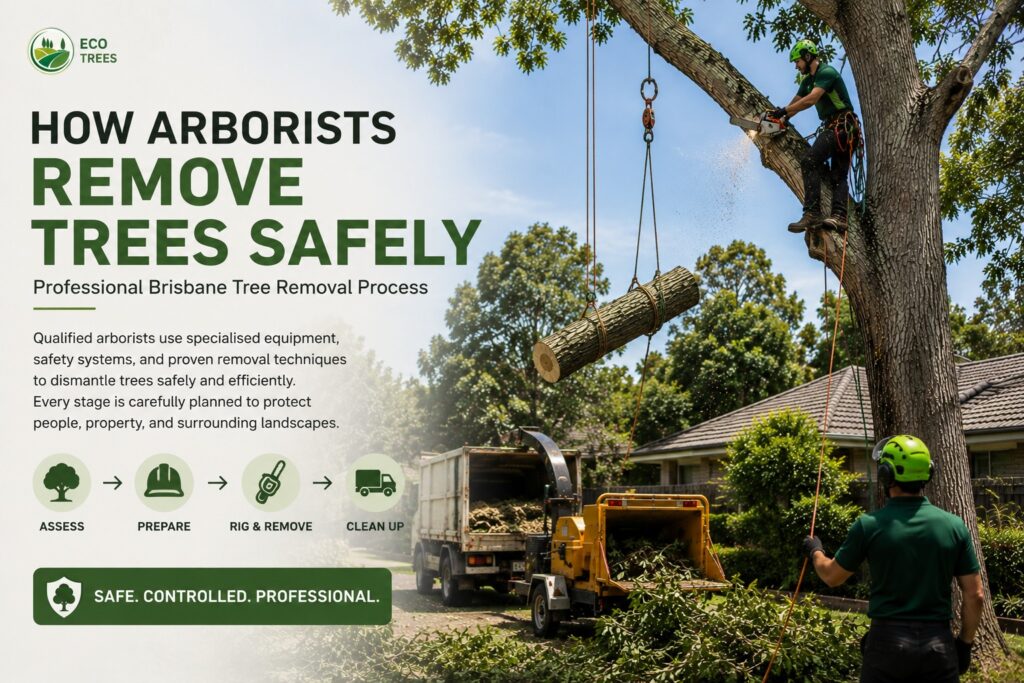
The exact process depends on the tree and property, but a professional removal commonly follows these stages:
- Assess the tree and site.
- Identify hazards and potential fall zones.
- Determine the safest removal method.
- Establish an exclusion zone.
- Set up climbing, rigging and other equipment where required.
- Remove branches and sections in a controlled sequence.
- Lower larger sections safely.
- Process and remove timber and branches.
- Grind or remove the stump if requested.
- Clean the work area.
The important point is that arborists don’t use one removal method for every tree.
A small tree in an open yard can be very different from a large tree growing over a roof, pool or driveway.
Safe tree removal involves assessment, planning, controlled cutting, appropriate equipment, exclusion zones, branch and trunk management, waste removal and site cleanup. Arborists choose the removal method according to the tree and surrounding hazards.
What does an arborist check before removing a tree?
Before removing a tree, an arborist assesses its size, species, structure, condition, lean, root stability, surrounding hazards and access to determine how the job can be completed safely.
This initial assessment is one of the most important parts of the process.
Tree size and structure
The arborist looks at the height, trunk diameter, canopy spread and branch structure. These factors help determine how much material needs to be removed and how it can be controlled.
Natural lean
A tree’s natural lean can affect how it behaves during removal. The arborist considers whether the tree is leaning toward a building, fence, road or other structure.
Tree health and decay
Deadwood, cavities, cracks, fungal growth and other defects can indicate structural problems.
A damaged tree may require a different approach because its branches or trunk may not behave predictably.
Root stability
Exposed, damaged or compromised roots can affect the stability of the entire tree.
Surrounding structures
The arborist identifies nearby:
- Houses
- Garages
- Fences
- Vehicles
- Swimming pools
- Sheds
- Roads
- Footpaths
- Neighbouring properties
Power infrastructure
Electrical lines and other utilities require special consideration because falling branches can create serious hazards.
Site access
The arborist also considers whether equipment can reach the work area and whether branches and timber can be removed efficiently.
Before cutting, arborists assess tree size, structure, health, roots, lean, surrounding buildings, power infrastructure and site access. This assessment determines the safest removal strategy.
Why do arborists assess the tree before cutting it?
Arborists assess the tree before cutting because its structure and surrounding environment determine how the tree will behave during removal.
A common mistake is to assume that a tree will simply fall in the direction you want.
Trees don’t always behave that way.
Uneven canopy weight, natural lean, internal decay, wind and root damage can all affect movement.
For example, a tree may look relatively straight from the ground but have most of its canopy extending toward a house. That changes the risk assessment and removal strategy.
An experienced arborist looks at the whole tree rather than focusing only on the trunk.
This is one reason expert tree removal requires more than chainsaw operation.
Tree assessment allows arborists to identify structural defects, weight distribution, lean, root problems and surrounding hazards before cutting begins. This information determines how the tree can be dismantled safely.
How do arborists choose the safest removal method?
Arborists choose the removal method according to the tree’s size, condition, location, access and surrounding hazards. There is no single technique that works for every tree.
Sectional dismantling
When a tree stands close to structures, arborists may remove it in sections rather than felling the entire tree.
Branches are removed first, followed by larger sections of the trunk.
This gives the crew greater control over where material goes.
Controlled lowering
Large branches or trunk sections can be lowered using ropes and rigging systems rather than allowing them to fall freely.
This becomes particularly important when the tree is positioned over a roof, driveway or pool.
Controlled felling
If there is sufficient open space and the tree’s condition allows it, the arborist may be able to fell the tree in a controlled direction.
This method is not appropriate for every site.
Specialist equipment
Some trees require additional equipment because of their size, location or complexity.
A professional specialist tree removal service can determine what equipment and removal method the site requires.
Arborists may use sectional dismantling, controlled lowering, controlled felling or specialist equipment depending on the site’s risks. The safest method is the one that provides adequate control over every part of the removal.
What equipment do arborists use to remove trees safely?
Professional tree removal can require chainsaws, climbing equipment, ropes, rigging systems, lowering devices, wood chippers, stump grinders and specialised access equipment.
The equipment depends on the job.
Common equipment includes:
- Chainsaws
- Climbing harnesses
- Helmets and protective equipment
- Climbing ropes
- Rigging ropes
- Pulleys
- Lowering devices
- Wood chippers
- Stump grinders
- Elevated work platforms
- Specialist lifting equipment
The important point is that professional equipment must be used correctly.
For example, a rigging system is not simply a rope tied around a branch. The arborist needs to understand the load, anchor points, rope angles, branch structure and lowering process.
This allows heavy sections to be controlled instead of dropped.
Arborists use specialised cutting, climbing, rigging, lowering, chipping and stump-removal equipment according to the tree and site. Equipment selection and correct operation are both essential for safe removal.
How do arborists control falling branches?
Arborists control falling branches by planning the removal sequence and using ropes, rigging and lowering systems when branches cannot safely fall to the ground.
This is particularly important in residential properties.
Imagine a large branch hanging above a roof.
Allowing it to fall naturally could damage tiles, gutters, windows or other structures.
Instead, the arborist can position the cutting point and use a controlled lowering system to guide the branch down.
The process may involve:
- Establishing a secure rigging point.
- Attaching the branch or section appropriately.
- Setting up the lowering system.
- Making the planned cut.
- Controlling the descent.
- Moving the material away from the work zone.
This controlled approach is one of the major differences between professional tree removal and DIY cutting.
Arborists use planned cuts and rigging systems to control branches and trunk sections. Controlled lowering helps prevent heavy material from falling onto roofs, vehicles, fences, pools or other property.
How do arborists safely remove a tree near a house?
Arborists usually dismantle trees near houses in controlled sections rather than allowing the entire tree to fall freely.
The closer the tree is to a structure, the less room there is for error.
Before starting, the arborist identifies potential impact areas and determines where each section can safely be placed.
Depending on the situation, the crew may:
- Remove smaller branches first.
- Reduce the canopy.
- Use climbing equipment.
- Rig larger branches.
- Lower trunk sections.
- Protect surrounding surfaces.
- Maintain an exclusion zone.
For example, a large tree growing beside a Brisbane home may have branches extending over the roof. Removing those branches requires more control than removing a tree in an open field.
This is why residential tree removal should be treated as a specialist task.
Trees near houses require controlled dismantling because there is limited space for falling material. Arborists remove branches and trunk sections progressively and use rigging when necessary to protect buildings.
Not sure which tree removal method your property needs?
Every tree and site is different. Get your tree assessed by an experienced Brisbane arborist and find out whether you need pruning, maintenance, complete removal or stump grinding.
Request a Free Tree Removal Quote
How are trees removed near power lines?
Trees near power lines require specialised safety procedures and should not be treated as ordinary tree-removal jobs.
Electrical infrastructure creates a serious hazard because branches, tools and equipment can come into contact with conductors.
The arborist must assess:
- Distance from electrical lines
- Branch movement
- Tree lean
- Equipment positioning
- Access
- Potential fall paths
- Applicable electrical safety requirements
If electrical infrastructure is involved, the work may require coordination with the relevant utility provider or appropriately authorised professionals.
As a homeowner, don’t attempt to cut a tree or branch that is touching or dangerously close to power lines.
Trees near power lines require specialised assessment and electrical safety procedures. Homeowners should not attempt DIY cutting around electrical infrastructure because unexpected movement can create serious hazards.
What happens when a tree is unstable, diseased or storm damaged?
Arborists change the removal strategy when a tree is unstable, diseased or storm damaged because its structure may not respond predictably to normal cutting techniques.
Storm damage is a good example.
A tree may have:
- Split branches
- Broken limbs
- A damaged trunk
- Uprooted roots
- Hanging branches
- Severe lean
The tree may already be under structural stress.
An arborist therefore needs to identify which sections can be safely approached and removed first.
In some cases, the priority is to remove an immediate hazard before completing the remaining work.
If a storm-damaged tree creates an immediate danger, an emergency tree removal service may be required.
Damaged, diseased and unstable trees require additional assessment because their structure may be unpredictable. Arborists adjust the removal sequence and equipment to manage these increased risks.
How do arborists protect your property during tree removal?
Arborists protect property by controlling where branches and trunk sections go, establishing exclusion zones and planning the removal around nearby structures.
Property protection starts before the first cut.
The crew considers:
- Roofs
- Walls
- Windows
- Vehicles
- Fences
- Pools
- Gardens
- Driveways
- Underground and overhead infrastructure
They may also move vehicles or other movable items away from the work zone.
The removal sequence is then designed to minimise unnecessary impact.
This is particularly important when a tree has limited fall space.
A professional tree removal company should explain these considerations before work begins rather than simply arriving and starting the chainsaw.
Property protection involves planning the drop zone, controlling branches and timber, establishing exclusion areas and considering surrounding structures before cutting begins.
Do arborists remove the stump and roots too?
Standard tree removal does not always include complete stump and root removal. These are usually treated as separate services depending on what the homeowner needs.
After removing the tree, the stump can remain in the ground.
If you want the area cleared for landscaping, paving or construction, stump grinding may be appropriate.
A tree stump removal service can deal with the remaining stump according to the site’s requirements.
Complete root removal is different.
If you need to remove tree and roots because you’re preparing the area for construction, explain this before the removal begins.
In many residential situations, grinding the stump below ground level is more practical than attempting to excavate every root.
Tree removal, stump grinding and complete root removal are separate considerations. Tell the arborist what you plan to do with the area so they can recommend the appropriate level of removal.
Is tree removal always necessary?
No, tree removal is not always necessary. Some trees can remain safely in place with appropriate pruning, maintenance or other arboricultural treatment.
This is an important part of professional tree assessment.
For example, a healthy tree may have several dead branches over a driveway.
Removing the entire tree may be unnecessary if selective pruning can eliminate the hazard.
This is where experienced tree pruning and removal services can help determine the appropriate option.
Pruning may be suitable when:
- The tree is healthy.
- Only certain branches are damaged.
- Clearance is the main problem.
- The canopy needs selective reduction.
- Deadwood needs removal.
Removal may be more appropriate when:
- Structural decay is severe.
- Root stability has been compromised.
- Major defects cannot be managed.
- Storm damage has made the tree unsafe.
- The tree presents an unacceptable ongoing risk.
A professional assessment should focus on solving the actual problem rather than automatically recommending removal.
Not every problematic tree needs to be removed. Professional assessment can determine whether pruning or maintenance can resolve the issue while preserving a healthy and structurally sound tree.
When should you hire a specialist tree removal service?
You should hire a specialist tree removal service when a tree is large, unstable, damaged, near structures or power lines, difficult to access or requires climbing and specialised equipment.
Professional assistance is especially important when you notice:
Significant leaning
A tree that has developed a noticeable lean can require assessment before any cutting begins.
Major cracks
Large cracks in the trunk or major branches can indicate structural weakness.
Extensive decay
Cavities, fungal growth and deteriorating wood can affect stability.
Root damage
Exposed or damaged roots can compromise the tree’s support.
Storm damage
Broken limbs and split trunks can create immediate hazards.
Restricted access
If the tree is surrounded by structures or there is limited space for falling material, controlled dismantling may be required.
Experienced Brisbane tree experts can assess the site and determine the safest approach.
Specialist tree removal is appropriate for large, unstable, damaged, restricted-access or high-risk trees. Professional assessment helps determine the safest removal method and equipment.
What happens after the tree is removed?
After the tree is dismantled, the crew processes the branches and timber, removes or manages the waste and cleans the work area according to the agreed scope.
The final stage can include:
- Branch chipping
- Timber removal
- Leaf and debris cleanup
- Stump grinding
- Surface cleanup
- Final safety inspection
Ask what is included in your quote before work begins.
Some companies may include complete waste removal while others may leave timber or mulch on site.
If you’re comparing a trees removal company, make sure you compare the complete scope rather than only the removal component.
Post-removal work can include chipping, timber disposal, stump grinding and site cleanup. Confirm these services in the quote so you know exactly what will happen after the tree comes down.
How does regular tree maintenance reduce removal risks?
Regular tree maintenance can identify deadwood, structural defects and other problems before they become major hazards.
This does not mean maintenance can prevent every tree failure.
However, regular inspections and appropriate pruning can help identify problems earlier.
For example, removing large dead branches before severe weather may reduce the risk of those branches falling during a storm.
When considering tree maintenance cost, also consider the potential cost of emergency work, property damage and unexpected tree failure.
Maintenance is not about cutting as much of the tree as possible. Good tree care focuses on removing what needs to be removed while preserving healthy structure.
Regular tree maintenance can identify potential hazards early and address certain problems through appropriate pruning. Preventive care can be more manageable than responding to avoidable emergency tree issues.
How do arborists remove a tree step by step?
Professional tree removal follows a planned sequence that prioritises assessment, controlled dismantling, property protection and safe cleanup.
Step 1: Assess the tree
The arborist evaluates the tree’s structure, condition, size and surroundings.
Step 2: Identify hazards
The crew identifies power lines, buildings, vehicles, public areas, access restrictions and other risks.
Step 3: Plan the removal
The arborist determines the safest removal sequence and selects appropriate equipment.
Step 4: Establish the work zone
People and unnecessary equipment are kept away from the area.
Step 5: Remove branches
Smaller branches are removed progressively according to the planned sequence.
Step 6: Control larger sections
Rigging and lowering systems may be used where sections cannot safely fall.
Step 7: Remove the trunk
The remaining trunk is dismantled or felled according to the site conditions.
Step 8: Process and remove debris
Branches can be chipped and timber removed according to the agreed scope.
Step 9: Deal with the stump
Stump grinding or additional removal can be completed if requested.
Step 10: Clean the site
The work area is cleared and checked before the crew leaves.
Safe tree removal follows a structured process from assessment and hazard identification through controlled dismantling, debris management, stump treatment and final cleanup.
What should you ask an arborist before tree removal?
Ask the arborist what removal method they recommend, what hazards they have identified and exactly what the quote includes.
Before approving the work, ask:
- Does the tree actually need removal?
- Could pruning solve the problem?
- What removal method will you use?
- Will rigging be required?
- How will you protect nearby structures?
- Is waste disposal included?
- Is stump grinding included?
- Are there additional equipment charges?
- Is the company appropriately insured?
- Are council requirements relevant?
- What happens if unexpected damage or decay is discovered?
A professional should be able to explain the process clearly.
You should never feel pressured to approve a tree removal job without understanding what is involved.
Conclusion: How do arborists remove trees safely?
Arborists remove trees safely through assessment, planning, controlled cutting, appropriate equipment and careful management of every branch and trunk section.
The biggest difference between professional tree removal and simply cutting down a tree is control.
Arborists don’t just ask, “How do we make this tree fall?”
They ask:
- Where can each section safely go?
- What could it hit?
- Is the tree structurally sound?
- Can the tree be retained through pruning?
- What equipment is required?
- How will the crew control heavy sections?
- What happens if the tree behaves unexpectedly?
- How will the property be protected?
If you have a large, damaged, unstable or difficult-to-access tree in Brisbane, professional assessment is the safest place to start.
Eco Tree Services can assess the tree and help determine whether you need pruning, maintenance, complete removal, stump grinding or emergency assistance.
Need a tree removed safely in Brisbane?
Don’t leave a hazardous, unstable or difficult-to-access tree to chance. Contact Eco Tree Services for professional tree assessment and removal.
FAQs
How do arborists remove trees safely?
Arborists remove trees safely by assessing the tree, identifying hazards, planning the removal sequence and controlling branches and trunk sections during dismantling. For example, a tree beside a house may need to be removed piece by piece with rigging instead of being felled in one section.
Do arborists always cut trees down from the bottom?
No, arborists do not always fell a tree from the ground. When a tree is near a building, fence or other structure, the arborist may climb the tree and dismantle it progressively from the top down. This gives the crew greater control over where branches and trunk sections go.
How do arborists remove trees near houses?
Arborists generally dismantle trees near houses in controlled sections to reduce the risk of property damage. For example, branches over a roof may be lowered using rigging rather than dropped directly onto the building.
How do arborists control falling branches?
Arborists use planned cuts, ropes, rigging and lowering systems to control branches when they cannot safely fall freely. A heavy branch above a driveway can be attached to a controlled lowering system so the crew can manage its descent.
Can arborists remove trees near power lines?
Trees near power lines require specialised safety procedures and should not be treated as ordinary tree-removal work. The arborist must assess the electrical hazard, branch movement, equipment positioning and applicable safety requirements before work begins.
Can a tree be removed without damaging the surrounding property?
Yes, professional tree removal can significantly reduce property-damage risks through controlled dismantling and careful planning. For example, when a tree is beside a swimming pool, the crew can plan the removal sequence and control branches rather than allowing them to fall freely.
Do arborists remove tree roots?
Standard tree removal does not usually include complete root removal. If you need to clear the area for construction or landscaping, discuss your requirements with the arborist because stump grinding or targeted root removal may be more appropriate than excavating the entire root system.
Does tree removal include stump grinding?
Not always; stump grinding is commonly treated as a separate service. If you want the remaining stump removed after the tree is cut down, ask for stump grinding to be included in the quote.
Is professional tree removal worth the cost?
For large, hazardous or difficult-to-access trees, professional removal can provide significantly better safety and property protection than attempting the work yourself. The cost also needs to be compared with equipment hire, waste disposal, time and the potential cost of property damage from an unsuccessful DIY removal.
How often should trees be maintained?
Tree maintenance should be based on the tree’s species, age, condition, location and surrounding risks rather than one fixed schedule. A professional assessment can identify whether pruning or other maintenance is required and help prevent minor problems from becoming larger hazards.
When should I call an emergency tree removal service?
Call for professional emergency assistance when a tree has fallen, partially uprooted or created an immediate risk to people or property. Storm-damaged trees can be unstable, so homeowners should avoid climbing them or attempting to cut suspended branches themselves.
How do I choose a tree removal company?
Choose a company based on experience, appropriate insurance, safety procedures, equipment, clear pricing and the scope of work rather than price alone. A professional company should explain how it plans to remove the tree and what happens to the branches, timber and stump afterward.