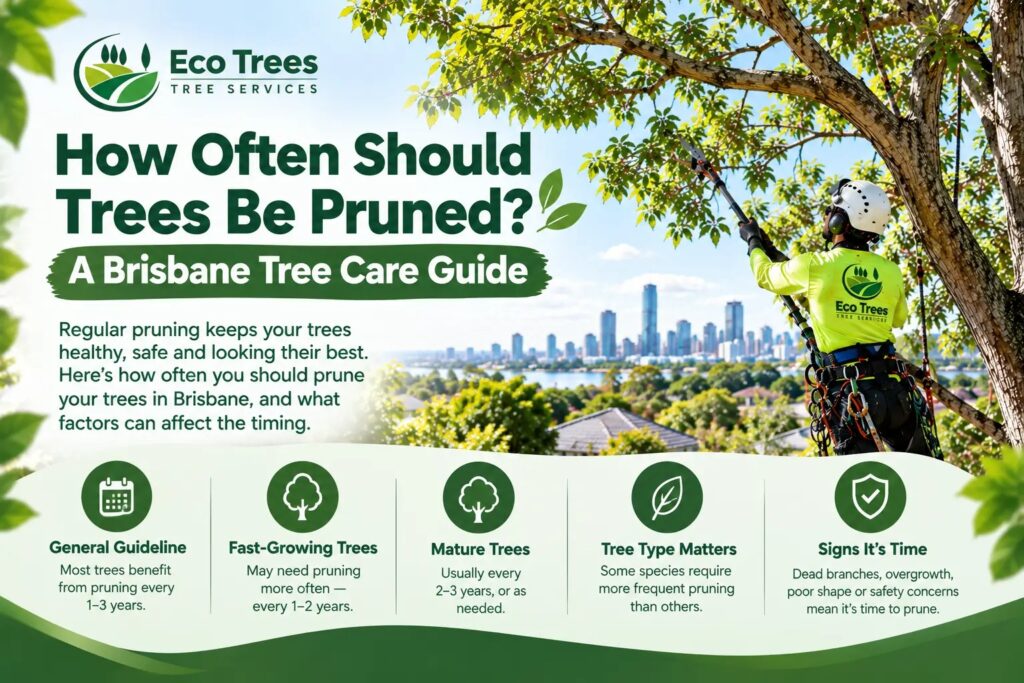
How Often Should Trees Be Pruned? A Brisbane Tree Care Guide
There is no single pruning schedule that works for every tree. In general, mature trees may only need pruning every 3–5 years, while younger trees can need attention more often, but species, health, growth rate, location and safety risks can change that timeline.
I get this question regularly from Brisbane homeowners: “How often should trees be pruned?”
The simple answer is that you should not prune a tree simply because a certain number of months has passed.
A healthy mature tree that has been well maintained may go several years between major pruning work. A young tree may need more regular formative pruning. A storm-damaged tree, tree with dangerous deadwood or tree growing into powerlines may need attention much sooner.
That is why I look at the tree first rather than putting every property on the same pruning schedule.
How Often Should Trees Be Pruned?
Skimable summary: Most mature trees do not need heavy pruning every year. A 3–5 year cycle can be a useful general guide for many mature trees, while young trees may need attention every 2–3 years. However, tree species, condition, location and the reason for pruning should determine the actual schedule.
As a general starting point, many mature trees can be assessed and selectively pruned every 3–5 years.
Younger trees may benefit from formative pruning approximately every 2–3 years, particularly while their structure is developing. These ranges are also reflected in established tree-care guidance, but they should be treated as general guidelines rather than rules.
There are plenty of exceptions.
For example, a fruit tree grown for production may require more regular pruning. A tree that has suffered storm damage may need immediate attention. A tree growing close to a house may need pruning for clearance even if it was pruned recently.
And dead or broken branches are a separate issue.
If a large branch has broken and is hanging over your roof, I would not tell you to wait another two years because your last pruning was recent.
The condition and risk of the tree matter more than the calendar.
What Factors Determine How Often a Tree Needs Pruning?
Skimable summary: Pruning frequency depends mainly on the tree’s species, age, health, growth rate, structure, location, previous maintenance and the reason you want it pruned.
When I assess a tree, I consider several things before recommending a pruning schedule.
Tree species
Different species grow at different rates and respond differently to pruning.
Some trees naturally develop dense canopies and may need more management. Others grow more slowly and can go longer between pruning.
This is one reason copying your neighbour’s pruning schedule is not necessarily a good idea.
Tree age
Young trees often need formative pruning to help establish good structure.
Mature trees usually need more selective maintenance rather than frequent heavy pruning.
Tree health
A healthy tree with a balanced structure is different from a tree showing disease, decay, deadwood or storm damage.
If the tree has obvious defects, I would assess those issues before deciding how often routine pruning should occur.
Location
A tree in the middle of a large backyard has different pruning requirements from a tree growing beside a house.
Location becomes particularly important where branches overhang:
- Roofs
- Driveways
- Footpaths
- Outdoor entertaining areas
- Vehicles
- Neighbouring properties
- Powerlines
Previous pruning
A tree that has been repeatedly over-pruned can respond differently from one that has been managed correctly over many years.
I always want to understand what has already been done before recommending more cuts.
How Often Should Mature Trees Be Pruned?
Skimable summary: Many mature trees can be maintained on a 3–5 year pruning cycle, but this depends on species, health, structure and location. Mature trees generally benefit from selective pruning rather than routine heavy cutting.
For many mature trees, every 3–5 years is a reasonable starting point for professional assessment and pruning, provided there are no urgent defects.
That does not mean I expect every mature tree to receive a major prune every three years.
Sometimes the right answer is simply to inspect the tree and leave it alone.
If the canopy is healthy, structurally sound and not causing clearance or safety problems, unnecessary pruning can create more problems than it solves.
The objective should be to remove what needs removing while preserving as much healthy canopy as possible.
Eco Tree Services provides tree pruning and maintenance in Brisbane using techniques such as crown thinning, crown lifting, crown reduction and deadwood removal depending on the tree’s needs.
Do Young Trees Need More Frequent Pruning?
Skimable summary: Young trees can need more frequent formative pruning than mature trees because early structural problems are easier to correct before branches become large and difficult to manage.
I actually prefer dealing with structural issues while a tree is young.
A small branch that is poorly positioned today can become a large structural problem several years later.
With young trees, pruning may focus on:
- Developing a strong branch structure
- Removing damaged growth
- Managing competing branches
- Maintaining suitable clearance
- Correcting structural problems early
- Avoiding unnecessary canopy removal
This is different from heavily cutting a young tree simply because it has grown quickly.
The goal is to guide development, not continually reduce the tree.
That is why pruning small trees should still be done with a clear reason behind every cut.
How Often Should Small Trees Be Pruned?
Skimable summary: Small trees do not automatically need frequent pruning. Their size makes them easier to access, but pruning should still be based on species, structure, health and future growth.
One mistake I see is assuming that small trees are safer to prune simply because the branches are within reach.
They may be easier to access, but poor cuts can still affect the tree as it grows.
With a smaller tree, I would rather make a few well-considered structural cuts than repeatedly trim the canopy.
For example, if a young tree has two competing leaders, dealing with the structural issue early may be worthwhile.
If it is simply growing normally with healthy branches and no clearance issue, there may be no reason to prune it yet.
This is particularly important for residential tree pruning, where homeowners sometimes want trees kept to an artificial size.
The better objective is usually to manage the tree’s structure and relationship with the property rather than continually fighting its natural growth.
Should Damaged or Diseased Trees Be Pruned More Often?
Skimable summary: Trees with storm damage, disease, significant deadwood or structural defects should be assessed when problems appear rather than waiting for their normal pruning cycle.
This is where a fixed pruning schedule can become dangerous.
Imagine a mature tree was professionally pruned 12 months ago.
A major storm then breaks two large branches.
I would not recommend waiting another two years because the tree was recently pruned.
The damaged branches need to be assessed based on their current condition.
Eco Tree Services’ storm-damage service specifically addresses fallen trees, broken hazardous limbs, tree stabilisation and storm debris because severe weather can create immediate tree hazards.
Similarly, extensive deadwood, serious decay, cracks or a dangerous lean may indicate that the tree needs a broader assessment rather than routine pruning.
Our guide to signs your tree needs removing explains why extensive deadwood, structural defects, root damage and storm damage can change the decision between pruning and removal.
What Is the Best Time of Year to Prune Trees in Brisbane?
Skimable summary: The best pruning time depends on the tree species and purpose of the work. Safety-related pruning should not be delayed simply because it is outside a preferred seasonal window.
You will often hear that winter is the best time to prune trees.
That can be true for certain trees and certain pruning objectives, but I would not apply it blindly to every tree in Brisbane.
The reference sources similarly emphasise that pruning timing depends on species, age, health and purpose, with dormant-season pruning often suitable for many trees.
In Brisbane, I would consider:
The tree species
Different species have different growth and flowering patterns.
The purpose of pruning
Structural pruning, deadwood removal, clearance pruning and canopy management do not necessarily have identical timing requirements.
The tree’s condition
Dead, broken or hazardous branches can require attention regardless of the season.
Brisbane weather
Heavy rain, storms and strong winds can change the urgency of tree maintenance.
The important point is that “winter is best” is not a substitute for assessing the actual tree.
Can You Prune Trees Too Often?
Skimable summary: Yes. Excessive pruning can remove too much healthy canopy, increase stress and interfere with the tree’s natural growth. Pruning should have a clear objective rather than follow an unnecessarily frequent schedule.
More pruning does not mean better tree care.
Every live branch that you remove has a consequence.
The tree relies on its leaves to produce energy through photosynthesis. Removing excessive healthy canopy can reduce that capacity and force the tree to respond to pruning wounds and new growth.
This is why I am cautious when someone asks for annual heavy pruning simply because the tree “gets too big.”
Sometimes the better solution is selective crown thinning, crown reduction or clearance pruning.
Other times, the tree may simply need to be left alone.
The aim is not to keep a tree permanently at the same size.
The aim is to manage it safely and appropriately for its location.
How Do You Know Your Tree Needs Pruning Now?
Skimable summary: Signs that a tree may need pruning include dead branches, broken limbs, branches interfering with structures, excessive canopy density, poor clearance and storm damage.
You do not necessarily need to be an arborist to identify signs that deserve attention.
Look for:
- Dead or broken branches
- Hanging limbs
- Branches touching the roof
- Growth interfering with powerlines
- Branches blocking driveways or paths
- Excessive growth around structures
- Dense or poorly structured canopy
- Storm-damaged branches
- Large branches with visible cracks
- Significant changes in the tree’s structure
One particularly important sign is new damage.
If the tree looked fine last month but a storm has left broken or hanging branches, that changes the situation.
Our article on the real cost of ignoring tree maintenance during Queensland’s wet season explains why proactive pruning, deadwooding and hazard assessments can help identify problems before severe weather turns them into bigger issues.
What Is the Difference Between Tree Pruning and Tree Trimming?
Skimable summary: Tree pruning is generally purposeful tree management focused on health, structure and safety, while tree trimming is a broader everyday term often used for cutting back unwanted growth.
People use tree pruning and tree trimming interchangeably, and that is understandable.
But when I assess a tree, I want to know what we are trying to achieve.
For example:
Deadwood removal focuses on dead or dying branches.
Crown thinning reduces canopy density selectively to improve light and airflow.
Crown lifting increases clearance beneath the canopy.
Crown reduction reduces canopy size while maintaining an appropriate structure.
Formative pruning helps develop better structure in younger trees.
So when someone searches for a tree pruning company, I recommend choosing a provider that can explain which pruning method is appropriate rather than treating every job as basic trimming.
When Should You Hire a Tree Pruning Company?
Skimable summary: A professional tree pruning company is particularly useful when trees are large, high, damaged, close to buildings or powerlines, difficult to access or showing structural problems.
There is a point where tree pruning stops being a simple garden task.
If you need a ladder to reach a branch, the tree is already telling you that professional equipment may be appropriate.
I strongly recommend professional assessment when:
- Branches are large or high.
- The tree is close to powerlines.
- Branches overhang a house.
- The tree has storm damage.
- You can see major cracks.
- There is extensive deadwood.
- The tree is leaning unexpectedly.
- You are unsure whether pruning or removal is appropriate.
- Access requires climbing or specialised equipment.
Eco Tree Services’ residential team handles everything from pruning and maintenance to deadwood removal, palm work, tree removal and stump grinding, including technically difficult climbing and tight-access situations.
How Do You Choose the Best Tree Pruning Service?
Skimable summary: The best tree pruning service should combine qualified arborists, appropriate insurance, safe equipment, a proper tree assessment and a clear explanation of the recommended work.
I would not choose a tree company based solely on the cheapest quote.
Before booking, look at:
Qualifications and experience
Ask whether qualified arborists will assess and perform the work.
Insurance
Tree work involves significant risks to people and property, so appropriate insurance matters.
Assessment
The company should be able to explain why specific branches need to be removed.
Pruning approach
Avoid companies that automatically recommend heavy cutting without explaining the objective.
Safety
Large trees, powerlines and difficult access require proper equipment and planning.
Eco Tree Services explains that professional arborists complete formal arboricultural training covering areas such as chainsaw use, tree health, Australian Standards and safe tree work.
What Is the Right Pruning Schedule for Your Tree?
Skimable summary: A practical pruning schedule starts with the individual tree rather than a fixed calendar. Mature trees may often need pruning every 3–5 years, young trees around every 2–3 years, while damaged or hazardous trees may need immediate assessment.
If you want a simple starting point, use this:
Tree situation | General pruning guide |
Mature, healthy tree | Often around every 3–5 years |
Young/developing tree | Often around every 2–3 years |
Fruit tree | May require annual pruning depending on species and purpose |
Storm-damaged tree | Assess as soon as practical |
Tree with hazardous deadwood | Assess rather than waiting for routine cycle |
Tree near structures/powerlines | Pruning frequency depends on clearance and growth |
Diseased or structurally compromised tree | Requires individual arborist assessment |
These are guidelines, not fixed rules. The right schedule depends on the individual tree.
At Eco Tree Services, I would rather inspect the tree and recommend the appropriate work than sell you a pruning schedule you do not need.
If your trees have not been assessed for several years, or you have noticed dead branches, excessive growth or storm damage, professional tree pruning and maintenance can help determine what needs attention and what can safely be left alone.
If you are unsure how often your trees should be pruned, contact Eco Tree Services for a professional assessment and free quote.
Frequently Asked Questions
How often should trees be pruned?
Most mature trees can often be pruned every 3–5 years, while younger trees may need attention every 2–3 years. However, species, health, growth rate, location and safety concerns can change the schedule.
For example, I would not wait three years to address a large broken branch hanging over a driveway just because the tree was recently pruned.
Is it okay to prune trees every year?
Annual pruning is not necessary for most mature trees and can lead to unnecessary removal of healthy growth. Some trees, such as certain fruit trees, may benefit from annual pruning for specific purposes.
If a mature shade tree is healthy and structurally sound, repeatedly cutting it every year simply to keep it small may do more harm than good.
How often should mature trees be pruned?
Many mature trees can be maintained on a 3–5 year pruning cycle, provided they remain healthy and structurally sound. The exact interval depends on species, growth, location and previous maintenance.
A mature tree beside a house may need more frequent attention than a similar tree in an open paddock because the consequences of branch failure are different.
How often should young trees be pruned?
Young trees may benefit from pruning approximately every 2–3 years while their structure develops. The focus should generally be on formative pruning, damaged branches and structural development rather than heavy canopy reduction.
A small structural problem is usually easier to manage before the affected branch becomes large.
What happens if trees are not pruned?
Neglected trees can develop deadwood, clearance problems, weak or competing branches and other structural issues, although not every tree needs routine pruning. The risks depend on the species, condition and location.
For example, a tree with branches growing against a roof may eventually cause clearance and property problems if the growth is ignored.
What month is best to prune trees?
There is no single best month for every tree in Brisbane. Pruning timing depends on the species, the reason for pruning and the tree’s condition.
For example, the preferred timing for structural pruning may differ from emergency removal of a broken branch. I would assess the tree before choosing the timing.
Can you prune a tree too much?
Yes, excessive pruning can remove too much healthy canopy and place unnecessary stress on the tree. Good pruning removes what is necessary while preserving the tree’s natural structure.
If someone suggests removing a large percentage of the canopy simply because the tree is getting too large, I would recommend getting a professional assessment before proceeding.
Should dead branches be removed immediately?
Hazardous dead or broken branches should be assessed promptly, especially when they are large or positioned over people, buildings, vehicles or walkways. Not every small piece of deadwood requires immediate removal.
The priority is identifying deadwood that creates a realistic safety risk. Eco Tree Services provides deadwood removal as part of its tree safety and maintenance services.