
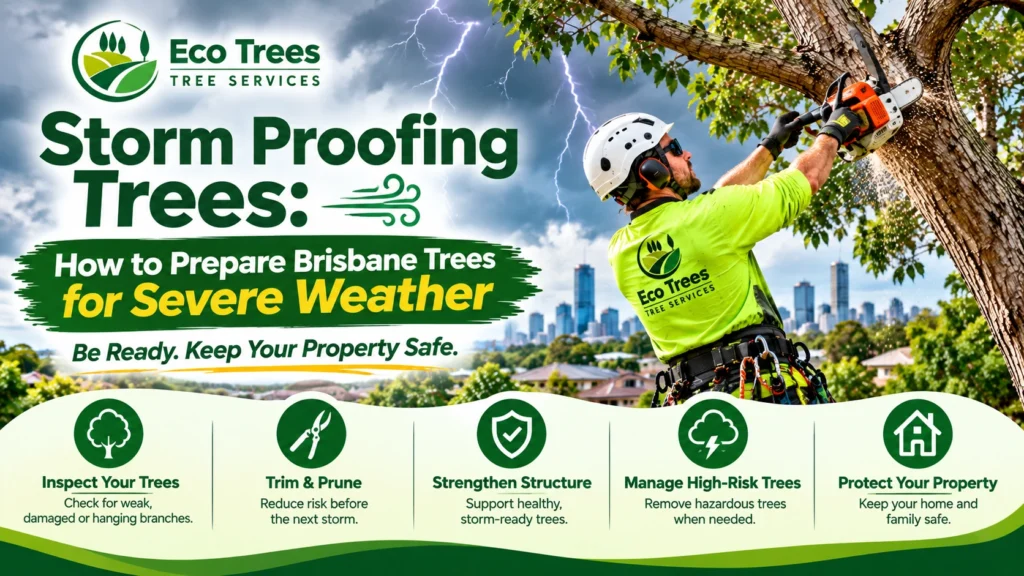
Storm Proofing Trees: How to Prepare Brisbane Trees for Severe Weather
You cannot completely storm-proof a tree, but you can reduce avoidable risks by identifying weak branches, structural defects, root problems and other hazards before severe weather arrives.
At Eco Tree Services, I don’t recommend waiting for the first major storm warning before thinking about your trees.
By that point, there may be very little you can safely do.
Storm proofing trees is really about preventative tree care: inspect the tree early, remove genuine hazards, maintain healthy structure and address problems before strong winds and saturated soil put additional stress on the tree.
This is especially important in Brisbane and South East Queensland, where summer storms can bring heavy rainfall, strong winds and saturated ground. Eco Tree Services’ own storm-season guidance recommends checking deadwood, canopy structure and branches near roofs, garages and powerlines before severe weather arrives.
The goal isn’t to cut a tree back as hard as possible.
The goal is to understand what could fail and deal with that problem appropriately.
What does storm proofing trees actually mean?
Skimable summary: Storm proofing trees means assessing a tree before severe weather, identifying structural and health problems, carrying out appropriate maintenance and protecting the surrounding property from avoidable hazards.
The phrase “storm proofing” can make it sound like there is a simple treatment that makes a tree immune to wind.
There isn’t.
Even a healthy, well-maintained tree can lose branches or fail during an extreme storm.
What preventative tree maintenance can do is reduce some of the risks that already exist.
That might involve:
- Removing dead branches
- Removing damaged or hanging limbs
- Addressing selected structural weaknesses
- Managing branches over roofs
- Reducing specific clearance problems
- Assessing significant tree lean
- Monitoring root stability
- Identifying decay or disease
- Improving long-term tree health
This is why I prefer to think of storm proofing as risk management rather than storm protection.
The tree remains a living structure.
Our job is to identify weaknesses before the weather puts them under pressure.
Why are Brisbane trees vulnerable during storms?
Skimable summary: Brisbane trees can face additional storm stress from strong winds, heavy rain, saturated soil, rapid growth and existing structural defects.
Brisbane’s subtropical climate gives trees plenty of opportunity to grow.
But the same climate can create challenging conditions during storm season.
Strong winds place mechanical stress on branches and trunks. Heavy rain can saturate the soil around roots. Trees that already have structural defects may be less able to cope with those additional forces.
Eco Tree Services notes that Brisbane’s wet season can bring torrential rain, saturated ground and late-summer storms, while weak limbs and unstable trees can become significant hazards during severe weather.
This doesn’t mean every large tree is dangerous.
It means the tree’s existing condition matters.
For example, a healthy tree with good structure may tolerate strong weather better than a tree with:
- Extensive deadwood
- Major cracks
- Severe decay
- Damaged roots
- A significant lean
- Poor previous pruning
- Storm damage from an earlier event
That’s why preventative inspection is more useful than simply looking at the tree when the forecast says a storm is coming.
What should you check before storm season?
Skimable summary: Before storm season, inspect the canopy, branches, trunk, roots and surrounding property for signs of weakness, decay, instability or potential impact.
You don’t need to climb your tree to perform an initial visual check.
Walk around it and look at the whole structure.
1. Dead or hanging branches
Dead branches are no longer supported by healthy living wood and can become falling hazards during strong winds.
Look for:
- Completely dead limbs
- Broken branches
- Hanging branches
- Large sections of deadwood
- Branches caught in the canopy
Eco’s storm-safety guidance specifically identifies dead, hanging and hollow branches as warning signs that should be addressed before cyclone and storm conditions.
2. Cracks and splits
Look closely at major branches and the trunk.
Large cracks or splits can indicate structural weakness.
Don’t assume a crack is harmless simply because it has been there for a while.
Wind can place additional force on an already compromised area.
3. Changes in lean
A tree that has always leaned slightly is not necessarily a problem.
A new or worsening lean is different.
Eco Tree Services identifies changes in trunk angle as a warning sign because saturated soil or root instability can affect the tree’s support.
4. Dense or poorly structured canopies
A dense canopy can increase the amount of foliage and branch surface exposed to wind.
Selective canopy management may sometimes help, but that does not mean you should remove large amounts of healthy growth.
The correct pruning approach depends on the tree.
5. Root and soil problems
Look around the base.
Check for:
- Exposed roots
- Soil movement
- Root lifting
- Cracking around the tree
- Significant soil erosion
- Recent excavation
- Heavy machinery damage
- Waterlogged ground
Root stability is particularly important after periods of heavy rainfall.
6. Branches over important structures
Look at the areas beneath and around the canopy.
Potential targets include:
- Roofs
- Garages
- Sheds
- Cars
- Driveways
- Fences
- Play areas
- Footpaths
- Power infrastructure
The closer a vulnerable branch is to a structure, the greater the consequence if it fails.
Eco’s pre-storm checklist specifically recommends addressing branches over roofs, garages and powerlines before storm conditions arrive.
Can pruning make trees safer before a storm?
Skimable summary: Appropriate preventative pruning can remove deadwood, damaged branches and certain hazards, but pruning cannot guarantee that a tree will survive severe weather.
Yes, pruning can help manage certain storm risks.
But I want to make an important distinction.
Pruning isn’t about making a tree as small as possible before a storm.
A qualified arborist may recommend targeted work such as:
- Deadwood removal
- Removing broken branches
- Crown thinning where appropriate
- Selective reduction
- Clearance pruning
- Removing structurally compromised limbs
Eco Tree Services’ Brisbane pruning service includes crown thinning, crown lifting, crown reduction and deadwood removal, with the appropriate technique depending on the tree and its condition.
The objective is to solve a particular problem while preserving healthy tree structure.
For example, if a large dead branch extends over a roof, removing that branch can address a specific hazard.
That does not mean the entire canopy needs to be reduced.
Should you remove or thin the entire canopy?
Skimable summary: No, you should not automatically remove or heavily thin a tree’s canopy to prepare for storms; excessive pruning can damage healthy structure and should only be performed when there is a clear arboricultural reason.
This is one of the biggest misunderstandings I see around storm preparation.
Someone hears that wind is dangerous for trees and assumes that cutting the canopy down will make the tree safer.
It isn’t that simple.
A tree’s structure depends on its branches, trunk, roots and natural growth pattern.
Heavy or indiscriminate pruning can create large wounds and change the tree’s structure.
Instead, I look at the specific issue.
For example:
Problem: Dead branch over a driveway.
Possible response: Remove the dead branch safely.
Problem: Excessive growth interfering with a structure.
Possible response: Targeted clearance pruning.
Problem: Dense canopy with a genuine structural management requirement.
Possible response: Selective canopy work by a qualified arborist.
Problem: Severe decay or compromised root stability.
Possible response: Further assessment to determine whether pruning can manage the risk or whether removal is necessary.
The answer should follow the problem.
How do you storm-proof small trees?
Skimable summary: Storm preparation for small trees focuses on establishing good structure, removing damaged growth, maintaining appropriate branch spacing and protecting the root zone before problems become larger.
Pruning small trees can be easier because many branches can be reached from the ground.
That doesn’t mean small trees should be pruned aggressively.
Young trees benefit from developing strong, well-spaced branch structures.
If you repeatedly remove healthy branches without understanding how the tree will respond, you can create structural problems later.
For small residential trees, I would look for:
- Competing leaders
- Crossing branches
- Deadwood
- Damaged limbs
- Poor branch attachments
- Branches rubbing against structures
- Unwanted growth toward powerlines
This is also where early maintenance can save you work later.
A branch that is easy to manage when the tree is small can become a much larger problem after years of unchecked growth.
What about mature trees?
Skimable summary: Mature trees need a more detailed storm assessment because their larger branches, greater canopy weight, height and root systems can create more significant consequences if structural problems exist.
Mature trees deserve particular attention before severe weather.
I’m not saying that large trees are automatically dangerous.
Many mature trees are perfectly capable of remaining healthy and stable for decades.
But when something goes wrong, the consequences can be larger.
A mature tree may have:
- Heavy primary limbs
- Large canopy spread
- Internal decay
- Previous pruning wounds
- Root disturbance
- Significant height
- Branches over buildings
- Complex branch unions
Eco Tree Services’ storm guidance recommends looking for major cracks, deadwood, fungal growth, exposed roots, soil upheaval and changes in lean before cyclone season.
If you’re unsure about an established tree, I would rather assess it before the storm than respond to a broken limb afterward.
You can also read our guide to mature tree maintenance for a broader approach to managing established trees.
How does root and soil health affect storm stability?
Skimable summary: Strong root systems help support trees during high winds, while root damage, soil disturbance, compaction and saturated ground can affect stability.
People often focus entirely on branches when they think about storm proofing.
But the roots matter just as much.
The tree’s roots anchor it into the ground and interact with the surrounding soil.
Problems can occur when roots are:
- Cut during construction
- Damaged by machinery
- Exposed
- Compacted
- Subjected to major soil disturbance
- Affected by severe erosion
- Growing in unstable or waterlogged conditions
Eco Tree Services notes that storm damage can sometimes affect root systems without immediately causing a tree to fall. Changes may become apparent later through leaning, canopy decline or other symptoms.
This is why I don’t recommend focusing only on what you can see above ground.
If you have recently had construction, excavation or major landscaping around a large tree, mention it during an arborist assessment.
Should you water trees before a storm?
Skimable summary: Watering should be based on the tree, soil and weather conditions rather than following a blanket pre-storm watering rule; excessive water can be a problem when the soil is already saturated.
This is another area where simple advice can become misleading.
If the soil is already saturated after heavy rainfall, adding more water isn’t going to make the tree more stable.
On the other hand, prolonged dry conditions can stress trees and affect overall health.
So rather than thinking, “A storm is coming, so I need to water the tree,” look at the actual conditions.
Consider:
- Recent rainfall
- Soil moisture
- Tree species
- Tree age
- Existing stress
- Root-zone condition
- Local weather
Healthy soil and appropriate moisture management contribute to healthier trees over the long term.
What should you do after a major storm?
Skimable summary: After a major storm, keep people away from damaged trees, inspect from a safe distance and arrange professional assessment for broken, split, leaning or partially uprooted trees.
Storm preparation doesn’t end when the weather clears.
A tree can look intact while still having hidden structural damage.
Eco Tree Services’ post-storm guidance explains that high winds can create internal cracks, splits and fractures that may not immediately result in a branch falling.
After a serious storm, look from a safe distance for:
- Broken branches
- Hanging limbs
- Split trunks
- New cracks
- Significant leaning
- Uprooted roots
- Branches resting on structures
- Damage near powerlines
Don’t climb the tree to investigate a suspicious branch.
Don’t stand beneath a hanging limb while deciding what to do.
And never attempt to cut a storm-damaged tree near powerlines yourself.
Eco’s guidance specifically warns that damaged trees can behave unpredictably and require professional assessment.
If the storm has left branches or trees across your property, Eco also provides emergency storm damage and tree clean-up services across Brisbane.
Can you storm-proof trees with regular maintenance?
Skimable summary: Regular tree maintenance cannot prevent every storm failure, but it can identify and address some hazards before severe weather exposes them.
This is where preventative maintenance has its greatest value.
You don’t maintain a tree because you expect to eliminate every possible risk.
You maintain it because you want to identify problems while you still have options.
Eco Tree Services explains that routine pruning, deadwooding and hazard assessments can identify weak branches and structural problems before severe weather turns them into emergency hazards.
That gives you a better opportunity to decide whether the right response is:
- Pruning
- Monitoring
- Improving the surrounding conditions
- Further assessment
- Tree removal
The earlier you identify the problem, the more options you may have.
When should you hire a tree pruning company?
Skimable summary: Hire a professional tree pruning company when trees are large, branches are high or heavy, structural defects are present, work is near buildings or powerlines, or you are uncertain about the correct pruning approach.
If you’re searching for the best tree pruning service, I recommend looking beyond the amount of tree a company says it can remove.
Ask what problem they are solving.
A professional assessment should consider:
- Tree health
- Structure
- Branch attachments
- Deadwood
- Root condition
- Surrounding structures
- Powerlines
- Access
- Previous pruning
- Storm exposure
Eco Tree Services’ qualified arborists are trained in arboriculture, tree health, pests and diseases, chainsaw use, Australian industry standards and safe tree work.
Our tree pruning and maintenance service is designed around targeted pruning rather than simply reducing every tree that looks large.
For residential properties, tree pruning and tree trimming should be based on what the tree actually needs.
And if the tree has become unstable or severely damaged, pruning may not be enough.
What are the biggest storm-proofing mistakes?
Skimable summary: Common mistakes include waiting until a storm is approaching, over-pruning healthy trees, ignoring root problems, attempting DIY work and assuming a tree is safe because it looks normal from the ground.
Waiting until the storm arrives
Once strong winds and heavy rain begin, tree work becomes significantly more hazardous.
Over-pruning
Cutting large amounts of healthy canopy is not a substitute for proper tree assessment.
Ignoring the roots
A tree can have a healthy-looking canopy while its root zone has been disturbed.
Ignoring old damage
Previous storm damage, cracks or large pruning wounds can become important during future storms.
Attempting DIY work
Large branches can weigh hundreds of kilograms.
Once you add height, gravity, wind and nearby structures, the risk increases significantly.
Assuming “it survived the last storm”
Surviving one storm doesn’t guarantee the tree will behave the same way during the next one.
Trees change.
Branches grow.
Roots can become damaged.
Decay can develop.
The surrounding property can also change.
Storm-proofing trees checklist
Skimable summary: A practical storm-proofing checklist should cover the canopy, trunk, roots, surrounding structures, powerlines and the tree’s overall health before severe weather arrives.
Before storm season, walk around your property and check:
Canopy
- Are there dead branches?
- Are branches hanging or broken?
- Is the canopy unusually dense?
- Are branches rubbing against each other?
Trunk
- Are there visible cracks?
- Are there cavities or signs of decay?
- Has the tree developed a new lean?
- Is there fungal growth around the base?
Roots and soil
- Are roots exposed?
- Has the soil shifted?
- Has construction disturbed the root zone?
- Is the soil excessively compacted or waterlogged?
Property
- Are branches over the roof?
- Are branches over your driveway?
- Could a falling branch hit a vehicle?
- Are there branches close to powerlines?
Tree health
- Is there significant dieback?
- Are leaves changing unexpectedly?
- Are pests visible?
- Has the tree recently suffered storm damage?
If you identify one or more significant warning signs, don’t wait for the next severe-weather warning to investigate it.
What should you do if a tree is already storm damaged?
Skimable summary: Restrict access to storm-damaged trees and arrange professional assistance rather than climbing, cutting or attempting to stabilise unstable branches yourself.
This is where I would be particularly cautious.
A storm-damaged tree can behave differently from a healthy tree.
Branches may be under tension.
Trunks can have hidden splits.
Root plates can be partially lifted.
A branch that appears to be hanging harmlessly may be under significant load.
Eco Tree Services recommends professional assessment after serious storms because hidden cracks and structural damage may not be visible from ground level.
If the damage is near electrical infrastructure, stay away and contact the relevant emergency or utility service.
If a tree has fallen onto a house, vehicle or access area, don’t try to cut it apart yourself simply because it appears to be lying on the ground.
Final advice from Eco Tree Services
Skimable summary: The safest approach to storm proofing trees is preventative assessment, targeted maintenance and early action rather than aggressive pruning immediately before a storm.
I don’t believe in trying to make a tree “storm-proof” by cutting half of it away.
Trees are living structures, and severe weather can damage even healthy trees.
What we can do is identify preventable risks.
That means checking for deadwood, cracks, decay, poor branch structure, root problems, significant lean and branches that could affect your home or other property.
Then we decide what the tree actually needs.
Sometimes that means pruning.
Sometimes it means monitoring.
Sometimes the surrounding soil or root zone needs attention.
And sometimes, where serious structural defects or instability exist, removal may be the safest option.
The best storm preparation happens before the storm, when there is enough time to assess the tree properly and make a considered decision.
If you’re concerned about a tree on your Brisbane property, our signs your tree may be unsafe before cyclone season guide is a useful starting point.
FAQs About Storm Proofing Trees
Can you completely storm-proof a tree?
No, you cannot completely storm-proof a tree. Preventative pruning and professional assessment can reduce certain risks, but extreme winds, saturated soil and severe weather can still damage healthy trees. I treat storm proofing as risk reduction rather than a guarantee that a tree will survive every storm.
What is the best way to storm-proof trees?
The best approach is to have trees assessed before severe weather and address genuine hazards such as deadwood, damaged branches, structural defects and root problems. For example, if I find a large dead branch over a roof, removing that specific hazard may be appropriate rather than cutting down the entire canopy.
Should I prune my trees before storm season?
You should consider preventative pruning when an assessment identifies dead, damaged, hazardous or poorly positioned branches. I would not recommend heavy pruning simply because storm season is approaching. The pruning should have a specific purpose and preserve as much healthy structure as possible.
Does tree trimming prevent storm damage?
Tree trimming cannot guarantee that storm damage will be prevented, but appropriate pruning can address some existing hazards. Removing deadwood or a structurally compromised branch can reduce a particular falling-branch risk. However, no pruning technique can make a tree immune to extreme weather.
Should I remove dead branches before a storm?
Yes, hazardous dead branches should be assessed and, where appropriate, removed before severe weather. Deadwood can become more likely to break under strong wind. Eco Tree Services specifically identifies dead and hanging branches as warning signs before cyclone season.
Can pruning small trees make them more storm resistant?
Appropriate pruning can help small trees develop better structure, but excessive pruning can create problems of its own. With pruning small trees, I focus on removing damaged or poorly positioned growth and encouraging a balanced structure rather than simply reducing the canopy.
Are mature trees more likely to fall during storms?
Not necessarily, because age alone does not determine whether a tree will fail. A healthy mature tree can remain stable for many years, while a younger tree with poor structure or root damage can also become hazardous. For mature trees, I pay particular attention to structural defects, decay, root condition and the weight of major limbs.
What happens if heavy rain makes the soil around a tree very wet?
Saturated soil can affect tree stability, particularly when the root system is already compromised or the tree has developed a lean. After prolonged rain, I recommend checking for soil movement, exposed roots, new leaning or changes around the base of the tree rather than assuming the tree is unaffected.
Should I inspect my trees after a storm?
Yes, trees should be checked after a significant storm, but only from a safe position unless a qualified arborist is carrying out the inspection. Hidden cracks, split limbs and root damage may not be obvious from the ground. Eco Tree Services recommends professional post-storm assessment when serious damage has occurred.
Can I cut a storm-damaged branch myself?
You should not attempt to cut large or unstable storm-damaged branches yourself. A damaged branch can be under tension or supported unpredictably. This becomes particularly dangerous when the branch is high, near a building or close to powerlines.
When should I call a tree pruning company?
Call a tree pruning company when you notice deadwood, large cracks, significant leaning, damaged branches, structural concerns or branches threatening buildings and other property. A qualified arborist can determine whether pruning is sufficient or whether the tree requires a different form of management.
What is the difference between storm preparation and emergency tree removal?
Storm preparation happens before severe weather to identify and manage foreseeable hazards, while emergency tree removal deals with trees that have already become dangerous after damage or failure. Preparing a tree before a storm gives you more time to assess the situation safely instead of making decisions while a damaged tree is already creating an immediate hazard.