What Happens During Tree Removal | Professional Brisbane Tree Removal Process
Professional tree removal in Brisbane is a planned process that starts with assessing the tree and surrounding property, then moves through risk management, controlled cutting, branch and trunk removal, stump management and final site cleanup. The tree is not simply cut at the base and allowed to fall.
If you have never had a tree removed before, it is normal to wonder what actually happens once the arborist arrives.
Will they cut the tree down in one piece? Will they climb it? What happens to the branches? Does the stump get removed? How long will the job take? And what happens if the tree is sitting directly beside your house?
These are the questions I hear from homeowners when they contact us about tree removal.
The answer depends on the tree and the property.
A large tree in an open backyard can sometimes be removed using a controlled felling method. A tree growing between a house, fence, driveway and power lines may need to be dismantled piece by piece using climbing equipment, ropes, rigging and specialised machinery.
That is why I don’t treat tree removal as a one-size-fits-all service.
At Eco Tree Services, we assess the tree, surrounding hazards and access before deciding how the removal should be carried out. Our goal is to remove the tree safely while protecting people, buildings, gardens and other property around it.
What happens during professional tree removal in Brisbane?
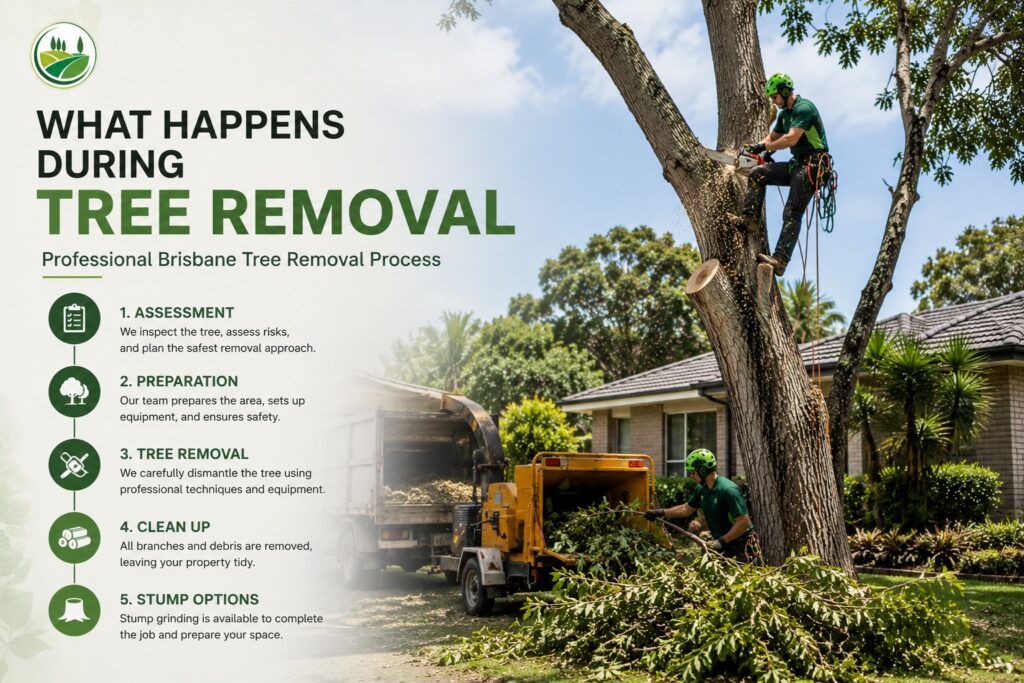
Professional tree removal normally follows a sequence of inspection, planning, site preparation, controlled cutting, removal of timber and branches, stump treatment and cleanup.
The process generally looks like this:
- The arborist inspects the tree.
- The surrounding property and hazards are assessed.
- Council or vegetation protection requirements are checked where applicable.
- The safest removal method is selected.
- The work area is secured.
- Climbing, rigging or machinery is positioned.
- Branches are removed progressively.
- The trunk is dismantled or felled in a controlled manner.
- Branches and timber are processed or removed.
- The stump is ground or removed if included in the job.
- The work area is cleaned.
The exact process changes according to the tree’s size, condition, location and access.
For example, an isolated tree in an open area may be felled in a controlled direction. A tree beside a Queenslander, garage or boundary fence may need sectional dismantling so individual branches and trunk sections can be lowered rather than dropped.
Professional tree removal in Brisbane involves inspection, risk planning, controlled cutting, waste removal, optional stump treatment and final cleanup rather than simply cutting the trunk at ground level.
Why does a tree removal expert inspect the tree first?
The initial inspection tells the arborist whether the tree can be safely removed and which removal technique is appropriate for the specific site.
This is one of the most important parts of the entire process.
Before making the first cut, an expert tree removal team needs to understand how the tree is structured and how it may behave during removal.
The arborist looks for signs such as:
- Dead branches.
- Cracks.
- Cavities.
- Decay.
- Weak branch unions.
- Storm damage.
- Excessive lean.
- Root instability.
- Uneven canopy weight.
- Disease or pest damage.
The arborist also considers the tree’s surroundings.
A structurally compromised tree next to a house presents a different risk from the same tree standing in an open paddock.
That difference determines the removal method.
A professional Brisbane tree expert should therefore be able to explain not just what needs to be removed but how the tree will be removed safely.
The first inspection identifies structural defects, hazards and environmental conditions that determine the safest tree removal method.
What does the arborist check before starting the job?
An arborist checks the tree, property, access, power infrastructure and ground conditions before deciding how to perform the removal.
Tree condition
The arborist examines the trunk, branches, canopy and visible root area.
A tree that appears healthy from ground level can still contain internal decay or structural weaknesses.
Surrounding structures
The team identifies anything that could be damaged by falling or moving timber.
This can include:
- Houses.
- Roofs.
- Garages.
- Sheds.
- Fences.
- Vehicles.
- Pools.
- Gardens.
- Driveways.
- Neighbouring properties.
Access
Access determines which equipment can reach the tree.
A backyard with a wide side gate may allow machinery to enter.
A narrow Brisbane property may require the team to carry equipment through the house-side access and use climbing and rigging techniques.
Power lines
Power lines require additional safety planning.
The arborist needs to understand where the lines are positioned and how branches, equipment and the tree itself could interact with them.
Ground conditions
The team also considers slopes, soft ground, underground services and whether machinery can safely operate in the area.
A professional assessment covers both the tree and the work environment because access, structures, power lines and ground conditions can completely change the removal strategy.
Do you need Council approval before removing a tree?
You should not assume that you can remove any tree simply because it grows on your private property. Brisbane has vegetation protection requirements that may apply to trees on private land.
Before arranging removal, homeowners should determine whether the tree is protected and whether an exemption or approval applies to the proposed work.
This is particularly important when the tree is:
- Large or significant.
- Native vegetation.
- Located in an environmentally sensitive area.
- Near waterways or other protected areas.
- Subject to vegetation protection requirements.
The safest approach is to check the relevant Brisbane City Council requirements before work begins.
If you are unsure, tell your arborist before the quote is prepared.
This can prevent a situation where the physical removal appears straightforward but the proposed work does not meet local requirements.
For your Eco Tree Services topical cluster, this is also the ideal place to internally link to your article:
Can You Remove a Tree Without Council Approval?
Property ownership does not automatically mean every tree can be removed. Check Brisbane City Council vegetation requirements and any applicable exemptions before arranging tree removal.
How do arborists prepare the property for tree removal?
Before cutting starts, the tree-removal team prepares the work zone, establishes safe access and keeps people and unnecessary property traffic away from the removal area.
The crew may:
- Establish an exclusion zone.
- Position vehicles and machinery.
- Prepare climbing equipment.
- Set up ropes and rigging.
- Identify branch drop zones.
- Protect vulnerable areas where practical.
- Clear unnecessary items from the work area.
- Coordinate ground workers.
This preparation becomes particularly important when the tree is large.
A branch does not have to fall directly onto a house to cause damage. It can swing, roll, bounce or move unexpectedly after landing.
Planning the work area gives the crew more control.
If you have children or pets, keep them away from the work zone until the crew has completed the job.
Site preparation creates a controlled working environment by securing access, positioning equipment and keeping people and property away from the removal zone.
How is the tree actually cut down?
The removal technique depends on the available space and surrounding hazards, with professional arborists commonly using controlled felling, sectional dismantling or rigging to manage the tree safely.
Controlled tree felling
If the property provides sufficient open space, the arborist may be able to fell the tree in a controlled direction.
The tree’s lean, structure, wind conditions and landing area all need to be considered.
This method can be efficient when the site allows it.
Sectional tree removal
When there is not enough room to fell the tree safely, the arborist can dismantle it in sections.
The upper branches are removed first.
The crew then works progressively down the tree.
Rigging and controlled lowering
When branches cannot simply be dropped, the arborist can use ropes, pulleys and rigging systems to control their descent.
This is particularly useful around houses, fences, pools and other structures.
Crane or EWP-assisted removal
Some difficult trees may require specialised machinery.
A crane can lift heavy sections away from a structure, while an elevated work platform can provide access where appropriate.
The equipment should be selected based on the site rather than automatically used for every job.
Trees may be felled in a controlled direction or dismantled section by section using climbing equipment, rigging, cranes or EWPs depending on site conditions.
What happens to the branches and trunk after cutting?
After cutting, branches are normally processed into manageable material while larger trunk sections are cut, moved or removed according to the agreed scope of work.
The ground crew plays a major role here.
Branches may be fed into a wood chipper where appropriate.
Larger timber sections may be:
- Cut into smaller pieces.
- Loaded for removal.
- Retained on the property if requested.
- Processed for another agreed purpose.
Before the work starts, I recommend asking exactly what your quote includes.
For example, does the price include:
- Green waste removal?
- Large log removal?
- Wood chips?
- Stump grinding?
- Final cleanup?
These details can make two apparently similar quotes very different.
After cutting, branches and timber are processed or removed according to the agreed scope, so homeowners should confirm waste disposal and cleanup before accepting a quote.
How do arborists protect your house and property?
Arborists protect property by controlling where branches and trunk sections move instead of allowing heavy material to fall freely near structures.
This becomes critical when the tree is close to a house.
Imagine a large branch growing above a tiled roof.
Dropping the branch directly could break tiles, gutters or roof structures.
Instead, the arborist may cut the branch into smaller sections and lower each section using rigging.
The same principle applies around:
- Fences.
- Vehicles.
- Solar panels.
- Windows.
- Garages.
- Pools.
- Gardens.
Property protection starts during planning.
The arborist should know where the vulnerable structures are before deciding where and how to make the cuts.
Professional tree removal protects property by planning drop zones and using controlled lowering techniques when branches or trunk sections cannot safely fall freely.
What happens if the tree is near power lines?
A tree near power lines requires additional safety planning and should never be treated as a normal DIY tree-removal job.
Power infrastructure introduces a serious additional hazard.
Branches can move unexpectedly.
Equipment can also create clearance issues.
If your tree is growing close to power lines, tell the tree-removal company before they inspect or quote the work.
The crew may need to follow specific utility requirements or involve appropriately qualified personnel depending on the circumstances.
Do not attempt to cut branches away from power lines yourself.
Trees near power lines require specialist safety assessment and appropriate procedures. Homeowners should never attempt DIY removal around electrical infrastructure.
What happens to the tree stump and roots?
The tree stump remains after the tree is removed unless you specifically arrange stump grinding or another form of stump removal.
Tree removal and stump removal are separate parts of the process.
If you want to use the area for landscaping, paving or construction, stump treatment may be worth including in the original quote.
A tree stump removal service can grind the stump below the required level and make the area easier to reuse.
Roots require a different approach.
You may not need to remove tree and roots completely.
Extensive root excavation can disturb surrounding soil and nearby structures, so the appropriate method depends on what you plan to do with the area afterward.
If you are planning construction or major landscaping, tell your arborist before the work begins.
Stump grinding is normally an additional step after tree removal, while complete root removal depends on the tree, surrounding structures and the property’s future use.
How long does professional tree removal take?
Professional tree removal can take anywhere from a few hours to a full day or longer depending on tree size, access, removal complexity, equipment and site conditions.
There is no reliable timeframe based on height alone.
For example:
A 20-metre tree in an open area may be removed efficiently if there is plenty of space.
A smaller tree behind a house may take much longer because every branch needs to be lowered carefully.
Time can increase when the job requires:
- Sectional dismantling.
- Rigging.
- Additional ground crew.
- Crane assistance.
- EWP access.
- Difficult waste removal.
- Stump grinding.
- Restricted property access.
Weather can also affect the schedule, particularly when wind or storms create unsafe working conditions.
Tree-removal duration depends on complexity rather than height alone. Access, rigging, machinery, property hazards and stump work can significantly affect the timeframe.
How much does tree removal cost in Brisbane?
Tree removal prices in Brisbane vary according to the tree, property, access, hazards, equipment, labour and additional services.
I would not recommend relying on one generic price when planning your budget.
The main factors include:
- Tree height.
- Trunk diameter.
- Tree species.
- Tree condition.
- Lean.
- Location.
- Access.
- Nearby buildings.
- Power lines.
- Rigging requirements.
- Crane or EWP requirements.
- Waste volume.
- Stump grinding.
- Root work.
For example, an affordable tree removal service may be possible for an easily accessible tree in an open yard.
But a tree growing behind a narrow house may require additional labour and specialised equipment.
That’s why an on-site assessment is more useful than comparing a generic online price.
Your existing article How Much Does Tree Removal Cost in Brisbane should be internally linked here using the anchor:
tree removal cost in Brisbane
Brisbane tree removal costs depend on tree size, access, hazards, labour, equipment and additional services, so homeowners should compare detailed quotes rather than a single advertised price.
Can pruning be used instead of removing the tree?
Yes, pruning can sometimes solve a tree problem without removing the entire tree, provided the tree is safe and suitable to retain.
Not every problematic tree needs to come down.
A professional tree pruning company may be able to address:
- Dead branches.
- Broken limbs.
- Overextended branches.
- Excessive canopy density.
- Branches growing toward buildings.
- Minor structural problems.
For example, if a healthy tree has one large branch extending toward your roof, complete removal may not be necessary.
Professional pruning could reduce the issue while retaining the tree.
However, pruning cannot fix every problem.
If the trunk has serious decay, the tree is structurally unstable or the root system has failed, removal may be the safer option.
This is why I recommend getting an assessment rather than deciding based only on how the tree looks.
Professional pruning can be an alternative to tree removal when a tree remains structurally safe, but severely compromised trees may require complete removal.
Not sure whether your tree can be removed without Council approval?
Before arranging tree removal, check the tree’s protection status and get professional advice about the safest way to proceed. Eco Tree Services can assess your tree and help you understand the work involved.
Request a Tree Assessment or Free Quot
What happens after the tree is removed?
After removal, the crew processes the remaining timber and branches, completes any agreed stump work and cleans the work area.
The final stage should not be overlooked.
A professional tree-removal service should clearly explain what happens to the material.
Depending on the quote, the team may:
- Chip branches.
- Remove green waste.
- Remove large logs.
- Grind the stump.
- Clear debris.
- Rake or tidy the immediate work area.
If you want to retain wood chips or logs, communicate this before the removal begins.
If you plan to landscape the area, tell the arborist so the stump treatment can match your plans.
Once the tree is removed, the team handles branches and timber, completes agreed stump work and cleans the area so the property can be used again.
What should you do before the tree removal team arrives?
Homeowners can make the removal process easier by clearing access, moving vehicles and outdoor items and keeping people and pets away from the work zone.
Before the team arrives:
Clear access
Move vehicles and unnecessary items away from the driveway and tree-removal area.
Secure pets
Keep dogs and other pets indoors or away from the work zone.
Remove fragile items
Move outdoor furniture, garden ornaments and other loose items if they are close to the work area.
Tell the arborist about hazards
Mention:
- Power lines.
- Underground services you know about.
- Narrow access.
- Neighbouring property concerns.
- Irrigation systems.
- Pool areas.
- Planned landscaping.
Confirm the scope
Make sure you know whether the quote includes:
- Tree removal.
- Green waste.
- Timber removal.
- Stump grinding.
- Cleanup.
Clear access, secure pets, remove fragile items and communicate known hazards before the arborist arrives. Also confirm exactly what the quote includes.
How do you choose the right tree removal company in Brisbane?
Choose a tree removal company based on qualifications, insurance, experience, safety procedures, equipment and a clear scope of work rather than choosing purely on price.
When comparing a specialist tree removal service, ask:
Are they experienced with large trees?
Large tree removal requires different planning from simple pruning.
Are they properly insured?
Ask about appropriate insurance cover before work begins.
Can they explain the removal method?
A professional should be able to explain how the tree will be dismantled or felled and how property will be protected.
Is cleanup included?
Ask whether green waste, timber and debris are included.
Is stump grinding included?
Do not assume it is automatically part of tree removal.
Can they handle emergency work?
If you have storm damage, ask whether they provide an emergency tree removal service.
Do they provide a written quote?
A written quote makes it easier to compare contractors and understand exactly what you are paying for.
I would always recommend looking beyond the cheapest quote.
A very low quote may exclude stump grinding, waste removal, specialised equipment or other parts of the job.
The right Brisbane tree-removal contractor should have relevant experience, insurance, suitable equipment, a clear removal plan and a transparent written quote.
What is the professional Brisbane tree removal process step by step?
The professional Brisbane tree removal process can be summarised into ten practical stages, from initial assessment through final cleanup.
Step 1: Initial enquiry
You explain why you want the tree removed and provide information about its location.
Step 2: Site assessment
The arborist inspects the tree and surrounding property.
Step 3: Risk identification
The team identifies structural problems, access issues, power lines and nearby structures.
Step 4: Removal planning
The arborist selects controlled felling, sectional dismantling, rigging or specialised equipment.
Step 5: Site preparation
The work area is secured and equipment is positioned.
Step 6: Canopy removal
Branches are progressively removed.
Step 7: Trunk removal
The main trunk is felled or dismantled into manageable sections.
Step 8: Waste processing
Branches and timber are chipped, removed or retained according to the agreed scope.
Step 9: Stump treatment
Stump grinding or removal is completed if requested.
Step 10: Final cleanup
The immediate work area is cleared and the property is left ready for its next use.
This is what homeowners should expect from a properly planned professional removal rather than simply watching someone cut through a trunk.
A professional tree removal follows a structured sequence: enquiry, inspection, risk assessment, planning, preparation, controlled cutting, timber processing, stump treatment and cleanup.
Conclusion: What should you expect during professional tree removal?
When you hire a professional Brisbane tree removal service, you should expect the job to begin with assessment and planning, not cutting.
The arborist should understand the tree, its condition, the surrounding property and the safest way to remove it.
Depending on the site, the tree may be:
- Felled in a controlled direction.
- Dismantled section by section.
- Lowered using ropes and rigging.
- Removed with an EWP.
- Assisted by a crane.
After the tree comes down, the crew should deal with the agreed timber and green waste, complete stump work if included and clean the work area.
At Eco Tree Services, we approach tree work around the actual conditions of the property rather than applying the same removal method to every tree.
If you’re unsure whether your tree needs removal, professional tree pruning and removal services can help determine whether pruning is sufficient or complete removal is the safer option.
For homeowners looking for experienced Brisbane tree experts, the most important thing is to choose a company that can explain the process clearly before the work begins.
FAQs
What happens first during tree removal?
The first step is normally a professional assessment of the tree and surrounding property. The arborist checks the tree’s condition, access, nearby buildings, power lines and other hazards before choosing the removal method. For example, a tree beside a house may need sectional dismantling rather than straightforward felling.
Does the entire tree fall at once?
Not necessarily. Large trees are often dismantled in sections when there is not enough space to safely fell the entire tree. An arborist may remove branches first, then progressively work down the trunk while lowering sections under control.
How long does professional tree removal take?
It can take several hours or longer depending on the tree and site. A tree in an open backyard may be relatively quick, while one surrounded by buildings, fences and power infrastructure may require extensive rigging and additional equipment.
Do arborists remove the stump after cutting down the tree?
Only if stump removal or grinding is included in the service. Standard tree removal does not automatically mean the stump will be removed. If you want the area cleared for landscaping, ask for stump grinding when requesting the quote.
Can tree roots be removed after the tree is cut down?
Yes, some root-removal work can be carried out, but complete root removal is not always necessary. If you are planning construction or paving over the area, tell the arborist beforehand so they can recommend the appropriate approach.
Is tree removal safe around a house?
Professional tree removal can be carried out safely around houses when the correct removal method and equipment are used. Instead of dropping heavy branches, arborists can dismantle the tree in sections and lower material using rigging.
What if my tree is near power lines?
Do not attempt to remove it yourself. Power lines introduce additional electrical and access hazards. A professional assessment is required to determine the appropriate procedure.
Can a tree be pruned instead of removed?
Yes, if the tree remains structurally safe and the problem can be managed through pruning. For example, a healthy tree with a few dead or overextended branches may only require professional pruning rather than complete removal.
What affects tree removal cost in Brisbane?
Tree size, access, condition, surrounding structures, equipment, labour, waste and stump work all affect the cost. A tree that looks similar in size to another tree can cost significantly more to remove if it is positioned behind a house with restricted access.
What should I look for in a tree removal company?
Look for experience, appropriate insurance, qualified arborists, suitable equipment and transparent written quotes. I would also ask how the contractor intends to protect your property and whether waste removal and stump grinding are included.
Do I need Council approval to remove a tree in Brisbane?
Sometimes. Brisbane has vegetation protection requirements that can apply to trees on private property. Check the relevant Council requirements before arranging removal, particularly if the tree may be protected.
Can I remove a large tree myself?
I strongly recommend professional removal for large or hazardous trees. Heavy branches and trunk sections can move unpredictably, and the risk increases significantly around buildings, vehicles and power lines.
What happens to the branches after tree removal?
Branches are commonly chipped or removed as green waste depending on the agreed service. If you want to keep the mulch or some timber, tell the tree-removal team before the work starts.
Do I need an emergency tree removal service after a storm?
You may need emergency assistance when storm damage creates an immediate risk to people or property. A split trunk, fallen tree or large suspended branch should be treated as potentially unstable. Keep away from the area and arrange professional assessment.
Is the cheapest tree removal company the best option?
No. Compare the complete scope of work rather than just the headline price. A cheaper quote may exclude stump grinding, waste removal, rigging or specialised equipment that another contractor has included.
Can an arborist tell me whether I really need tree removal?
Yes, a professional assessment can help determine whether pruning, maintenance or removal is the most appropriate option. If the tree is healthy but has a specific branch problem, pruning may solve the issue without removing the entire tree.