Why Tree Pruning Matters: A Brisbane Homeowner’s Guide
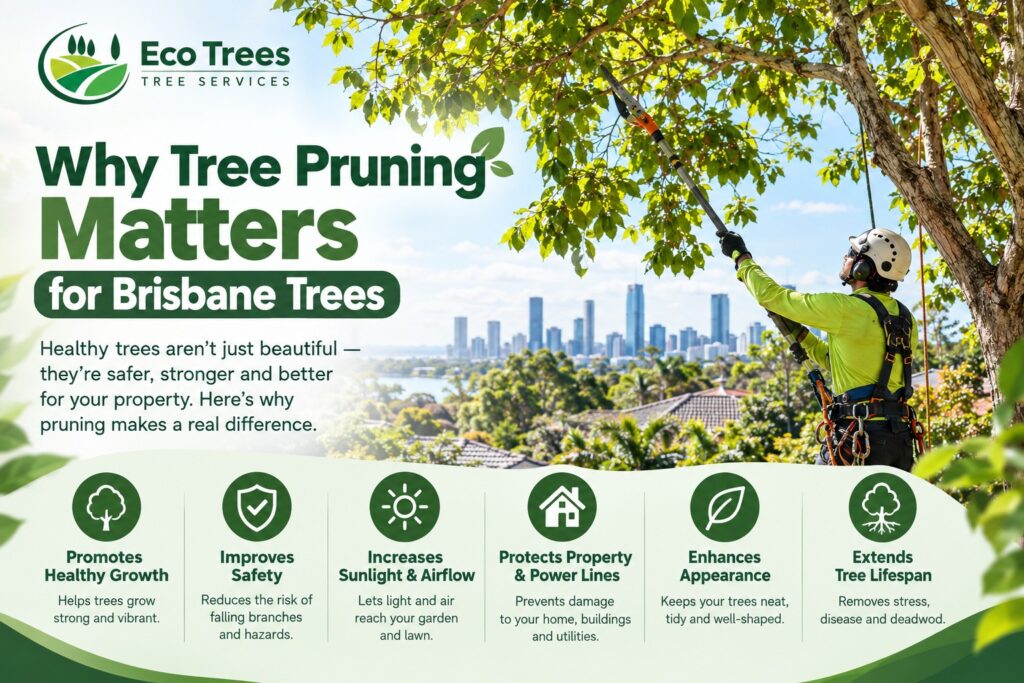
Tree pruning matters because it keeps trees healthier, safer and better structured while reducing the risk of dead or unstable branches causing problems around your property. Regular pruning can also improve airflow, sunlight, clearance and the overall appearance of your trees.
At Eco Tree Services, I often see homeowners wait until a tree becomes overgrown, starts dropping branches or interferes with their property before they think about pruning.
By that stage, the work can become more complicated than it needed to be.
Tree pruning is not simply about making a tree look neat. Done correctly, it can help manage structural problems, remove damaged growth, improve clearance and support the long-term health of the tree.
The important part is knowing what to prune, how much to remove and why the tree needs pruning in the first place.
What does tree pruning actually do?
Tree pruning selectively removes branches to improve a tree’s health, structure, safety and growth while keeping the remaining canopy balanced.
A professional arborist does not simply cut branches because they are long or inconvenient. We assess the tree first and determine which branches need attention.
Depending on the tree and the problem, pruning may involve:
- Removing dead or dying branches
- Removing damaged or diseased growth
- Reducing excessive canopy density
- Raising the canopy away from structures
- Reducing selected canopy growth
- Removing branches that are rubbing or crossing
- Improving clearance around buildings and access areas
- Managing branches that have become hazardous
Our tree pruning and maintenance services cover techniques including crown thinning, crown lifting, crown reduction and deadwood removal.
Skimable summary: Tree pruning is the selective removal of branches to improve tree health, structure, safety, clearance and appearance without unnecessarily removing the entire tree.
Why is tree pruning important for tree health?
Tree pruning supports tree health by removing dead, damaged and diseased branches and improving the conditions around the remaining canopy.
A tree has to manage its branches, leaves and overall structure as it grows. Damaged or dead branches provide no useful growth and can become liabilities if they remain attached.
Removing the right branches can also improve airflow and sunlight through the canopy.
This matters because dense, poorly managed growth can create problems that are harder to address later.
Pruning can help with:
- Deadwood management
- Damaged branch removal
- Diseased growth management
- Better canopy airflow
- Improved light penetration
- Better branch distribution
- Long-term structural development
However, more pruning is not automatically better.
One of the biggest mistakes I see is treating pruning as a simple process of cutting away as much growth as possible. Excessive or poorly positioned cuts can create new problems rather than solve existing ones.
That is why the objective should always be targeted pruning rather than unnecessary cutting.
Skimable summary: Tree pruning supports healthier trees by removing dead, damaged or problematic growth and improving airflow and light penetration, but excessive pruning can be harmful.
Can pruning make trees safer around your home?
Yes. Removing hazardous, dead or structurally weak branches can reduce the risk of branch failure around homes, driveways, walkways and other frequently used areas.
This is one of the most practical reasons for residential tree pruning.
A large dead branch above a driveway might not look particularly dangerous on a calm day. But if strong wind arrives, that branch can become a falling-object hazard.
The same applies to branches growing toward:
- Roofs
- Fences
- Cars
- Sheds
- Outdoor living areas
- Footpaths
- Power infrastructure
- Neighbouring properties
Pruning cannot eliminate every tree-related risk, but it can help manage obvious branch hazards when the tree remains suitable for retention.
For Brisbane properties, this becomes particularly important before periods of severe weather. Eco Tree Services also covers seasonal tree safety through its existing resources, including guidance on preparing trees before cyclone season.
For example, if a mature tree has several large dead branches extending over your roof, removing those branches may be a sensible preventative step rather than waiting for the next major storm.
Skimable summary: Pruning can improve residential tree safety by removing dead, damaged or hazardous branches before they fail and affect buildings, vehicles, people or surrounding infrastructure.
How does pruning improve tree structure and growth?
Correct pruning can improve the structure of a tree by managing competing, weak, damaged or poorly positioned branches.
Trees do not always develop perfectly balanced canopies.
Some branches grow faster than others. Some cross or rub against neighbouring branches. Others may develop weak unions or create excessive weight on one side of the canopy.
A professional arborist can identify these structural issues and determine whether pruning can improve the tree’s form.
Structural pruning may address:
- Crossing branches
- Rubbing branches
- Poorly positioned growth
- Excessive canopy weight
- Weak or damaged branches
- Uneven canopy development
- Branches interfering with structures
The goal is not to make every tree perfectly symmetrical.
The goal is to create a healthier and more manageable structure while respecting the natural characteristics of the species.
This is particularly important when pruning younger trees because structural issues can become much harder to correct as the tree gets larger.
Skimable summary: Structural pruning manages poorly positioned, damaged and competing branches so trees can develop a stronger, more balanced and manageable canopy.
Does tree pruning improve the appearance of your property?
Yes. Professional pruning can improve a tree’s shape, canopy balance and clearance, which can make the entire property look better maintained.
But appearance should not be the only reason for pruning.
I prefer to start with the tree’s health and structure, then consider aesthetics as part of the overall result.
A well-pruned tree can:
- Look more balanced
- Improve visibility around the property
- Create better clearance
- Reduce messy deadwood
- Complement gardens and landscaping
- Keep branches away from structures
- Improve the overall appearance of the yard
The difference becomes particularly noticeable when an overgrown tree has started dominating a small residential garden.
Rather than removing the whole tree, carefully reducing selected growth may allow the homeowner to keep the tree while improving the way it fits into the property.
Skimable summary: Professional pruning can improve canopy shape, clearance and visual balance while maintaining the tree’s health and natural form.
Why does residential tree pruning matter in Brisbane?
Residential tree pruning matters because Brisbane properties often have mature trees growing close to homes, fences, driveways, gardens and other structures.
Space can become a major issue as trees mature.
A tree that was perfectly suitable when it was small may eventually develop branches over a roof, block access, interfere with neighbouring property or create excessive shade.
This does not automatically mean the tree needs to be removed.
In many cases, appropriate pruning can manage the problem while allowing the tree to remain.
Our residential tree services include pruning and maintenance, deadwood and tree safety work, palm cleaning and removal, tree removal and other property-specific tree services.
For example, if a large tree is growing over a Brisbane home’s roof, the first question should not always be, “How do we remove it?”
The better question can be, “Can the risk and clearance problem be safely managed through appropriate pruning?”
Skimable summary: Residential tree pruning helps Brisbane homeowners manage mature trees around roofs, fences, gardens, driveways and other structures without automatically resorting to complete tree removal.
Is pruning small trees really necessary?
Yes, pruning small trees can be important because early structural correction can prevent bigger problems as the tree matures.
It is easy to overlook a young tree because its branches are small and there is little immediate risk.
But the structure that develops while a tree is young can influence how it behaves later.
Early pruning may help address:
- Competing leaders
- Poor branch placement
- Damaged growth
- Crossing branches
- Low branches
- Uneven development
The key is not to prune a young tree aggressively.
Small trees generally need thoughtful structural management rather than heavy cutting.
For example, correcting a poorly positioned branch while it is still small may be considerably easier than dealing with the same branch after it has become a large, heavy limb.
Skimable summary: Pruning small trees helps correct structural problems early, making future maintenance easier while supporting stronger and more balanced development.
What is the difference between tree pruning and tree trimming?
Tree pruning generally focuses on tree health, structure and safety, while tree trimming is often used more broadly to describe cutting back overgrown growth for clearance or appearance.
People often use the terms interchangeably, but the important distinction is the purpose and technique behind the work.
Professional tree pruning may involve specific arboricultural techniques such as crown thinning, crown lifting, crown reduction and deadwood removal.
Tree trimming can refer more generally to cutting back branches to manage size, clearance or appearance.
I would not focus too heavily on the terminology when choosing a contractor.
Instead, ask:
- Who will assess the tree?
- What branches need to be removed?
- Why do they need removing?
- How much canopy will be removed?
- What pruning technique will be used?
- Is the tree healthy enough to retain?
A contractor who simply wants to cut everything back is not necessarily providing the best tree care.
Skimable summary: Tree pruning and tree trimming can overlap in everyday language, but professional pruning is based on the tree’s health, structure, safety and specific management needs.
When should you hire a professional tree pruning company?
You should hire a qualified tree pruning company when the tree is large, difficult to access, close to structures, near power infrastructure or requires significant pruning.
Tree work involves real risks.
A branch can carry substantial weight, and cutting it from the wrong position can cause it to swing, split or fall unexpectedly.
Our service information explains that arborists undergo specific training in areas including chainsaw use, tree cutting, tree health, pests, diseases and Australian standards.
I recommend professional assessment particularly when:
- The tree is large or mature.
- Branches are close to your roof.
- The tree is near powerlines.
- Large branches need removal.
- The tree shows signs of disease or decay.
- You are unsure how much should be pruned.
- The tree has been damaged by storms.
- You want structural pruning on a young tree.
If the tree has serious structural problems, pruning may also not be enough.
Our guide to signs your tree needs removing explains warning signs such as major trunk cracks, severe decay, significant leaning, extensive deadwood and root damage.
Skimable summary: A professional tree pruning company is particularly important for large, hazardous or difficult-to-access trees and whenever the correct pruning approach is unclear.
How often should Brisbane trees be pruned?
There is no single pruning schedule that works for every Brisbane tree because frequency depends on the species, age, growth rate, location and condition.
Some trees may need regular maintenance because they grow rapidly or have branches that repeatedly interfere with structures.
Others may need pruning less frequently.
Rather than putting every tree on an arbitrary annual schedule, I recommend assessing the actual condition of the tree.
Look at:
- New growth
- Deadwood
- Branch clearance
- Canopy density
- Structural development
- Disease or pest symptoms
- Proximity to buildings
- Previous pruning cuts
Season also matters for certain species and pruning objectives. Brisbane’s subtropical climate means pruning decisions should account for local growing conditions rather than applying a generic pruning calendar.
Skimable summary: Brisbane trees do not all need pruning at the same interval. Species, growth, age, structure, location and seasonal conditions should determine the appropriate maintenance schedule.
Can pruning prevent problems before they become expensive?
Yes. Planned pruning can help address developing branch and clearance problems before they become emergency situations or cause property damage.
This is one of the strongest reasons to treat tree maintenance as preventative care.
Imagine a branch gradually extending over a roof.
At first, it may simply touch the gutter.
Later, it may rub against the roof during windy weather.
Eventually, the branch could become damaged or fail.
Addressing the clearance issue earlier may be much simpler than dealing with property damage after a major storm.
The same principle applies to deadwood. Removing a clearly dead branch before it falls is generally more sensible than waiting for it to become a problem.
Eco Tree Services’ blog library also covers the relationship between neglected tree maintenance and Queensland’s wet-season risks, reinforcing the value of proactive tree care.
Skimable summary: Preventative pruning can address deadwood, clearance and structural issues before they develop into larger safety, property or emergency tree-care problems.
How does Eco Tree Services approach tree pruning?
At Eco Tree Services, we assess the tree first and then recommend pruning based on its health, structure, location and the problem you actually need to solve.
I don’t believe every overgrown tree needs aggressive cutting.
Sometimes the right answer is deadwood removal.
Sometimes it is crown lifting.
Sometimes the canopy needs selective reduction.
Sometimes the tree needs ongoing maintenance.
And sometimes pruning is not the right solution because the tree has become too hazardous or structurally compromised.
Our Brisbane tree pruning service includes crown thinning, crown lifting, crown reduction and deadwood or branch removal, with the work tailored to local South East Queensland conditions.
We also take a safety-first approach to tree work and are fully insured and trained to handle tree services safely.
That assessment-first approach is important because the objective should never be to remove as many branches as possible.
The objective should be to solve the problem while maintaining the tree wherever it is safe and practical to do so.
Skimable summary: Eco Tree Services assesses each tree before pruning and selects the appropriate technique based on health, structure, safety, location and the homeowner’s actual requirements.
Why does tree pruning matter in the long term?
Tree pruning matters because good maintenance can help trees remain healthier, safer and more manageable as they mature.
It is not just about making the tree look better this weekend.
The decisions you make while a tree is young or structurally sound can affect how difficult that tree becomes to manage later.
Regular professional assessment can help identify:
- Dead or damaged branches
- Structural weaknesses
- Excessive canopy growth
- Clearance problems
- Disease or pest concerns
- Branches interfering with buildings
- Changes following severe weather
For me, the biggest benefit is simple: pruning gives you an opportunity to deal with manageable tree problems before they become much harder problems.
If you are unsure whether your tree needs pruning, trimming or removal, getting an arborist to assess it is usually a better starting point than deciding based on appearance alone.
Skimable summary: Tree pruning is long-term tree maintenance that helps manage health, structure, safety and growth before minor issues become larger and more difficult problems.
FAQs
Why does tree pruning matter?
Tree pruning matters because it can improve tree health, structure, safety, clearance and appearance. For example, removing dead branches from an otherwise healthy tree can reduce a falling-branch risk while allowing the tree to continue growing.
How often should trees be pruned?
Trees should be pruned according to their species, growth rate, age, condition and location rather than following one fixed schedule. For example, a fast-growing tree beside a roof may need more frequent maintenance than a mature tree with good clearance and stable structure.
Is pruning small trees important?
Yes, pruning small trees can help correct structural problems before they become difficult to manage. For example, removing a poorly positioned competing branch while it is still small can be easier and less invasive than correcting the same problem after the branch becomes large.
What is the difference between tree pruning and tree trimming?
Tree pruning generally focuses on tree health, structure and safety, while tree trimming is often used more broadly for cutting back growth. For example, an arborist may prune a damaged branch for structural reasons rather than simply trimming the canopy to make it smaller.
Can tree pruning make my property safer?
Yes, removing dead, damaged and hazardous branches can reduce certain risks around homes and other structures. For example, pruning a dead branch extending over a driveway can reduce the chance of it falling onto vehicles or people.
Does tree pruning help trees grow?
Correct pruning can support healthier and better-structured growth by removing problematic branches and improving canopy conditions. For example, selective pruning can improve airflow and light penetration without unnecessarily removing healthy growth.
Is professional tree pruning better than DIY pruning?
Professional pruning is generally safer and more appropriate for mature, large or difficult-to-access trees. For example, a large branch over a roof may require climbing, rigging and controlled lowering rather than simply cutting it from ground level.
When should I hire a tree pruning company?
You should hire a tree pruning company when a tree is large, close to buildings or power infrastructure, structurally complicated, damaged or difficult to access. For example, if branches are growing against your roof, an arborist can determine whether selective pruning can resolve the clearance problem safely.
How do I choose the best tree pruning service?
Choose a qualified and insured arborist who assesses the tree before recommending work. For example, a good tree pruning service should explain which branches need removal, why they need removal and how the work will affect the tree.
Can pruning prevent tree removal?
Sometimes, yes. If the tree remains structurally sound, appropriate pruning can address certain safety, clearance and growth problems without removing the entire tree. For example, a healthy tree with a few hazardous branches may only need targeted pruning rather than complete removal.
Is residential tree pruning different from commercial pruning?
The core arboricultural principles are similar, but residential pruning often involves tighter access and closer proximity to homes, fences, gardens and other structures. For example, a tree growing between a house and boundary fence may require more controlled pruning than a tree in an open commercial site.
Can pruning fix a dangerous tree?
Pruning can reduce some branch-related risks, but it cannot make every structurally unsafe tree safe. For example, removing dead branches from a healthy tree may resolve a hazard, while a tree with severe trunk decay or major root instability may require professional assessment for removal instead.