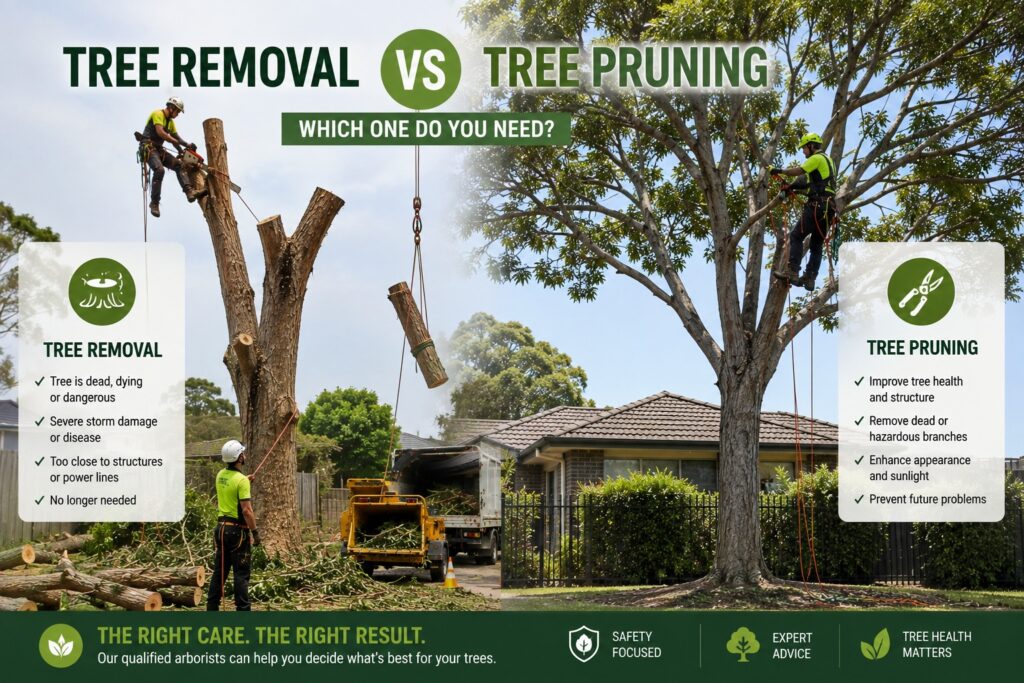
Tree Removal vs Tree Pruning: Which One Do You Need?
The choice between tree removal and tree pruning comes down to the tree’s health, structure, location and safety risk. If the tree can remain healthy and structurally sound with the right pruning, removal may be unnecessary. But if the tree is dead, severely damaged, unstable or creating an unacceptable hazard, professional removal may be the safer option.
I know how easy it is to look at an overgrown or unhealthy tree and think, “That probably needs to come down.”
But tree removal isn’t always the right answer.
Sometimes the tree simply needs proper pruning to remove dead branches, reduce excessive growth or improve its structure. In other situations, pruning only delays a problem that ultimately requires complete removal.
That is why I don’t recommend deciding between pruning and removal based only on how the tree looks from the ground.
The right decision depends on what is happening inside and around the tree.
A professional assessment considers the tree’s health, branch structure, trunk condition, roots, surrounding buildings, access and potential hazards before recommending the work.
What is the difference between tree removal and tree pruning?
Tree pruning removes selected branches to improve a tree’s health, safety or structure, while tree removal involves removing the entire tree when it can no longer be safely retained.
Pruning is generally about managing a tree that is worth keeping.
Removal is about taking out a tree that has become unsuitable, unsafe or no longer viable for its location.
Professional pruning may involve:
- Removing dead or damaged branches.
- Removing diseased limbs.
- Reducing excessive canopy growth.
- Improving clearance around structures.
- Managing branches near access areas.
- Improving airflow and light penetration.
- Correcting certain structural problems.
Tree removal is more extensive.
It involves safely dismantling or felling the entire tree and managing the resulting timber, branches and stump.
Eco Tree Services provides both tree pruning and maintenance services and professional tree removal services across Brisbane, so the appropriate option can be assessed based on the actual condition of the tree rather than automatically choosing removal.
Skimmable takeaway: Tree pruning keeps a suitable tree in place by selectively removing branches, while tree removal eliminates the entire tree when health, structure, location or safety concerns make retention unsuitable.
When does a tree need pruning instead of removal?
A tree generally needs pruning instead of removal when it remains healthy and structurally sound but has branches that require management.
This is one of the most important distinctions homeowners need to understand.
An overgrown tree isn’t necessarily a dangerous tree.
You may simply have branches growing:
- Towards your roof.
- Over a driveway.
- Across a walkway.
- Into another tree.
- Towards power infrastructure.
- Too heavily on one side.
- Too densely through the canopy.
In these situations, appropriate pruning may solve the problem without removing the entire tree.
Pruning may be appropriate when:
The tree still has healthy growth and a stable trunk.
The problem affects individual branches rather than the entire tree.
Deadwood needs to be removed.
The canopy has become excessively dense.
Branches require clearance from buildings or access areas.
The tree needs structural management as it grows.
The goal should be to remove only what is necessary.
Over-pruning can create its own problems, which is why I recommend using a qualified tree pruning company rather than treating pruning as simply cutting branches off.
Skimmable takeaway: Pruning is usually the better option when a tree remains healthy and stable but has deadwood, excessive growth, poor branch clearance or manageable structural issues.
When does a tree need to be removed?
Tree removal becomes appropriate when a tree is dead, severely declining, structurally unstable, extensively damaged or creating a safety risk that cannot be reasonably managed through pruning.
Some warning signs include:
- Significant trunk decay.
- Large cavities.
- Major structural cracks.
- Extensive deadwood.
- Severe root damage.
- A dangerous lean.
- Major storm damage.
- Severe disease or decline.
- Large unstable branches.
- A location where failure could seriously damage property or injure someone.
The important point is that the tree doesn’t need to look completely dead before removal becomes necessary.
A tree can still have green leaves while suffering from serious structural problems.
For example, a mature tree beside a house may have a healthy-looking canopy but significant decay in the trunk.
That’s why I look at the whole tree rather than relying on one visible symptom.
If removal is necessary, a professional tree removal service can determine the safest way to dismantle and remove it.
Skimmable takeaway: Removal may be necessary when a tree has severe decay, structural instability, major damage, extensive decline or an unacceptable risk that pruning cannot resolve.
Can pruning save a damaged or unhealthy tree?
Sometimes pruning can help manage a damaged or unhealthy tree, but it cannot fix every tree problem.
This is where professional assessment matters.
For example, imagine a large tree that has lost several branches during a storm.
If the trunk remains stable and most of the canopy is healthy, selective pruning may remove damaged limbs and allow the tree to remain.
Now consider a different situation.
The same tree has a large trunk split, significant decay and damaged roots.
Removing a few branches won’t solve the underlying structural problem.
In that situation, pruning may reduce some immediate hazards but won’t make the tree structurally sound again.
A qualified arborist needs to determine whether the damage is localised or whether it affects the tree’s overall stability.
Skimmable takeaway: Pruning can help when damage is limited and the tree remains structurally sound, but it cannot reverse severe decay, major trunk defects or serious root instability.
What are the signs that pruning is the better option?
Pruning is often the better option when the tree is healthy overall and the problem can be solved by selectively removing specific branches.
Look for situations such as:
Dead branches but a healthy main structure
Deadwood can often be removed without removing the entire tree.
Overgrown canopy
Excessive growth can sometimes be managed through appropriate crown pruning.
Branches affecting buildings
Branches growing towards roofs, gutters or structures may need selective reduction or removal.
Poor clearance
Pruning can improve clearance around driveways, paths and outdoor areas.
Structural management
Some trees benefit from formative or corrective pruning while they are still healthy.
Seasonal maintenance
Regular professional maintenance can help identify problems before they become significant.
Eco Tree Services’ pruning service includes options such as crown thinning, crown lifting, crown reduction and deadwood removal, depending on the tree’s needs.
Skimmable takeaway: Pruning is generally preferable when the tree remains healthy but has manageable branch growth, deadwood, clearance issues or structural concerns.
What are the signs that tree removal is necessary?
Tree removal is more likely to be necessary when the tree presents a significant structural or safety risk that cannot be adequately managed through pruning.
Watch for:
- Extensive trunk decay.
- Large cracks or splits.
- Significant root damage.
- Major cavities.
- Severe storm damage.
- A tree that is substantially dead.
- Large branches that are structurally compromised.
- Severe leaning combined with root or structural problems.
- A tree threatening buildings or other high-value targets.
I also pay close attention to the location.
A structurally questionable tree in an empty part of a large property presents a different risk from the same tree growing directly beside a bedroom, driveway or frequently used pathway.
This is why tree risk isn’t determined by appearance alone.
Eco Tree Services also identifies hazardous placement, storm damage, dead or dying trees and disease or pest issues among situations where removal may be required.
Skimmable takeaway: Removal becomes more appropriate when structural defects, decay, root problems, severe damage or location create a risk that cannot be safely managed through pruning.
Is tree pruning cheaper than tree removal?
Tree pruning is generally less extensive than complete tree removal, but the actual cost depends on the size, access, complexity and condition of the tree.
A small pruning job may be relatively straightforward.
A large tree requiring climbing, rigging and extensive branch removal can become considerably more involved.
Tree removal can require additional work such as:
- Controlled dismantling.
- Rigging.
- Heavy equipment.
- Debris processing.
- Timber removal.
- Stump grinding.
- Restricted-access work.
This is why I don’t recommend choosing pruning simply because it appears cheaper.
If a tree genuinely needs removal, repeatedly pruning it can eventually become a false economy.
On the other hand, removing a healthy tree that could have been safely managed through pruning is unnecessary.
The correct decision should come first. Cost comes after that.
Skimmable takeaway: Pruning is often less extensive than removal, but price depends on tree size, access, complexity and equipment. The safest long-term solution should determine the service, not price alone.
Can pruning prevent the need for tree removal?
Regular professional pruning can reduce some tree-related risks and help maintain healthy structure, but it cannot prevent every tree from eventually requiring removal.
Good tree maintenance can help identify:
- Deadwood.
- Weak branches.
- Poor branch unions.
- Excessive growth.
- Disease symptoms.
- Storm damage.
- Developing structural problems.
Early intervention may allow manageable problems to be addressed before they become serious.
However, pruning cannot reverse severe trunk decay, major root failure or a tree that has reached an unsafe structural condition.
This is why I see pruning as part of preventative tree care rather than a guarantee that a tree will never need removal.
Eco Tree Services also recommends regular maintenance and assessment as part of keeping Brisbane trees healthy and safe.
Skimmable takeaway: Regular pruning can help maintain tree structure and identify problems early, but it cannot prevent removal when severe decay, root failure or structural instability develops.
What happens during professional tree pruning?
Professional tree pruning starts with assessing the tree and identifying which branches need to be removed before making controlled cuts.
The arborist considers the tree’s:
- Species.
- Age and condition.
- Branch structure.
- Canopy density.
- Surrounding buildings.
- Access.
- Powerline proximity.
- Overall safety.
The goal isn’t simply to make the tree smaller.
The goal is to make appropriate cuts that address the identified problem while maintaining healthy structure.
Depending on the tree, pruning may include deadwood removal, crown lifting, crown thinning or crown reduction.
Poor pruning can cause unnecessary wounds or leave the tree with an unnatural structure.
That’s why I recommend a best tree pruning service that focuses on the tree’s long-term health rather than simply removing as many branches as possible.
For a closer look at what to consider when choosing a qualified arborist, Eco Tree Services also covers the subject in Hiring a Qualified Arborist: A Checklist for Your Peace of Mind.
Skimmable takeaway: Professional pruning involves assessing the tree, identifying specific branch problems and making controlled cuts that improve safety, structure and tree health without unnecessary removal.
What happens during professional tree removal?
Professional tree removal involves assessing the site, planning the removal method, safely dismantling the tree and clearing the resulting debris.
A removal job can involve several stages.
1. Site assessment
The arborist examines the tree and surrounding property.
2. Removal planning
The team determines whether the tree can be felled or needs to be dismantled in sections.
3. Controlled dismantling
Branches and sections of the trunk may be lowered carefully when buildings, fences or other obstacles are nearby.
4. Debris processing
Branches and timber are removed or processed according to the agreed scope.
5. Stump management
If required, stump grinding can be arranged separately.
6. Final cleanup
The work area is cleared so the property is left safe and usable.
Eco Tree Services explains this structured approach in its guide on How Arborists Remove Trees Safely, where the removal process includes assessment, controlled dismantling, stump treatment and final site cleanup.
Skimmable takeaway: Professional tree removal follows a planned process involving site assessment, controlled dismantling, debris management, optional stump treatment and final cleanup.
Can you remove a tree and roots at the same time?
Tree removal and root removal are separate parts of the job, and you do not always need to remove the entire root system after taking down a tree.
Once the tree has been removed, the stump remains unless you arrange stump grinding or another form of stump removal.
The right approach depends on what you plan to do with the area.
For example, if you’re simply opening up space in the garden, stump grinding may be sufficient.
If you’re preparing the area for construction or another significant landscaping project, additional root and stump work may be required.
I recommend discussing this before the work begins so the quote reflects what you actually want completed.
Eco Tree Services also provides stump grinding services as part of its wider tree-care offering.
Skimmable takeaway: Removing the tree does not automatically remove the stump or roots. Stump grinding and additional root removal should be discussed separately based on the property’s future use.
Should you prune or remove a tree near your house?
A tree near your house should be professionally assessed before you decide whether pruning or removal is appropriate.
Location changes the risk.
A healthy tree beside your house may only need selective pruning to maintain clearance.
A tree with significant decay beside the same house may require removal.
The assessment should consider:
- Distance from the building.
- Tree height.
- Branch spread.
- Trunk condition.
- Root stability.
- Potential fall direction.
- Access for equipment.
- Nearby fences and structures.
Don’t assume that every tree close to a house needs to be removed.
Likewise, don’t assume that pruning will make every hazardous tree safe.
The solution depends on the actual risk.
Eco Tree Services specifically handles residential tree work, including pruning, maintenance, deadwood management and full tree removal, including jobs involving tight access and technical climbing.
Skimmable takeaway: Trees near houses do not automatically require removal. The decision between pruning and removal depends on the tree’s condition, structure, location, access and potential consequences of failure.
How do Brisbane tree experts decide between pruning and removal?
Brisbane tree experts assess the tree’s health, structure, roots, location and surrounding risks before deciding whether pruning or removal is appropriate.
A professional assessment should answer a simple question:
Can this tree remain safely in place?
If yes, the next question becomes:
What work is needed to keep it healthy and safe?
That could mean:
- Routine pruning.
- Deadwood removal.
- Crown reduction.
- Structural pruning.
- Monitoring.
- Tree maintenance.
If the answer is no, removal may be the appropriate solution.
Eco Tree Services works with qualified arborists and states that its team has extensive arboricultural training and experience, including AQF Level III climbing arborists.
This distinction is important because you don’t want a contractor recommending removal simply because it’s easier.
You also don’t want someone recommending pruning when the tree has already become structurally unsafe.
Skimmable takeaway: Brisbane tree experts should assess whether a tree can safely remain before recommending work, with pruning used for manageable problems and removal considered when the tree cannot be safely retained.
Why does professional assessment matter?
Professional assessment matters because the safest and most cost-effective solution isn’t always obvious from the ground.
A tree may look healthy but have structural problems.
Another may look unhealthy but still be perfectly capable of remaining in the landscape with appropriate care.
A qualified arborist considers factors that aren’t obvious to most homeowners.
That includes tree biology, branch unions, trunk defects, root condition, disease, pests and surrounding targets.
It also helps you avoid unnecessary work.
If pruning solves the problem safely, there’s no reason to remove the whole tree.
If removal is genuinely necessary, an assessment helps determine the safest method.
Before hiring anyone, I also recommend checking qualifications, insurance and whether the quote clearly explains the work being proposed. Eco Tree Services’ arborist checklist recommends checking qualifications, insurance and getting a detailed written quote before work begins.
Skimmable takeaway: Professional assessment reduces guesswork by considering tree health, structure, roots, location and risk before recommending pruning or removal.
Tree Removal vs Tree Pruning: Which service do you actually need?
If your tree is healthy but overgrown, damaged in isolated areas or causing manageable clearance problems, professional pruning is usually the first option to investigate. If the tree is dead, severely decayed, unstable or poses a risk that pruning cannot resolve, removal may be necessary.
The biggest mistake I see homeowners make is treating pruning and removal as interchangeable services.
They aren’t.
Pruning is about managing and preserving a tree.
Removal is about safely taking the tree out.
The right choice comes down to the condition of the tree and whether it can safely remain where it is.
If you’re unsure, start with an assessment rather than making the decision yourself.
That way, you can understand whether you actually need a tree pruning company, a specialist tree removal service, or another form of tree care.
If removal is required, Eco Tree Services provides professional tree removal across Brisbane and South East Queensland. If pruning is sufficient, its dedicated pruning and maintenance team can help manage the tree without unnecessarily removing it.
Frequently Asked Questions
Is tree pruning better than tree removal?
Pruning is better when the tree is healthy enough to remain safely in place. Pruning removes selected branches while preserving the tree, whereas removal is appropriate when the tree has become unsafe, severely damaged or unsuitable for its location.
How do I know whether my tree needs pruning or removal?
Look at the tree’s overall health, structure and safety rather than one symptom. A healthy tree with dead branches may only need pruning, while extensive decay, severe leaning, major root damage or structural instability may indicate that removal is necessary.
Can pruning stop a tree from becoming dangerous?
Pruning can reduce some risks but cannot fix every structural problem. Removing dead or unstable branches can improve safety, but severe trunk decay, root failure or major structural defects may still require removal.
Is tree removal more expensive than tree pruning?
Tree removal is generally more extensive, but the cost depends on the individual job. Tree size, access, equipment requirements, condition and whether stump grinding or debris removal is included can all affect the final price.
Can a diseased tree be pruned instead of removed?
Yes, some diseased trees can be managed through professional pruning. If the disease affects specific branches while the main structure remains healthy, removing affected material may be appropriate. Severe disease combined with structural decline can change the recommendation.
Should I remove a tree that is close to my house?
Not automatically. A tree close to a house may only require pruning if it is healthy and structurally sound. If it has significant decay, unstable branches or root problems, removal may be safer.
Can I prune a tree myself?
Small, low-risk pruning may be possible, but large trees and branches near buildings or infrastructure should be handled professionally. Tree work can involve falling branches, climbing hazards and unpredictable movement, particularly when large limbs are involved.
What is the difference between tree pruning and tree lopping?
Pruning is targeted tree care, while lopping generally involves indiscriminate or excessive branch removal. Professional pruning focuses on tree health, structure and safety rather than simply cutting the canopy down.
Do I need stump removal after tree removal?
Not always. Tree removal leaves a stump unless stump grinding or another stump-removal method is included. Whether you need it removed depends on your landscaping plans and how you intend to use the area.
What does tree and root removal include?
Tree and root removal can involve removing the tree, stump and additional roots where required, but these are often separate parts of the overall work. The exact scope should be confirmed before the job begins.
When should I call Brisbane tree experts?
Call Brisbane tree experts when you’re unsure whether a tree needs pruning or removal, particularly if it is large, damaged, diseased, leaning or close to buildings and infrastructure. Professional assessment can help you choose the safest option.