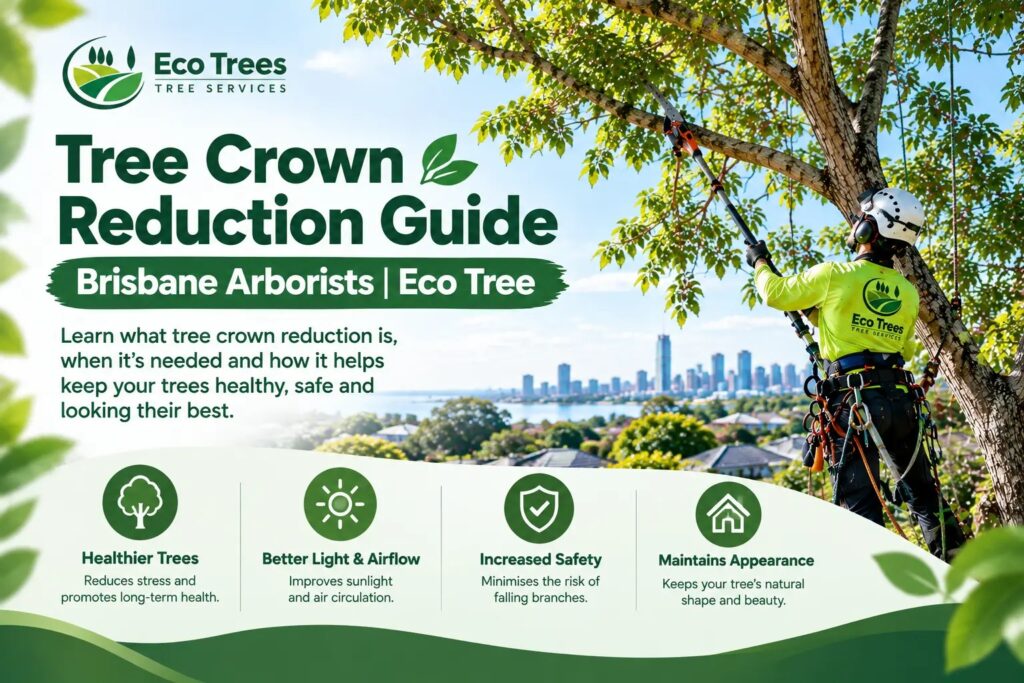
Tree Crown Reduction Guide: What It Is, Benefits and When You Need It
Tree crown reduction is a professional pruning technique used to reduce the overall height and spread of a tree’s canopy while preserving as much of its natural structure as possible. It is not the same as simply cutting branches shorter, and it should never mean removing large amounts of the canopy at random.
At Eco Tree Services, I often find that homeowners know their tree has become too large for its surroundings but are unsure what the right solution is.
Should they trim it? Thin it? Cut the height down? Remove some large branches? Or remove the entire tree?
That confusion is understandable because several tree pruning techniques can look similar from the ground.
Crown reduction has a specific purpose. When performed correctly, it can help manage a tree that has outgrown its available space, reduce selected canopy dimensions and address clearance or structural concerns without immediately resorting to tree removal.
The important part is how much is removed, where the cuts are made and whether the tree is suitable for reduction in the first place.
What is tree crown reduction?
Tree crown reduction is the selective reduction of a tree’s overall canopy size, usually by shortening branches back to suitable lateral branches while maintaining the tree’s natural form and structural balance.
The crown is the part of the tree made up of its branches and foliage above the main trunk.
When that crown grows beyond the space available to it, selective reduction can help bring the canopy back into better proportion with the property.
This does not mean cutting the top off the tree or making random cuts halfway along branches.
A proper reduction plan considers the existing branch structure and identifies appropriate pruning points that allow the remaining branches to continue developing naturally.
Eco Tree Services lists crown reduction as a specific pruning technique designed to reduce canopy size while managing growth and maintaining structural integrity.
The distinction matters because poor reduction can create new problems rather than solving the original one.
Skimable summary: Tree crown reduction reduces the overall height or spread of a tree’s canopy through selective pruning. The aim is to manage the tree’s size while preserving its natural structure, rather than simply cutting branches back indiscriminately.
Why would a tree need crown reduction?
A tree may need crown reduction when its canopy has grown beyond the available space or is creating clearance, structural or property-related problems.
A healthy tree does not necessarily need reduction simply because it is large.
I look at the relationship between the tree and everything around it.
For example, a mature tree may have gradually extended over a roof, driveway or outdoor living area. Its branches may now occupy space that was never a problem when the tree was smaller.
Common reasons for considering crown reduction include:
- Branches extending too far over a building
- Excessive canopy spread
- A tree becoming too large for its location
- Branches creating clearance problems
- Excessive shading
- Managing selected structural concerns
- Reducing the size of an overextended canopy
- Maintaining appropriate separation from surrounding property
The supplied O’Brien’s Tree Care guide similarly explains crown reduction as a technique for trees that have outgrown their available space or create potential hazards around structures.
However, I would not automatically recommend reduction whenever a homeowner says, “The tree is too big.”
The first question should be whether the tree actually needs to become smaller or whether another pruning technique would solve the problem.
Skimable summary: Crown reduction is considered when a tree has outgrown its available space or creates problems involving height, spread, clearance, shade or structure. A large tree is not automatically a tree that needs reduction.
How is crown reduction different from crown thinning?
Crown reduction reduces the overall size of the canopy, while crown thinning reduces canopy density without primarily reducing the tree’s overall dimensions.
This is one of the most important distinctions in professional tree pruning.
Imagine a tree that is not particularly wide or tall but has become extremely dense inside the canopy.
That tree may need crown thinning rather than crown reduction.
Now imagine another tree that has grown several metres beyond the space available to it and is extending over a roof.
That situation may call for crown reduction.
The two techniques solve different problems.
Crown reduction
Reduces selected branch length and the overall canopy dimensions.
Crown thinning
Selectively removes branches throughout the canopy to reduce density and improve light and airflow.
Crown lifting
Removes selected lower branches to create clearance beneath the canopy.
Deadwood removal
Removes dead, dying or broken branches for safety and tree health.
Eco Tree Services provides crown thinning, crown lifting, crown reduction and deadwood removal as separate pruning services because each technique has a different purpose.
O’Brien’s Tree Care also distinguishes crown reduction from crown thinning, explaining that reduction focuses on reducing overall canopy size while thinning focuses on density, light penetration and air circulation.
Skimable summary: Crown reduction makes the canopy smaller, crown thinning makes it less dense, crown lifting creates clearance underneath and deadwood removal targets dead or damaged branches. Choosing the right technique depends on the actual problem.
When is crown reduction the right solution?
Crown reduction is appropriate when reducing the tree’s overall size can solve a genuine space, clearance or structural problem without compromising the tree’s health.
I generally look for a practical reason for reduction rather than recommending it purely for appearance.
For example, consider a mature tree growing beside a Brisbane home.
The tree is healthy, but its branches have gradually extended across the roof. The homeowner wants to keep the tree because it provides shade and contributes to the garden.
Removing the entire tree may be unnecessary.
If the species, structure and condition allow it, a carefully planned crown reduction may bring the canopy back from the building while allowing the tree to remain.
That is where reduction can provide a middle ground between doing nothing and removing the tree.
The NGH Tree Care reference similarly describes crown reduction as useful when trees outgrow their surroundings, extend toward roofs or create excessive shade, while emphasising that reduction should be planned rather than treated as ordinary trimming.
Skimable summary: Crown reduction is most useful when a healthy tree has become too large for its available space and selective size reduction can solve the problem while retaining the tree.
What are the benefits of tree crown reduction?
When properly planned and carried out, crown reduction can help manage canopy size, improve clearance, reduce selected branch loads and maintain a tree within a more suitable space.
The benefits depend on why the tree needs reduction in the first place.
Better property clearance
Reducing selected branches can create more space between the canopy and nearby roofs, structures or other property features.
Improved canopy management
A tree that has significantly overextended can become easier to manage after an appropriate reduction.
Reduced branch weight
Reducing selected branch length can decrease the weight carried toward the ends of some limbs.
Improved appearance
A professionally reduced tree should retain a natural shape rather than appearing flat, chopped or artificially rounded.
Retaining a healthy tree
Perhaps the biggest benefit is that suitable crown reduction can sometimes allow homeowners to retain a healthy tree rather than removing it solely because it has outgrown its location.
Tree Care Specialists identifies safety, aesthetics, health, sunlight and airflow among the potential benefits of appropriate crown reduction.
However, I would avoid promising that crown reduction makes a tree “storm-proof.” No pruning technique can guarantee that.
Skimable summary: Crown reduction can improve clearance, manage canopy size, reduce selected branch loads and preserve a suitable healthy tree. The result depends on the species, condition, structure and quality of the pruning.
How is a tree crown reduction performed?
A professional crown reduction starts with assessment and planning before any branches are cut.
At Eco Tree Services, I would first assess the tree’s condition, structure, size and relationship with the surrounding property.
The reduction then needs to be planned around appropriate pruning points rather than simply deciding how many metres to remove.
Step 1: Assess the tree
The arborist checks the canopy, trunk, branch unions, defects, deadwood and general health.
Step 2: Identify the problem
We determine whether the issue is excessive height, canopy spread, clearance, branch weight or another concern.
Step 3: Plan the reduction
The intended reduction should be proportionate to the tree and its condition.
Step 4: Select appropriate branches
Branches are shortened back to suitable lateral growth rather than cut randomly.
Step 5: Maintain natural structure
The arborist works to retain a balanced canopy rather than creating a flat or artificial shape.
Step 6: Review the finished canopy
The tree is checked from different angles to make sure the reduction is even and the remaining structure is appropriate.
Tree Care Specialists’ guide similarly describes assessment, planning, controlled cutting and a final inspection as key parts of the reduction process.
Skimable summary: Crown reduction involves assessment, planning, selective branch reduction and a final structural check. The arborist should reduce the canopy to suitable lateral branches rather than making random or stub cuts.
How much can a tree be reduced safely?
There is no single reduction percentage that is safe for every tree. The amount depends on the species, age, health, structure, existing canopy and the reason for the work.
This is where generic online advice can become misleading.
You may see recommendations suggesting that a certain percentage can always be removed.
I would not treat that number as a universal rule.
A mature tree under stress may respond very differently from a healthy tree with vigorous growth. Some species also tolerate pruning differently.
The objective should be to remove only what is necessary to achieve the intended outcome while retaining enough healthy canopy for the tree to continue functioning normally.
The NGH reference also stresses that the amount of reduction should be determined according to the individual tree’s species, size and condition.
If a tree requires a very large reduction to solve a property problem, that can be a sign that the location and tree size need a more serious assessment.
Skimable summary: Safe crown reduction has no universal percentage. The amount should be determined from the tree’s species, size, condition, structure and the problem being addressed.
Can crown reduction damage a tree?
Yes, incorrect crown reduction can damage a tree, particularly when too much live canopy is removed or branches are cut at inappropriate points.
This is why crown reduction should not be treated as ordinary garden trimming.
One of the biggest problems I see in poor pruning is excessive cutting.
Removing large sections of the canopy can place unnecessary stress on the tree and may encourage unwanted regrowth.
Another problem is making cuts at random points along branches.
The NGH Tree Care reference specifically warns that random stub cuts can trigger rapid epicormic growth, creating clusters of weak shoots around the cuts.
Tree Care Specialists also identifies over-pruning as one of the common mistakes that can stress a tree.
A good crown reduction should therefore look controlled.
You should still see the tree’s natural character when the work is finished.
Skimable summary: Poor crown reduction can stress a tree and encourage weak regrowth. Excessive canopy removal and random stub cuts are major problems, which is why reduction should be planned and performed selectively.
When is the best time for crown reduction?
The best time for crown reduction depends on the tree species, local climate, tree condition and reason for pruning.
There is no single month that applies to every Brisbane tree.
Tree Care Specialists notes that late winter to early spring is often suitable for crown reduction, while species-specific requirements still need to be considered.
For Brisbane and South East Queensland, I prefer to assess the actual tree rather than apply a rigid calendar.
Seasonal maintenance is particularly important because wet-season storms can expose weak branches and structural problems.
Our guide to tree maintenance during Queensland’s wet season explains why putting off routine tree care can increase the chance of more serious problems during severe weather.
Likewise, homeowners preparing their trees for seasonal changes can use our advice on tree care before winter.
Skimable summary: Crown reduction timing depends on species, climate, health and purpose. Late winter or early spring may suit some trees, but Brisbane trees should be assessed individually rather than following a universal pruning calendar.
Is crown reduction suitable for pruning small trees?
Yes, but pruning small trees usually focuses on establishing good structure rather than repeatedly reducing their overall size.
A young tree can often be managed more easily before structural problems become significant.
For example, if two branches are competing for the same space, addressing that problem early may prevent a much larger corrective pruning job later.
But I would not reduce a young tree simply because you want to keep it small.
Trees are living structures that need sufficient foliage to support healthy development.
Early formative pruning should have a clear purpose.
For residential properties, that might include:
- Removing a poorly positioned branch
- Improving branch spacing
- Establishing suitable clearance
- Correcting competing leaders
- Removing damaged growth
- Guiding future canopy development
The goal is to create a better-structured tree, not repeatedly force it into a size it cannot naturally maintain.
Skimable summary: Crown reduction can be appropriate for smaller trees in specific circumstances, but pruning small trees should generally focus on formative structure, clearance and healthy development rather than aggressive size reduction.
Is crown reduction the same as tree pruning and tree trimming?
No. Crown reduction is a specific type of pruning, while tree pruning and tree trimming can describe a much broader range of work.
This distinction matters when you are searching for a contractor.
A homeowner might search for tree trimming because the tree looks too large, but the actual work required may be crown reduction.
Another homeowner might need deadwood removal, crown thinning or crown lifting.
Simply asking someone to “trim the tree” does not explain the problem.
At Eco Tree Services, our tree pruning and maintenance services cover several techniques, including crown reduction, crown thinning, crown lifting and deadwood removal.
I recommend describing the problem first.
For example:
“My tree is extending over my roof.”
That gives an arborist something useful to assess.
Skimable summary: Crown reduction is one specific pruning technique. Tree pruning and tree trimming are broader terms that can include reduction, thinning, lifting and deadwood removal depending on the tree’s needs.
Can crown reduction prevent tree removal?
Sometimes, crown reduction can help retain a healthy tree that has simply become too large for its location, but it cannot solve every structural or health problem.
This is an important distinction.
A tree does not need to be removed just because it has become inconvenient.
If the tree is healthy and the main issue is excessive canopy size, appropriate reduction may provide a practical solution.
But if the tree has severe decay, major structural defects, significant instability or another serious hazard, reducing the canopy may not remove the underlying problem.
Our guide to signs your tree needs removing explains some of the situations where continued pruning may no longer be the safest option.
I always prefer to identify whether the problem is manageable before recommending removal.
Skimable summary: Crown reduction can sometimes retain a healthy tree that has outgrown its space, but it cannot correct every structural or health defect. Serious hazards require a broader arboricultural assessment.
When should you hire a tree pruning company for crown reduction?
You should hire a tree pruning company when the tree is large, difficult to access, close to buildings or power lines, structurally complex or requires significant canopy reduction.
Crown reduction involves working with the tree’s structural framework.
It also often involves climbing, chainsaws, ropes and the controlled lowering of branches.
That creates risks that are difficult to manage with basic household equipment.
I would be particularly cautious if the tree:
- Overhangs a house
- Sits beside a driveway
- Is close to power infrastructure
- Has large or heavy branches
- Has visible decay
- Has previously suffered storm damage
- Requires climbing
- Has a complex or unstable structure
Choosing the best tree pruning service should therefore involve more than comparing quotes.
Look for qualified arboricultural experience, appropriate insurance, safe work practices and a clear explanation of the proposed pruning.
Eco Tree Services provides professional tree pruning and maintenance across Brisbane and South East Queensland.
Skimable summary: Hire a professional tree pruning company when crown reduction involves height, heavy branches, structures, power lines or complex tree structure. Arboricultural assessment and safe work practices are essential for significant reductions.
How does Eco Tree Services approach crown reduction?
We start by identifying the problem the tree is causing and then determine whether crown reduction is actually the right solution.
I do not believe in reducing a tree simply because someone wants it “smaller.”
The tree still needs to remain healthy, structurally balanced and appropriate for its surroundings.
Our assessment considers:
Tree condition
Is the tree healthy enough for the proposed work?
Structure
Are there weak unions, competing branches, deadwood or other defects?
Location
How close is the canopy to the roof, driveway, fence, garden or other structures?
Canopy size
How much does the tree actually need to be reduced?
Long-term management
Will the proposed reduction solve the problem or simply create a cycle of repeated heavy pruning?
Our Brisbane tree care checklist can also help homeowners identify routine tree-care issues before they develop into larger problems.
If a storm has already affected the tree, our guidance on signs your tree is unsafe before cyclone season is another useful resource.
Skimable summary: Eco Tree Services assesses tree health, structure, location, canopy size and long-term requirements before recommending crown reduction. The objective is to solve the property problem while protecting the tree’s future condition.
What should you expect after a professional crown reduction?
A correctly reduced tree should look smaller and more controlled while still retaining its natural form and sufficient healthy foliage.
The result should not look like the tree has simply been chopped down from the outside.
The canopy should remain balanced.
The branch structure should still make sense.
And the reduction should address the original reason for the work.
For example, if branches were extending over a roof, you should see improved clearance without the tree appearing severely stripped.
If the objective was to reduce excessive spread, the canopy should sit more comfortably within its available space.
Good crown reduction is therefore partly about what is removed and partly about what remains.
Skimable summary: A professional crown reduction should leave a naturally shaped, balanced canopy with improved clearance or reduced spread. The tree should look managed rather than severely cut back.
Tree crown reduction guide: the simple answer
Tree crown reduction is the selective reduction of a tree’s overall canopy height or spread to manage its size while preserving its natural structure. It is most useful when a healthy tree has outgrown its available space or is creating clearance or structural concerns.
It is not the same as crown thinning.
It is not the same as crown lifting.
And it is definitely not the same as cutting branches back at random points.
If your tree has become too large for the space around it, I recommend getting the tree assessed before deciding what type of pruning it needs.
In some cases, crown reduction may allow you to retain a healthy tree while solving a genuine property problem.
In others, crown thinning, crown lifting, deadwood removal or even tree removal may be more appropriate.
The right answer comes from assessing the tree first rather than deciding on the pruning technique before anyone has seen it.
At Eco Tree Services, our goal is simple: solve the problem while protecting the tree wherever it is practical and safe to do so.