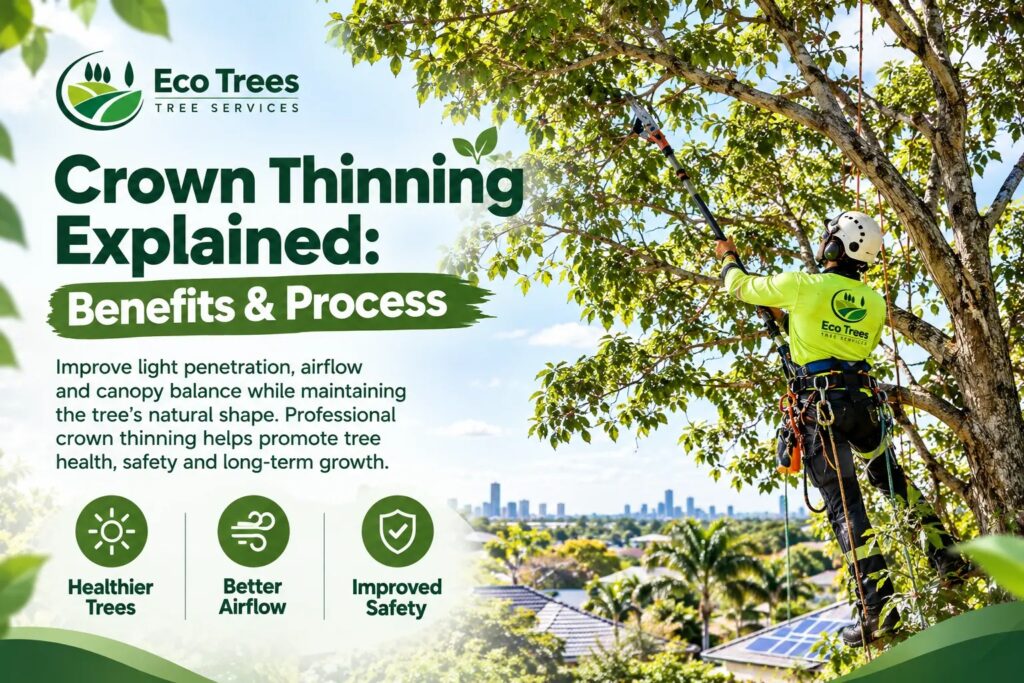
Crown Thinning Explained: What It Is, Benefits and When Trees Need It
Crown thinning is a selective pruning technique that reduces the density of a tree’s canopy without significantly changing its overall size or natural shape. Done correctly, it can improve airflow, increase light penetration, reduce excessive branch weight and help maintain a healthier, better-balanced tree.
At Eco Tree Services, we often speak with Brisbane homeowners who know their tree looks too dense but are unsure what type of pruning it actually needs.
Some assume the entire canopy needs to be cut back. Others think removing a few large branches is the same as crown thinning.
It isn’t.
Crown thinning involves carefully selecting and removing branches throughout the canopy while keeping the tree’s natural structure and appearance. The objective is not to make the tree smaller. The objective is to make the canopy less crowded.
What is crown thinning?
Crown thinning is the selective removal of branches and foliage throughout a tree’s canopy to reduce density while preserving its natural shape.
Rather than cutting the outside of the tree back heavily, an arborist identifies selected branches within the canopy and removes them strategically.
This creates more space between branches and allows sunlight and air to move through areas that were previously overcrowded.
Eco Tree Services lists crown thinning as one of its professional pruning techniques, specifically describing it as reducing foliage density to improve light and airflow.
The important word here is selective.
Crown thinning should not involve randomly removing branches until the tree looks sparse. Each cut should have a reason.
For example, if a mature tree has several crossing branches creating a dense section in the middle of the canopy, an arborist may selectively remove some of that growth rather than cutting large limbs from the outside.
Skimable summary: Crown thinning reduces canopy density by selectively removing branches while maintaining the tree’s natural size, shape and structure. It is primarily used to improve light, airflow and canopy balance rather than dramatically reduce tree height.
How does crown thinning actually work?
A professional crown thinning job involves assessing the canopy, identifying suitable branches for removal and making selective cuts that distribute foliage more evenly.
The process normally starts with an assessment of the whole tree.
I look at the structure, branch unions, canopy density, deadwood, competing branches, surrounding property and the tree’s overall condition before deciding what needs to be removed.
The basic crown thinning process
- Assess the tree: Identify structural problems, dense areas, damaged branches and the tree’s overall health.
- Identify suitable branches: Select smaller or poorly positioned branches that can be removed without unnecessarily stressing the tree.
- Distribute the cuts: Avoid concentrating too many cuts in one section of the canopy.
- Preserve the natural shape: Maintain the tree’s characteristic form rather than creating an artificial appearance.
- Check the final canopy: Make sure enough healthy foliage remains and the canopy is still structurally balanced.
The supplied Hickson Wardle reference describes crown thinning as carefully removing smaller branches throughout the canopy while retaining the natural shape and silhouette.
This is why crown thinning is not simply a matter of getting into a tree and cutting branches wherever the canopy looks thick.
Skimable summary: Crown thinning requires selective branch removal throughout the canopy. The arborist should distribute cuts carefully, retain healthy foliage and preserve the tree’s natural structure rather than simply making the canopy look thinner.
Why would a Brisbane tree need crown thinning?
A tree may need crown thinning when its canopy becomes excessively dense, restricts airflow or light, develops competing growth or carries unnecessary branch weight.
Brisbane’s growing conditions can produce vigorous tree growth, and a dense canopy can become difficult to manage around residential properties.
Some common reasons for considering crown thinning include:
- Excessively dense foliage
- Poor airflow through the canopy
- Heavy internal growth
- Branches competing for space
- Reduced light reaching gardens below
- Overcrowded branch structure
- Certain storm-preparation concerns
- Managing selected growth around a property
However, I would not recommend crown thinning simply because a tree looks large.
A large tree can be perfectly healthy and structurally sound.
The question should be whether the canopy is causing a specific problem and whether thinning is the correct solution.
Our tree pruning and maintenance service includes crown thinning alongside crown lifting, crown reduction and deadwood removal.
Skimable summary: Crown thinning can be useful when a canopy is excessively dense or poorly distributed. The technique should solve a specific tree-health, structure, light, airflow or management issue rather than being performed simply to make a tree look smaller.
What are the benefits of crown thinning?
The main benefits of crown thinning are improved light penetration, better airflow, reduced canopy density and improved branch distribution while preserving the tree’s natural form.
When done correctly, selective thinning can make a noticeable difference without dramatically changing the appearance of the tree.
Improved airflow
A dense canopy can restrict movement of air through the branches and foliage. Creating carefully selected gaps can improve circulation.
Better light penetration
Thinning can allow more sunlight to reach inner branches and the ground beneath the tree.
This can also make a difference to surrounding gardens where excessive shade has become a problem.
Reduced branch competition
Removing selected competing branches can give the remaining structure more room to develop.
Better canopy balance
Selective cuts can help distribute growth more evenly rather than allowing one section of the tree to become excessively dense.
Maintaining the natural appearance
Unlike aggressive reduction, crown thinning aims to retain the tree’s natural shape.
Hickson Wardle identifies improved airflow, greater light penetration and reduced excessive weight among the reasons for crown thinning.
Skimable summary: Crown thinning can improve airflow and light penetration, reduce overcrowding and help balance the canopy without substantially reducing the tree’s overall size or natural appearance.
Is crown thinning the same as crown reduction or crown lifting?
No. Crown thinning, crown reduction and crown lifting are different pruning techniques designed to solve different problems.
This is one of the biggest areas of confusion I see with homeowners.
Pruning technique | Main purpose |
Crown thinning | Reduce canopy density while maintaining overall shape |
Crown reduction | Reduce the overall size or spread of the canopy |
Crown lifting | Remove lower branches to increase clearance |
Deadwood removal | Remove dead or dying branches for safety and tree health |
For example, if your tree is blocking sunlight because the canopy is extremely dense, crown thinning may be appropriate.
If the entire tree has grown too large for the available space, crown reduction may be more suitable.
If low branches are blocking a driveway or walkway, crown lifting may solve the problem.
Eco Tree Services provides all three techniques as part of its professional tree pruning services.
The Tree Care Specialists reference also distinguishes crown thinning from crown reduction and crown raising, noting that reduction focuses on decreasing overall canopy size while raising removes lower branches.
Skimable summary: Crown thinning reduces density, crown reduction reduces overall canopy size and crown lifting removes lower branches for clearance. Choosing the correct technique depends on the actual problem with the tree.
When is crown thinning the right choice?
Crown thinning is usually the right choice when you want to reduce canopy density without significantly reducing the tree’s overall height or spread.
Imagine a mature backyard tree that still has plenty of space around it but has become extremely dense through the middle.
The homeowner may think, “This tree is too big.”
But when we look at it, the actual issue may be that the canopy is overcrowded rather than oversized.
In that situation, removing selected branches throughout the canopy may address the problem while allowing the tree to retain its natural form.
On the other hand, if the branches are extending significantly over a roof or neighbouring structure, thinning may not provide enough clearance.
That is when another pruning technique may be more appropriate.
Skimable summary: Crown thinning is most suitable when canopy density is the problem but the tree’s overall size is acceptable. If height, spread or clearance is the main concern, another pruning method may be more appropriate.
Is crown thinning suitable for pruning small trees?
Yes, crown thinning can be appropriate for smaller trees, but young trees should not be aggressively thinned simply because they have dense foliage.
Pruning small trees is often about establishing good structure early.
A young tree may develop branches that compete with each other, cross through the canopy or grow in an undesirable direction. Selective pruning can help guide its future structure.
But I always consider how much live growth the tree actually needs.
Removing too much foliage from a young tree can be counterproductive.
The aim should be to make a small number of purposeful cuts rather than treating the tree as a miniature version of a mature tree.
This is particularly important for residential tree pruning because the tree will continue developing after the work is finished.
Skimable summary: Crown thinning can be used on small trees when selective structural pruning is needed, but young trees should not be over-pruned. Early pruning should focus on developing strong, well-spaced growth.
When should crown thinning be carried out?
The best time for crown thinning depends on the tree species, its condition, the reason for pruning and local conditions.
There is no universal month that applies to every Brisbane tree.
The supplied Hickson Wardle reference notes that crown thinning is commonly carried out during the dormant period, while also stating that immediate safety concerns can override normal timing.
For Brisbane, I would assess the individual tree rather than applying a generic calendar.
Seasonal tree maintenance is particularly important before periods of severe weather. Eco Tree Services has also highlighted the risks of neglecting tree maintenance during Queensland’s wet season, when heavy rain and storms can expose weak branches and unstable trees.
Our guide to tree care before winter is also useful for homeowners who want to identify potential problems before seasonal conditions change.
Skimable summary: Crown thinning timing depends on species, tree health, climate and purpose. Seasonal timing matters, but an immediate safety issue should be addressed rather than delayed for an ideal pruning season.
Can crown thinning help before Brisbane storm season?
Crown thinning may help manage certain canopy-density and structural concerns, but it should never be treated as a guarantee against storm damage.
This distinction is important.
You may hear that thinning automatically makes a tree “storm-proof”. It doesn’t.
Trees respond to wind, rain, soil conditions, branch structure, species characteristics and many other factors.
However, appropriate pruning can address weak, dead or poorly positioned branches and may improve the overall structure of a tree.
Eco Tree Services recommends proactive tree maintenance to identify weak branches and structural problems before severe weather creates an emergency.
Our guide to signs your tree may be unsafe before cyclone season can help homeowners identify warning signs that deserve professional assessment.
Skimable summary: Crown thinning can form part of preventative tree maintenance, but it cannot make a tree storm-proof. Professional assessment should identify structural weaknesses and determine whether thinning, another pruning method or removal is appropriate.
Can you crown thin a tree yourself?
You can technically remove branches yourself, but professional crown thinning requires arboricultural knowledge, safe access and an understanding of how individual cuts affect the whole canopy.
The risk increases quickly when a tree is tall or the branches are large.
You also need to understand which branches should remain.
One of the most common mistakes is looking at the canopy from the ground and thinking, “That branch looks unnecessary.”
Once you are inside the canopy, the structural relationship between branches can be very different.
Working near electrical infrastructure creates another serious risk.
Eco Tree Services specifically warns that tree pruning can be dangerous without appropriate equipment and training, particularly when working at height, near power lines or with large branches.
If the tree is large, difficult to access or close to a structure, I recommend getting a qualified arborist to assess it rather than attempting crown thinning yourself.
Skimable summary: DIY crown thinning becomes risky as tree height, branch size and access difficulty increase. Professional pruning is particularly important around buildings, power lines and large or structurally complex trees.
How does a professional tree pruning company approach crown thinning?
A professional tree pruning company should start by identifying the tree’s problem rather than deciding in advance how many branches to remove.
At Eco Tree Services, the assessment comes first.
We consider:
Tree health
Is the tree healthy enough to tolerate the proposed pruning?
Canopy structure
Are branches competing, crossing, damaged or excessively concentrated?
Property surroundings
Are there roofs, fences, vehicles, paths or other structures underneath or around the canopy?
Tree species
Different trees respond differently to pruning, so species characteristics matter.
Desired outcome
Are you trying to improve airflow, increase light, manage structure, improve clearance or address a safety issue?
Only after considering these factors should the pruning approach be selected.
That is also why I would not choose a best tree pruning service based solely on price.
You want someone who can explain what they are removing and, more importantly, why they are removing it.
Skimable summary: A professional tree pruning company should assess tree health, structure, species, surroundings and the desired outcome before selecting branches for removal. The quality of the decision matters as much as the cutting itself.
How does crown thinning fit into residential tree pruning?
Crown thinning is one part of residential tree pruning and should be used only when it matches the tree’s actual needs.
For a typical Brisbane property, pruning might involve several different techniques during the life of a tree.
A young tree may need formative pruning.
A mature tree may need deadwood removal or selective crown thinning.
A tree growing toward a building may need crown reduction or lifting.
A storm-damaged tree may need urgent branch removal.
This is why I avoid treating tree pruning and tree trimming as a one-size-fits-all service.
The right approach changes depending on the tree and the property.
For homeowners looking at ongoing maintenance, our Brisbane tree care checklist provides another useful starting point for identifying seasonal tree-care tasks.
Skimable summary: Crown thinning is one technique within residential tree pruning. The appropriate method can change as a tree grows, develops structural issues or interacts differently with the surrounding property.
What happens if a tree is over-thinned?
Over-thinning can stress a tree, alter its natural appearance and leave too much foliage removed from the canopy.
More pruning does not automatically mean better pruning.
This is particularly important when homeowners ask for “as much as possible to be taken out.”
The tree still needs enough foliage to support its normal biological functions.
The Tree Care Specialists reference warns against over-pruning and notes that removing too many branches can stress the tree.
A good crown-thinning job should therefore look relatively subtle when finished.
You should still recognise the tree.
The objective is to create a better-distributed canopy, not turn a mature tree into a collection of isolated branches.
Skimable summary: Over-thinning can unnecessarily stress a tree and damage its natural appearance. Good crown thinning should be selective and restrained, leaving enough healthy foliage and preserving the tree’s characteristic form.
Crown thinning explained in one simple answer
Crown thinning means selectively removing branches throughout a tree’s canopy to reduce density, improve airflow and light penetration, and maintain a balanced natural shape without significantly reducing the tree’s overall size.
If your tree looks dense, that does not automatically mean it needs crown thinning.
If it looks too large, you may need crown reduction.
If the lower branches are causing clearance problems, crown lifting may be more appropriate.
If there are dead or damaged branches, deadwood removal may be the priority.
And if the tree has serious structural problems, pruning may not be enough.
At Eco Tree Services, I would rather assess the tree properly and recommend the right technique than remove branches simply because a homeowner thinks the canopy looks too thick.
That approach protects the tree, the property around it and the investment you have made in maintaining your landscape.