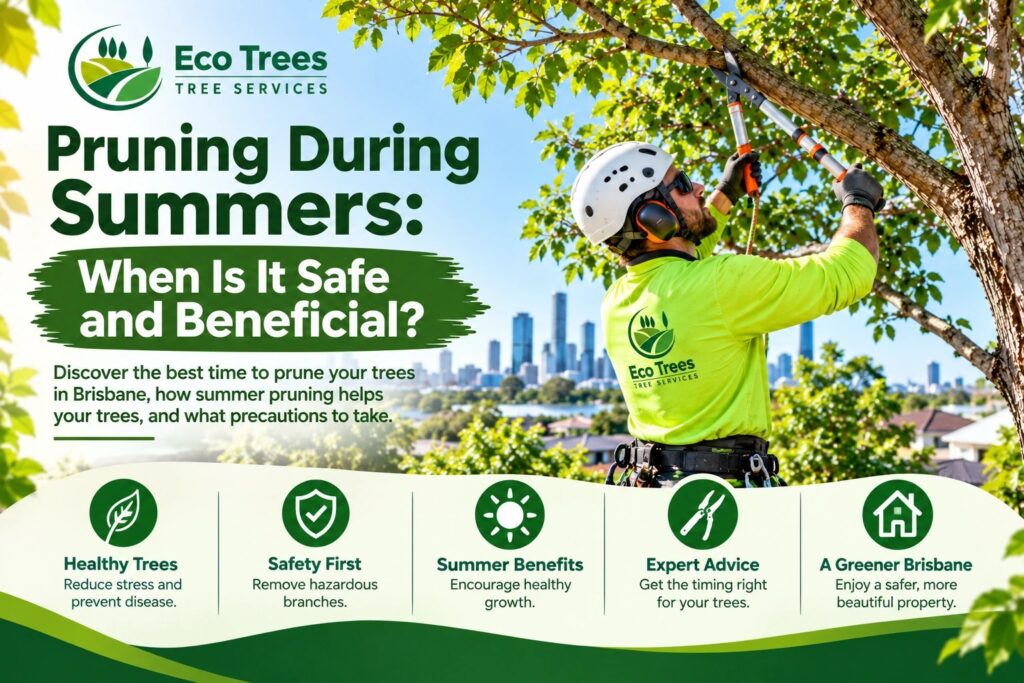
Pruning During Summers: When Is It Safe and Beneficial?
Pruning during summers can be beneficial when you use it for the right tree, at the right time and for the right reason. Summer is particularly useful for controlling vigorous growth, removing dead or damaged branches, improving canopy airflow and managing certain fruit trees, but it is not a universal pruning season for every species.
At Eco Tree Services, one of the common questions I hear is whether homeowners should wait until winter before pruning.
The answer is: not necessarily.
The best time to prune depends on the tree species, its condition, the type of pruning required and what you are trying to achieve.
For some trees, summer pruning can help control growth and maintain the canopy. For fruit trees, summer pruning can be useful after harvest or at a species-specific stage of development. But pruning a stressed tree heavily during extreme heat is a different situation.
That distinction matters.
Is pruning during summers actually safe?
Skimable summary: Summer pruning can be safe when the tree is healthy, the pruning objective is appropriate and the work is limited to what the tree needs. Extreme heat, drought stress and excessive pruning can increase stress, so timing and technique matter.
Summer does not automatically make pruning unsafe.
In fact, summer pruning is a recognised technique for managing growth and canopy size. ABC Organic Gardener explains that summer pruning is often focused on controlling vigorous growth, maintaining shape and improving light penetration and airflow, while winter pruning is commonly used for structural work.
Arbor Pride similarly describes summer pruning as useful for growth control and shaping while emphasising that the timing still needs to account for the particular tree and its condition.
The mistake is treating “summer pruning” as one single technique.
There is a big difference between:
- Removing a dead branch
- Removing storm-damaged wood
- Reducing excessive new growth
- Thinning a crowded canopy
- Pruning a fruit tree after harvest
- Removing a large structural limb
- Heavily reducing a tree during extreme heat
Those jobs should not all be approached in the same way.
Why do homeowners prune trees during summer?
Skimable summary: Summer pruning is mainly useful for controlling active growth, maintaining canopy shape, improving light and airflow, removing damaged wood and managing certain fruit trees.
Trees can grow aggressively during warm weather.
In Brisbane and South East Queensland, favourable growing conditions can produce a lot of new shoots and foliage. If that growth starts interfering with buildings, paths, gardens or other parts of the property, selective pruning can help manage it.
Summer pruning may be used to:
Control vigorous growth
Some trees produce substantial new growth during warmer months.
Selective pruning can help maintain the tree’s natural shape without waiting for the canopy to become excessively dense.
Improve airflow
A dense canopy can restrict air movement through the tree.
Selective thinning can improve airflow and allow more light into the canopy when appropriate.
Manage sunlight
Strategic pruning can improve light penetration through the canopy.
This can be particularly relevant for fruit trees where sunlight exposure affects fruit development and ripening.
Remove dead or damaged branches
Dead, broken or damaged branches don’t become healthy again simply because summer has arrived.
Removing hazardous deadwood can be an important part of routine tree maintenance.
Maintain clearance
Summer growth can push branches closer to roofs, driveways, paths and other structures.
In these situations, targeted pruning may be more appropriate than allowing the branches to continue growing until they become a bigger problem.
Our tree pruning and maintenance services in Brisbane cover crown thinning, crown lifting, crown reduction and deadwood removal based on the condition and requirements of the tree.
When is summer pruning beneficial?
Skimable summary: Summer pruning is most useful when the objective is growth control, selective canopy management, removal of dead or damaged wood, clearance or species-specific fruit-tree pruning.
I don’t recommend choosing summer simply because someone says it is “the best season to prune.”
Instead, I start with the reason for pruning.
Summer pruning can make sense when:
- The tree has excessive new growth
- The canopy has become too dense
- Dead or damaged branches need removal
- Branches are interfering with structures
- Specific fruit-tree pruning is required
- You want to manage the size of vigorous growth
- Selective canopy management is needed
ABC Organic Gardener notes that many fruit trees benefit from both winter and summer pruning, with summer pruning focusing more on controlling growth and opening the canopy. It also identifies the period immediately after harvest as an important summer-pruning window for many fruit trees.
This is why I would never give a homeowner one universal answer such as “always prune in summer” or “never prune in summer.”
Tree species and pruning objectives matter.
Which trees should you prune during summer?
Skimable summary: Summer pruning can suit some fruit trees, evergreen trees and fast-growing trees, but the correct timing varies by species, growth pattern, health and the desired result.
This is where tree-specific knowledge becomes important.
Fruit trees are a good example.
The ABC Organic Gardener guidance explains that summer pruning can be especially useful after harvest for many fruit trees and can help control growth and improve light penetration.
My Garden Therapy also identifies fruit trees, roses and hedges as plants where summer pruning can be useful for managing size, improving airflow and maintaining form.
But that does not mean every tree on your property should receive the same treatment.
Before pruning, consider:
- Tree species
- Tree age
- Current health
- Recent weather conditions
- Growth rate
- Amount of canopy being removed
- Reason for pruning
- Location of the tree
- Proximity to buildings or power infrastructure
For a mature Brisbane tree, I would rather inspect it first than recommend a seasonal pruning schedule based only on the calendar.
Should you prune a tree during extreme summer heat?
Skimable summary: Avoid unnecessary or heavy pruning when a tree is already under significant heat or drought stress, particularly if the work would remove a large amount of healthy canopy.
This is one of the areas where homeowners can get into trouble.
A tree already dealing with heat and moisture stress does not necessarily need more intervention.
Brisbane weather can move between intense heat, dry periods and heavy rainfall. Eco Tree Services notes that both excessive water and prolonged dryness can place trees under stress, while South East Queensland conditions can also create favourable conditions for pests and disease.
If a tree is visibly struggling, don’t automatically reach for the saw.
First work out why.
Look for:
- Wilting or unusual foliage
- Premature leaf drop
- Extensive dieback
- Dry or brittle growth
- Signs of pests
- Fungal growth
- Root-zone problems
- Soil that is excessively dry or waterlogged
If you are dealing with a stressed tree, the right solution may involve assessment and improving growing conditions rather than simply removing branches.
How should you prune trees during summer?
Skimable summary: Safe summer pruning starts with inspection, removes only necessary branches, uses clean and appropriate cuts and avoids excessive canopy removal.
The technique matters just as much as the season.
1. Inspect the tree first
Before making a cut, look at the whole tree.
Identify:
- Dead branches
- Broken branches
- Diseased sections
- Crossing branches
- Rubbing branches
- Excessive new growth
- Branches interfering with structures
2. Start with dead, damaged or diseased wood
This is usually more important than cosmetic shaping.
Removing problematic branches can improve safety and reduce sources of potential disease or decay.
3. Thin selectively
Don’t treat thinning as removing as much foliage as possible.
The goal is to make targeted cuts while maintaining the tree’s natural structure.
4. Maintain the natural form
A tree should still look like a tree after pruning.
Avoid cutting branches simply because they extend beyond an imaginary line.
5. Use clean, appropriate cuts
Poor cuts can create unnecessary wounds.
Tools should also be kept clean, particularly when moving between trees or dealing with suspected disease. My Garden Therapy specifically recommends disinfecting pruning tools before and after use to reduce disease transmission.
6. Know when to stop
This is probably the most important point.
Good pruning is selective. It is not a competition to see how much foliage you can remove.
Is summer pruning different for small and mature trees?
Skimable summary: Pruning small trees is usually easier to manage from ground level, while mature trees require greater care because of branch weight, height, structure and surrounding hazards.
Yes.
Pruning small trees and pruning large mature trees should not be treated as the same job.
With a small tree, you may be able to inspect and manage some branches from the ground.
With a mature tree, a branch can be significantly heavier, higher and more difficult to control.
There can also be:
- Roofs underneath the canopy
- Powerlines nearby
- Vehicles
- Fences
- Neighbouring properties
- People using the area
- Weak or damaged branches
This is where professional assessment becomes important.
Eco Tree Services specifically warns that tree pruning can become dangerous when working at height, near powerlines or with large branches, and recommends qualified arborists for this type of work.
The same principle applies to residential tree pruning.
A tree being located in your backyard does not automatically make it a safe DIY job.
Does summer pruning help Brisbane trees before storm season?
Skimable summary: Selective preventative pruning before Brisbane’s summer storm period can address deadwood, weak branches and certain structural concerns, but pruning should be based on the tree’s condition rather than removing healthy canopy simply because storms are approaching.
This is particularly relevant in Brisbane.
Summer isn’t just a growing season here. It is also a period when severe storms can put additional loads on trees.
Eco Tree Services recommends preventative care before Brisbane’s higher-risk storm period, including identifying and removing deadwood and addressing vulnerable branches.
Our guide on signs that your tree is unsafe before cyclone season covers warning signs homeowners should look for before severe weather.
The important distinction is this:
Storm preparation does not mean cutting a healthy tree heavily.
Instead, the aim is to identify existing problems.
That might mean:
- Removing dead branches
- Removing damaged limbs
- Addressing weak branch attachments
- Managing branches over structures
- Reducing specific hazards
- Assessing a tree with visible structural concerns
If a storm has already damaged the tree, don’t climb it yourself.
Our post-storm tree check-up guide explains why damage can be difficult to assess from ground level and why an arborist inspection may be necessary after serious storms.
What are the biggest mistakes people make when pruning in summer?
Skimable summary: The biggest summer-pruning mistakes include over-pruning, ignoring tree stress, pruning at the wrong time for the species, making poor cuts and attempting hazardous work without professional equipment.
Over-pruning
Removing too much healthy canopy can place unnecessary stress on a tree.
It can also expose previously shaded branches and areas of the tree to stronger sunlight.
Arbor Pride specifically warns that excessive summer pruning can cause stress and other problems, reinforcing the principle that less can be more when managing a healthy tree.
Treating every tree the same
A fruit tree, ornamental tree, mature native tree and hedge do not necessarily have the same pruning requirements.
Pruning because the tree looks untidy
Not every branch that sticks out needs to be removed.
Pruning should have a reason.
Ignoring the weather
Don’t schedule unnecessary heavy work when conditions are exceptionally hot and dry.
Cutting without considering future growth
A branch should be assessed in terms of where it is growing and what will happen after it is removed.
Using blunt or dirty tools
Poor tools make clean cuts harder and increase the potential for disease transmission.
Trying to reach dangerous branches
This is where a gardening task becomes an arboricultural job.
If you need ladders, climbing equipment or chainsaws to reach large branches, I strongly recommend getting a qualified arborist involved.
When should you hire a tree pruning company?
Skimable summary: Hire a professional tree pruning company when the tree is large, branches are heavy or high, the work is near powerlines or structures, the tree shows structural problems, or you are unsure what should be removed.
If you’re searching for the best tree pruning service, don’t choose based only on how quickly someone can cut the tree back.
Ask whether the company can explain:
- Why pruning is required
- Which branches need removal
- How much canopy should remain
- Whether the tree shows structural problems
- Whether the timing is appropriate
- How the work will be performed safely
- Whether the arborists are qualified and insured
At Eco Tree Services, our qualified arborists assess trees based on their health, structure, location and specific maintenance requirements. Our Brisbane pruning service covers crown thinning, crown lifting, crown reduction and deadwood removal.
Our qualified arborist checklist also explains what homeowners should look for when comparing arborists, including qualifications, insurance, references and written quotes.
For large trees, professional equipment isn’t simply about convenience.
It is about controlling the work safely.
What should you check after summer pruning?
Skimable summary: After pruning, monitor the tree for healthy foliage, normal growth and any signs of stress, disease or further branch damage.
Summer pruning isn’t finished when the last branch hits the ground.
Keep an eye on the tree afterwards.
Look for:
- Healthy new growth
- Unusual leaf loss
- Dieback
- Signs of pests
- Fungal symptoms
- Drying branches
- New structural problems
If the tree was already showing signs of decline before pruning, continue monitoring it rather than assuming pruning solved the underlying issue.
Eco Tree Services’ guide on common causes of tree decline in Brisbane explains why water stress, pests, disease and environmental conditions can all contribute to declining tree health.
Summer tree pruning checklist
Skimable summary: Before pruning during summer, confirm the tree’s condition, the reason for pruning, the weather, the species-specific timing and the safety requirements.
Before starting, ask:
Tree health
- Is the tree healthy enough to prune?
- Is there visible stress?
- Are there signs of pests or disease?
- Is there significant dieback?
Pruning objective
- Am I removing deadwood?
- Am I controlling excessive growth?
- Am I improving clearance?
- Am I managing the canopy?
- Am I pruning for a specific fruiting objective?
Timing
- Is summer appropriate for this particular tree?
- Has the tree recently experienced extreme heat or drought?
- Has the tree recently suffered storm damage?
Safety
- Can the work be completed safely from ground level?
- Are there powerlines nearby?
- Are large branches positioned over structures?
- Do I need climbing or specialised equipment?
If you cannot answer these questions confidently, this is where a professional assessment makes sense.
Final advice from Eco Tree Services
Skimable summary: Summer pruning can be a useful part of tree maintenance, but the correct approach depends on the species, tree health, pruning objective and weather conditions.
I don’t believe in pruning a tree simply because the calendar says it’s summer.
I believe in looking at the tree first.
If it has excessive growth, deadwood, damaged branches or a canopy that needs selective management, summer may provide an appropriate opportunity to address those issues.
For some fruit trees, summer pruning after harvest can be particularly useful. For other trees, structural work may be better suited to another season.
And if a tree is already stressed by extreme heat, drought, disease or recent storm damage, the priority should be understanding the problem rather than automatically cutting it back.
The best pruning season is ultimately the season that suits the tree, the pruning objective and the conditions.
At Eco Tree Services, we focus on that assessment first so homeowners aren’t paying for unnecessary pruning or taking risks with work that requires professional arboricultural skills.
FAQs About Pruning During Summers
Is summer a good time to prune trees?
Yes, summer can be a good time to prune certain trees, but it depends on the species and the reason for pruning. Summer is particularly useful for controlling vigorous growth, managing canopy size and pruning some fruit trees after harvest. I wouldn’t automatically prune every tree simply because it is summer.
Can you prune trees in Brisbane during summer?
Yes, trees can be pruned in Brisbane during summer when the timing and pruning method are appropriate. Brisbane’s warm growing conditions can produce vigorous growth, while summer storms create additional reasons to inspect trees for deadwood and weak branches. The key is avoiding unnecessary heavy pruning when a tree is already under significant heat or moisture stress.
Is it better to prune trees in summer or winter?
Neither season is universally better because the right timing depends on the tree species and pruning objective. Winter can be useful for certain structural pruning tasks, while summer can be useful for growth control, canopy management and some fruit trees. I always look at what the tree needs before deciding when to prune.
Can I prune a tree during very hot weather?
It is better to avoid unnecessary heavy pruning during extreme heat, particularly when the tree is already stressed. If a tree is wilting, showing dieback or experiencing drought stress, I would first investigate the cause. Removing large amounts of healthy canopy at that point may create additional stress.
Should I prune fruit trees during summer?
Many fruit trees can benefit from summer pruning, particularly after harvest, but the correct timing and technique depend on the species. Summer pruning can help control vigorous growth, improve light penetration and manage the canopy. For example, ABC Organic Gardener recommends summer pruning after harvest for many fruit trees.
Is summer pruning good for small trees?
Yes, summer pruning can be useful for small trees when you have a clear reason for removing specific growth. Pruning small trees can be easier to manage from ground level, but I still recommend avoiding unnecessary cuts. A small tree can develop structural problems from poor pruning just as a mature tree can.
Can summer pruning prevent storm damage?
Proper preventative pruning can address certain hazards, but it cannot guarantee that a tree will not fail during a storm. Removing deadwood and addressing known structural problems can reduce some risks, but severe weather can still damage healthy trees. Eco Tree Services recommends preventative inspection and maintenance before Brisbane’s storm period.
Should I hire a tree pruning company for summer pruning?
You should consider a professional tree pruning company when the tree is large, branches are high or heavy, the work is near powerlines or buildings, or the tree has structural concerns. In these situations, the difficult part isn’t simply cutting the branch. It is assessing the tree and controlling the work safely.
What is the biggest mistake when pruning during summers?
The biggest mistake is removing too much healthy growth without considering the tree’s species, condition and purpose of pruning. I often find that homeowners think a harder cut will produce a better result. With tree pruning, selective work is usually more appropriate than simply reducing the canopy as much as possible.