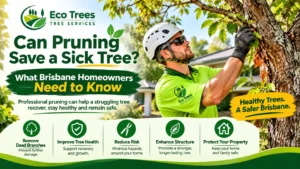
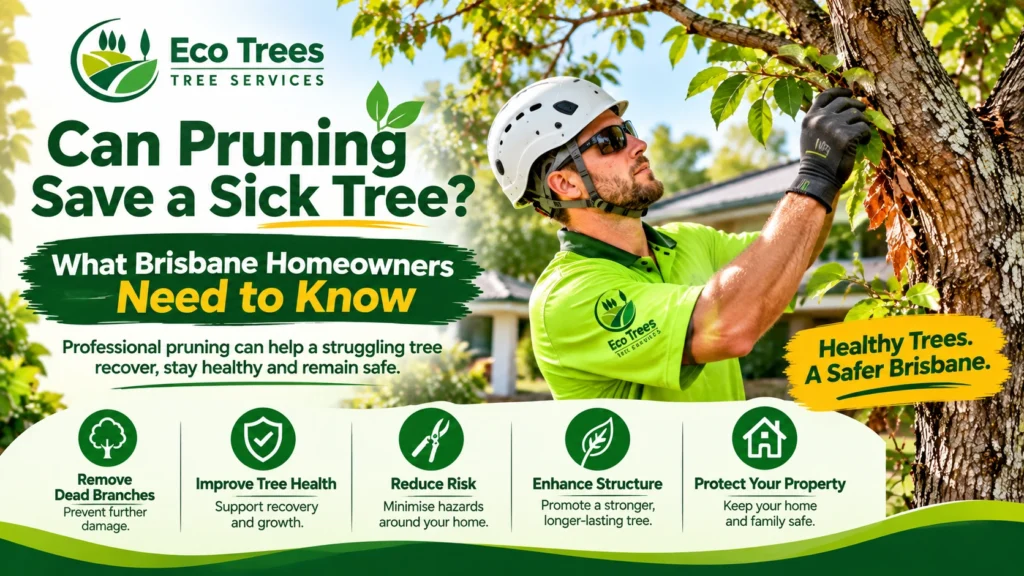
Can Pruning Save a Sick Tree? What Brisbane Homeowners Need to Know
Yes, pruning can sometimes save a sick or struggling tree, but only when the underlying problem is something pruning can actually address. Removing dead, diseased or damaged branches can reduce stress, improve airflow and light, and help a tree put its resources into healthier growth. But pruning cannot repair severe root damage, advanced decay or a structurally unsafe trunk.
At Eco Tree Services, one of the first things I look at when someone asks me to prune a sick tree is not where I should make the first cut. It is why the tree is struggling in the first place.
A tree with deadwood and minor dieback may respond very well to careful pruning. A tree with major root failure or advanced trunk decay is a completely different situation.
That distinction matters because aggressive pruning can make an already stressed tree worse if you remove healthy growth without addressing the actual cause.
What makes a tree look sick or unhealthy?
Skimable summary: A struggling tree may show dead branches, thinning foliage, discoloured leaves, dieback, fungal growth, pest activity, storm damage or structural changes. These symptoms do not automatically mean the tree needs to be removed.
Sometimes the signs are obvious. Sometimes they are easy to overlook.
You may notice:
- Dead or brittle branches
- Branches losing leaves prematurely
- A thinning or patchy canopy
- Yellow, brown or discoloured foliage
- Fungal growth or mushrooms around the base
- Cracked or damaged branches
- Signs of insect activity
- Uneven or abnormal growth
- Storm-damaged limbs
- Progressive branch dieback
The important thing is that these symptoms tell you something is wrong, but they do not necessarily tell you what the problem is.
For example, dieback can have several possible causes, including pests, environmental stress and disease. Eco Tree Services’ recent guidance on tree diseases also points out that fungal growth around the base can sometimes indicate deeper decay affecting the tree’s structure or root system.
That is why I don’t recommend looking at a few dead branches and immediately deciding that the whole tree is dying.
Can pruning actually save a sick tree?
Skimable summary: Pruning can help a sick tree when removing specific branches reduces structural stress, removes dead or damaged material, improves canopy conditions or allows healthier growth to develop.
The short answer is yes, sometimes.
I think of pruning as one part of a tree-health plan rather than a cure for every problem.
When done correctly, pruning can:
- Remove dead branches that no longer contribute to the tree
- Remove broken or storm-damaged limbs
- Reduce unnecessary weight on weak branches
- Improve light penetration
- Improve airflow through a crowded canopy
- Correct certain structural problems
- Reduce the risk of branch failure
- Help maintain a healthier and more balanced canopy
Removing dead branches is particularly useful from a safety perspective because deadwood can become a falling hazard, especially during Brisbane’s storms and wet-season conditions. Professional pruning can also identify structural problems that may not be obvious from ground level.
But there is an important difference between removing a problem branch and cutting large portions of a stressed tree’s healthy canopy.
I never want to remove healthy growth simply because a tree looks unhealthy.
When can pruning help a struggling tree?
Skimable summary: Pruning is most useful when the tree still has healthy structure and the problem involves deadwood, damaged limbs, minor dieback, overcrowding or manageable structural issues.
There are several situations where careful pruning can make a meaningful difference.
Dead or dying branches
Deadwood does not recover. Removing it can reduce safety risks and clean up the canopy.
It can also help you identify how much of the tree is actually affected.
A tree with several dead branches but plenty of healthy foliage can be very different from a tree experiencing widespread canopy decline.
Storm damage
Brisbane trees regularly deal with heavy rain, strong winds and sudden storms.
A damaged branch may split, hang dangerously or place additional weight on another weak section of the canopy.
Targeted remedial pruning can remove the damaged section and leave the remaining healthy structure intact.
Eco Tree Services recommends professional post-storm inspections because some cracks and structural injuries are not immediately obvious after severe weather.
Overcrowded canopies
Sometimes the tree is alive and healthy but has too much competing growth.
Selective pruning can improve the arrangement of branches and allow better light and airflow through the canopy.
This is very different from simply cutting the top or sides of the tree back heavily.
Minor dieback
If only certain parts of the canopy are declining, pruning may be appropriate after identifying the cause.
The key is not to assume that removing the visible symptoms has solved the problem.
If the underlying issue is soil, pests, disease, water stress or root damage, that problem still needs attention.
When won’t pruning save the tree?
Skimable summary: Pruning cannot reverse major root failure, advanced trunk decay, severe structural defects or a tree that has already lost too much viable tissue.
This is where I think homeowners need an honest answer.
Pruning is useful, but it is not magic.
I would be concerned if I found:
- Advanced trunk decay
- Major cracks or splits in the trunk
- Severe root damage
- Significant root instability
- Extensive structural failure
- A severe lean combined with ground or root movement
- Widespread canopy death
- Serious disease affecting the tree’s structural integrity
In these situations, pruning might remove individual hazards, but it may not solve the underlying problem.
Eco Tree Services’ guidance makes the same distinction: pruning may be appropriate where specific branches are damaged or deadwood needs removal, while removal may become more appropriate when severe structural decay, compromised root stability or major unmanaged defects are present.
This is why I would rather inspect the entire tree than promise that a few cuts will save it.
How do I decide what needs to be pruned?
Skimable summary: A proper pruning decision starts with assessing the whole tree, identifying the cause of decline and deciding which branches genuinely need removal.
Before I recommend pruning, I want to understand what is happening throughout the tree.
I look at:
The canopy
Are only a few branches affected, or is the entire canopy declining?
The trunk
Are there cracks, cavities, decay, wounds or other structural defects?
The roots and surrounding soil
Has construction, paving, excavation, compaction or other activity affected the root zone?
The branches
Are they dead, broken, crossing, weakly attached or competing unnecessarily?
The environment
Is the tree dealing with excessive shade, poor drainage, drought stress, storm exposure or restricted growing space?
This whole-tree approach is important because the same visible symptom can have very different causes.
A tree with yellow leaves might need a completely different response from a tree with dead branches caused by storm damage.
Can over-pruning make a sick tree worse?
Skimable summary: Yes. Removing too much healthy canopy from an already stressed tree can increase stress and leave it with fewer healthy leaves to support recovery.
This is one of the biggest mistakes I see homeowners make.
The tree looks sick, so they think:
“Let’s cut more off and give it a fresh start.”
I understand the logic, but trees don’t work like hedges.
Healthy leaves are important because the canopy supports the tree’s energy production. Removing large amounts of healthy growth can place additional stress on a tree that is already struggling.
Over-pruning can also create unnecessary wounds and change the tree’s natural structure.
That is why I prefer targeted pruning over aggressive cutting.
If a branch does not need to come off, I don’t remove it just to make the tree look tidier.
What is the difference between tree pruning and tree trimming?
Skimable summary: Tree pruning focuses on tree health, structure and safety, while general trimming can sometimes refer to reducing or shaping growth. For a sick tree, the objective should be corrective and selective rather than simply making the canopy smaller.
You will often hear people use tree pruning and tree trimming as if they mean exactly the same thing.
In everyday language, they can overlap.
But when I’m dealing with a sick or declining tree, I’m thinking about much more than appearance.
The question isn’t:
“How much can we cut off?”
The question is:
“Which branches need to be removed, and why?”
That might mean removing deadwood, damaged limbs, weak growth or selected branches that are creating a structural problem.
It does not automatically mean reducing the entire canopy.
Does pruning small trees work differently?
Skimable summary: Pruning small trees can be easier to manage, but the same principle applies: identify the reason for pruning and avoid removing healthy growth unnecessarily.
People sometimes assume that because a tree is small, pruning it is automatically simple.
It isn’t always.
Early structural pruning can actually be very valuable because it can help establish better branch spacing and reduce future structural problems.
However, homeowners still need to avoid making random cuts.
For pruning small trees, I would still consider:
- Which branches are developing poorly?
- Are branches competing with each other?
- Is there dead or damaged growth?
- Is the tree developing a balanced structure?
- Is the pruning actually necessary?
Small does not mean risk-free, particularly when tools, ladders or electrical lines are involved.
What should you do if your tree is showing signs of decline?
Skimable summary: Start by identifying the symptoms, avoid unnecessary DIY pruning and arrange a professional assessment if the cause is unclear or the tree has structural concerns.
My advice is simple: don’t start cutting just because the tree looks unhealthy.
Start by observing what has changed.
Look for:
- Where the dieback is occurring
- Whether new growth is still appearing
- Whether only individual branches are affected
- Changes around the trunk
- Fungal growth
- Pest activity
- Recent storm damage
- Changes to soil or drainage
- Changes in nearby construction or landscaping
If the cause isn’t obvious, get an assessment before making major cuts.
Eco Tree Services’ Brisbane tree-care guidance also recommends early assessment when you notice symptoms such as discoloured leaves, fungal growth, structural weaknesses or decay.
Why should you use a professional tree pruning company?
Skimable summary: A qualified tree pruning company can assess the tree before cutting, identify structural or health issues and carry out targeted pruning safely.
A sick tree is not the tree I would recommend experimenting on.
Professional pruning requires more than knowing how to use a chainsaw or saw.
At Eco Tree Services, our arborists are trained in arboriculture, including tree health, pests and diseases, safe cutting techniques and working to appropriate Australian standards.
A professional assessment can help determine whether you actually need:
- Selective pruning
- Deadwood removal
- Remedial pruning
- Storm-damage pruning
- Ongoing tree maintenance
- Further tree-health investigation
- Or, where necessary, removal
If you are comparing options for the best tree pruning service, I recommend looking beyond the cheapest quote and checking qualifications, insurance, experience and whether the company actually assesses the tree before recommending work.
Our qualified arborist checklist covers the practical things I recommend homeowners check before hiring someone.
Can regular pruning prevent a tree from becoming seriously unhealthy?
Skimable summary: Regular, appropriate tree maintenance can identify deadwood, weak branches and developing structural problems before they become larger safety or health issues.
Prevention is usually easier than trying to rescue a tree after years of neglect.
Regular inspections and appropriate pruning can help identify problems while there is still healthy structure to work with.
This becomes particularly important in Brisbane and South-East Queensland, where wet-season rain, saturated ground and storms can place additional pressure on weak trees and branches.
I also recommend homeowners keep an eye on their trees after significant weather events rather than assuming that everything is fine because no branch has fallen.
Our guide on post-storm tree check-ups explains why some storm-related structural damage can remain hidden.
So, can pruning save a sick tree?
Skimable summary: Pruning can save or significantly help some struggling trees, particularly where deadwood, damaged branches, overcrowding or manageable dieback are the main issues. It cannot reverse every form of tree decline.
So, can pruning save a sick tree?
Yes, it can.
But I would never say that pruning alone will save every sick tree.
If the tree has dead branches, storm damage, minor dieback or an overcrowded canopy, targeted pruning may remove the immediate problem and give the remaining healthy structure a better chance.
If the tree has advanced decay, major root damage or severe structural failure, pruning may not be enough.
The biggest mistake is treating the visible symptom instead of finding the cause.
If your tree has started looking unhealthy, I recommend getting it assessed before you reach for the saw. Sometimes a carefully planned prune is all the tree needs. Sometimes it needs a broader treatment plan. And sometimes, unfortunately, removal is the safest option.
At Eco Tree Services, we assess the tree first and recommend the work based on its actual condition rather than simply cutting because someone has asked us to.
If you are concerned about a sick, damaged or declining tree in Brisbane or South-East Queensland, contact Eco Tree Services for professional advice and a quote.
FAQs
Can pruning save a dying tree?
Sometimes, but only if the tree still has enough healthy structure and the underlying problem can be managed. Pruning can help remove dead, damaged or diseased branches, but it cannot restore severely damaged roots or reverse advanced structural decay.
For example, if I inspect a tree with several dead branches but a healthy trunk and plenty of live canopy, selective pruning may be worthwhile. If the trunk is extensively decayed, I would look at the safety of the whole tree rather than promising that pruning will save it.
Should I prune a sick tree?
You should identify why the tree is sick before carrying out major pruning. Pruning can help some conditions, but unnecessary cutting can add stress to an already struggling tree.
I would first look at the canopy, trunk, branches, root zone and surrounding conditions before deciding what needs to be removed.
Can removing dead branches help a tree?
Yes, removing dead branches can improve tree safety and remove material that no longer contributes to healthy growth. Deadwood can also become a falling hazard, particularly during storms.
The important part is making the correct cut and not removing healthy branches unnecessarily.
Can over-pruning kill a tree?
Yes, excessive or inappropriate pruning can seriously stress a tree and contribute to decline. Removing too much healthy canopy reduces the tree’s ability to maintain itself and can create unnecessary wounds.
I have seen homeowners cut a tree back heavily because they thought it would encourage new growth. With a stressed tree, that approach can create another problem instead of solving the first one.
How do I know whether to prune or remove a tree?
The decision depends on the tree’s health, structure, root stability, defects and level of risk. Pruning may be appropriate when only certain branches are damaged or dead, while removal may need consideration when severe decay, root instability or major structural defects are present.
That is why I recommend an arborist assessment rather than making the decision based only on what the tree looks like from the ground.
Is residential tree pruning safe to do yourself?
It is not always safe, particularly when branches are large, the tree is tall, equipment is required or powerlines are nearby. Professional arborists have the training and equipment needed to manage these risks.
For residential tree pruning, I would rather see a homeowner arrange an assessment than climb a ladder with a chainsaw and try to diagnose the tree at the same time.
If you’re unsure, get professional advice before cutting.