What Is an Arborist? A Brisbane Homeowner's Guide
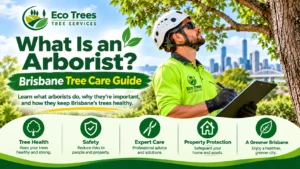
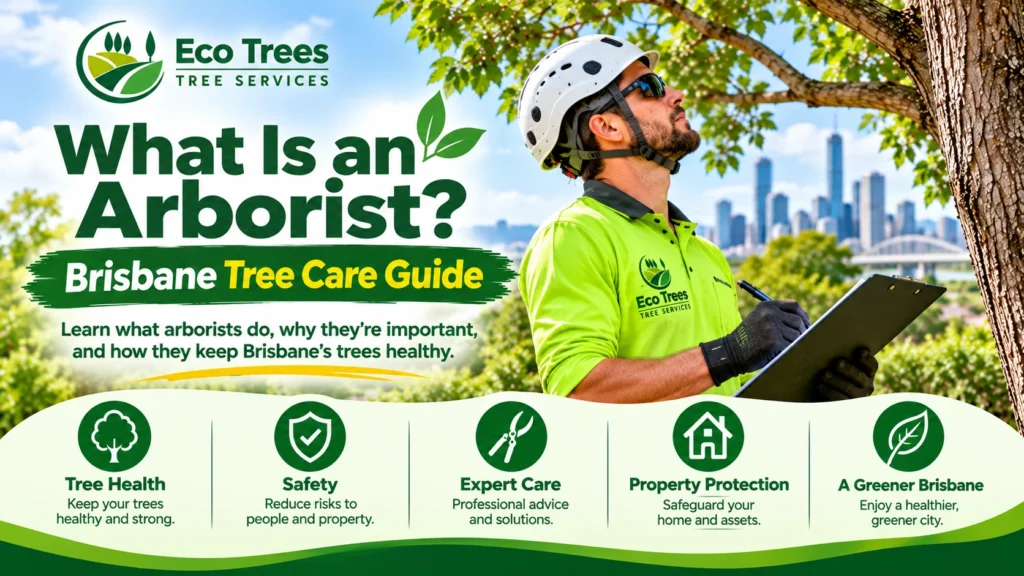
An arborist is a trained tree-care professional who understands how trees grow, how to manage their health and structure, and how to safely prune, assess or remove them when necessary. An arborist does much more than simply cut branches or remove trees.
If you’ve searched for “what is an arborist”, you’re probably trying to understand whether you actually need one or whether a general tree service can handle the job.
At Eco Tree Services, I see this confusion regularly. A tree may look like a straightforward landscaping problem from the ground, but once you consider its size, structure, roots, surrounding buildings, powerlines, decay and potential failure points, the job can become much more complicated.
That is where an arborist comes in.
An arborist specialises in the care and management of individual trees. The work can involve tree health assessment, pruning, deadwood removal, storm damage, tree removal, stump grinding and advice about whether a tree should be retained or removed.
For Brisbane homeowners, choosing a qualified arborist can make the difference between simply cutting a tree and actually managing it safely.
What Is an Arborist?
Skimable summary: An arborist is a trained professional specialising in tree care, tree health, pruning, structural assessment, risk management and tree removal. Arborists use their knowledge of tree biology, structure and safety to determine the appropriate solution for individual trees.
The simplest definition is this:
An arborist is a professional trained in arboriculture, which is the cultivation, management and care of trees and other woody plants.
The role goes beyond cutting branches.
A qualified arborist needs to understand how trees respond to pruning, how branches and trunks carry weight, how roots contribute to stability, how diseases and pests affect trees, and what hazards may exist around a tree.
For example, a homeowner might look at a large branch hanging over a driveway and think, “That branch needs to come down.”
An arborist looks at the bigger picture.
I would consider:
- Whether the branch is dead, damaged or structurally weak
- Where the branch connects to the main structure
- Whether removing it could affect the tree’s balance
- Whether other branches have similar defects
- What is underneath the branch
- Whether there are buildings, vehicles, fences or powerlines nearby
- Whether pruning is enough or whether the entire tree requires assessment
This is why I don’t see arboriculture as simply tree cutting. It is tree management.
Heritage Tree Care similarly describes arborists as trained professionals who work across tree health, pruning, planting, assessment, removal, stump work and risk management. J K Cooper also distinguishes arborists from forestry and logging by focusing on individual tree care and management.
What Does an Arborist Do?
Skimable summary: Arborists assess, maintain and manage trees through services such as pruning, deadwood removal, tree health assessment, tree removal, stump grinding and storm-damage work.
The exact work depends on the tree and the property.
At Eco Tree Services, our work commonly includes several areas of arboriculture.
Tree assessment
Before deciding what to do with a tree, I want to understand its condition.
An assessment can consider:
- Tree structure
- Trunk condition
- Branch unions
- Deadwood
- Signs of decay
- Root conditions
- Lean
- Storm damage
- Surrounding structures
- Access and worksite hazards
This is particularly important when a homeowner is unsure whether a tree needs pruning or complete removal.
Tree pruning
Pruning involves selectively removing branches for reasons such as tree health, safety, clearance, structure or canopy management.
Our Brisbane tree pruning work includes techniques such as crown thinning, crown lifting, crown reduction and deadwood removal.
You can learn more about our [tree pruning and maintenance services in Brisbane] through Eco Tree Services.
Tree removal
Sometimes a tree has reached a condition where removal is the safest practical solution.
This can happen because of severe structural damage, extensive decay, serious root problems, storm damage, disease or an unsuitable location.
Professional tree removal is not simply a matter of cutting through the trunk.
Our guide to [how arborists remove trees safely] explains why assessment, planning, controlled dismantling and appropriate equipment matter when removing larger or difficult trees.
Stump grinding
Removing a tree does not necessarily remove the stump.
An arborist service provider may also offer stump grinding to reduce the remaining stump below ground level, helping homeowners reclaim the area for landscaping or other uses.
Storm damage work
Brisbane trees can be affected by strong winds, heavy rain and severe storms.
An arborist may need to deal with:
- Fallen trees
- Broken branches
- Hanging limbs
- Split trunks
- Damaged trees
- Trees requiring stabilisation
- Storm debris
Eco Tree Services provides [emergency storm damage and tree clean-up services] across Brisbane.
Why Do You Need an Arborist Instead of a Regular Tree Service?
Skimable summary: The main difference is specialist knowledge. Arborists understand tree structure, health, pruning techniques and safety risks, allowing them to determine what work a tree actually needs instead of treating every problem as a cutting or removal job.
This is one of the most important distinctions homeowners should understand.
A person may have experience operating a chainsaw or cutting branches, but that does not automatically mean they understand arboriculture.
When I assess a tree, I am not just asking, “What can I cut?”
I am asking, “What should be removed, why should it be removed, and what will happen to the tree after I remove it?”
That distinction matters.
For example, excessive pruning can unnecessarily reduce the tree’s canopy. Removing the wrong structural branches can also create new problems rather than solving the original one.
Safety is another major consideration.
Working on mature trees can involve:
- Height
- Heavy branches
- Chainsaws
- Ropes and rigging
- Unstable trees
- Hidden decay
- Powerlines
- Buildings and vehicles
- Restricted access
Eco Tree Services explains that professional tree work requires appropriate training and equipment, particularly when trees are large, damaged, near powerlines or difficult to access.
If you’re considering DIY work, our guide on [whether DIY tree removal is safe] explains why mature or poorly positioned trees should not be treated like ordinary garden maintenance.
What Services Do Arborists Provide?
Skimable summary: Arborist services can cover the complete lifecycle of tree care, from assessment and pruning to storm response, removal and stump grinding.
Depending on the company and qualifications involved, arborists can provide services such as:
Tree pruning and trimming
Selective branch removal to improve safety, structure, clearance and tree health.
Deadwood removal
Removing dead or dying branches that may become hazards, particularly when they are located above roofs, driveways, paths or areas used by people.
Tree removal
Removing trees that are dead, structurally compromised, severely damaged or otherwise unsuitable to remain in their current location.
Stump grinding
Grinding the remaining stump after tree removal to improve safety and allow the area to be reused.
Storm damage cleanup
Assessing and managing trees and branches damaged by severe weather.
Tree health assessment
Identifying visible signs of decline, disease, pest activity, structural weakness or other problems affecting a tree.
Risk assessment
Considering the likelihood of branch or tree failure and the potential consequences for people and property.
Hedge and vegetation management
Some arborist businesses also provide related vegetation services, depending on their equipment and expertise.
The range of work means that arborists in Brisbane can help with much more than emergency tree removal.
When Should You Call an Arborist?
Skimable summary: Call an arborist when a tree is damaged, unstable, diseased, overgrown, difficult to access, close to structures or powerlines, or when you cannot determine whether it needs pruning or removal.
You don’t need to wait until a tree becomes an emergency.
I recommend getting professional advice when you notice changes such as:
- A sudden or worsening lean
- Large dead branches
- Cracks in the trunk
- Split branch unions
- Cavities or obvious decay
- Fungal growth around the base
- Exposed or damaged roots
- Storm damage
- Branches growing toward buildings
- Branches interfering with access
- Trees close to power infrastructure
- Significant canopy decline
- A tree that has suddenly changed appearance
A tree does not automatically need removal just because it looks unhealthy.
For example, a tree with several dead branches may only need targeted pruning. On the other hand, a tree with major structural decay and compromised roots may require removal.
Our guide to [the signs your tree needs removing] explains the warning signs I recommend homeowners look for before making that decision.
Are Arborists Qualified Professionals?
Skimable summary: Qualified arborists receive formal training in arboriculture and develop practical skills in tree care, pruning, tree health, equipment use and safety. Homeowners should verify qualifications, insurance and experience before hiring an arborist.
Yes, professional arborists undergo training to develop specialist tree-care skills.
At Eco Tree Services, our team has completed an apprenticeship and Certificate III in Horticulture specialising in Arboriculture. Our training covers areas including chainsaw use, tree health, pruning, Australian industry standards, pests and diseases and rescue procedures.
That training is important because tree work can involve significant risks.
When choosing an arborist, I recommend checking:
- Relevant arboriculture qualifications
- Practical experience
- Public liability insurance
- Workers’ compensation arrangements
- Professional indemnity insurance where relevant
- Reviews and references
- The scope of work included in the quote
I’ve also put together a [qualified arborist checklist] to help homeowners understand what to check before hiring a tree-care professional.
Heritage Tree Care identifies Certificate III in Arboriculture as a key vocational qualification and notes that arborists also develop practical skills through supervised work and experience. Eco Tree Services similarly identifies its Certificate III in Horticulture specialising in Arboriculture as part of its qualification pathway.
How Do You Choose a Professional Arborist in Brisbane?
Skimable summary: When comparing arborists in Brisbane, look beyond the cheapest quote. Check qualifications, insurance, experience, reviews, scope of work and whether the company assesses the tree before recommending pruning or removal.
If you’re searching for a professional arborist in Brisbane, I would use a simple checklist.
1. Check qualifications
Ask what arboriculture qualifications the people carrying out the work hold.
2. Check insurance
Tree work can involve significant property and personal risks. A reputable provider should be able to explain its insurance coverage.
3. Look at relevant experience
A company experienced with small residential pruning may not necessarily be the right choice for a large, difficult-access tree.
Match the provider’s experience to the job.
4. Ask what they recommend and why
This is important.
If you ask for tree removal, a good arborist should still assess whether removal is actually necessary.
Sometimes pruning or maintenance can preserve the tree.
5. Get a written quote
The quote should clearly explain the work included.
For example, ask whether it includes:
- Pruning
- Tree removal
- Stump grinding
- Debris removal
- Site cleanup
- Additional equipment
- Access requirements
This avoids confusion later.
6. Check reviews
Reviews can provide useful information about communication, professionalism, safety and cleanup.
For more guidance, read our [checklist for hiring a qualified arborist].
How Much Does an Arborist Cost?
Skimable summary: Arborist pricing varies according to the tree’s size, condition, location, access, required equipment, complexity and type of work. A proper quote should reflect the actual site rather than relying only on a generic price.
There is no single arborist price that applies to every tree.
A small tree in an open backyard is completely different from a large mature tree growing beside a house.
The cost can be affected by:
- Tree height
- Trunk diameter
- Number of branches
- Tree condition
- Disease or decay
- Access to the property
- Proximity to buildings
- Powerlines
- Required climbing or rigging
- Machinery requirements
- Stump grinding
- Waste and debris removal
- Difficulty of the work
This is why I would be cautious about choosing an arborists service provider based entirely on the cheapest advertised price.
Two companies may quote different amounts because they are proposing different methods, equipment or levels of service.
The better question is not simply, “How much does an arborist cost?”
It is:
“What exactly is included in the quote, and what method will be used to complete the work safely?”
Can an Arborist Save a Tree Instead of Removing It?
Skimable summary: Yes, an arborist may be able to preserve a tree when the problem is limited to certain branches, manageable canopy growth or treatable health issues. Removal becomes more appropriate when structural or root problems create an unacceptable safety risk.
This is one of the reasons I recommend an assessment before automatically choosing removal.
Imagine a healthy mature tree with several large dead branches over a driveway.
Removing the entire tree may be unnecessary.
Targeted pruning could remove the hazardous branches while allowing the tree to remain.
Now consider a different situation: the same tree has extensive trunk decay, major root damage and a significant structural defect.
In that case, pruning may not solve the underlying problem.
The objective of professional arboriculture should not be to remove every problem tree.
It should be to determine the safest and most appropriate solution for the tree and the property.
Our article about [the real cost of ignoring tree maintenance during Queensland’s wet season] also explains why early maintenance can help identify structural problems before they become more serious.
What Is the Difference Between an Arborist and a Tree Lopper?
Skimable summary: An arborist is trained in arboriculture and approaches tree work through tree health, structure, safety and long-term management. The term “tree lopper” can describe someone who cuts trees or branches, but the title alone does not establish arboricultural qualifications.
This distinction can be confusing because people sometimes use the terms interchangeably.
The key thing I recommend looking at is not the label on the business.
Look at the person’s:
- Qualifications
- Experience
- Insurance
- Work methods
- Understanding of tree health
- Safety procedures
- Ability to assess whether pruning or removal is appropriate
A person who simply cuts branches may complete the physical task.
An arborist should also understand the consequences of that work for the tree.
That matters particularly when you’re dealing with mature trees, structural defects, storm damage or trees close to property.
What Makes an Arborist Different From a General Gardener?
Skimable summary: Gardeners generally focus on broader landscape and garden maintenance, while arborists specialise in the biology, structure, health, pruning, assessment and removal of trees.
A gardener may handle lawns, planting, garden beds, hedges and general landscape maintenance.
An arborist works with trees as specialised living structures.
That distinction becomes important when a tree is:
- Large
- Mature
- Diseased
- Structurally damaged
- Near a building
- Near powerlines
- Difficult to access
- Storm damaged
- Potentially hazardous
For basic garden maintenance, a gardener may be appropriate.
For significant tree work, I recommend using a qualified arborist.
Why Are Arborists Important in Brisbane?
Skimable summary: Brisbane’s established trees can face fast growth, storms, wet-season conditions, pests, structural stress and restricted urban spaces, making professional tree assessment and maintenance particularly useful for homeowners.
Brisbane has a large number of mature trees across residential properties, streets, parks and commercial sites.
That means homeowners can face situations where trees grow close to roofs, driveways, fences, buildings and utility infrastructure.
Weather can also change the risk profile of a tree.
After significant storms, a tree may have cracked branches, split unions, exposed roots or hidden structural damage even when the canopy initially looks normal.
Our [post-storm tree check-up guide] explains why damage may not always be obvious immediately after severe weather.
Regular maintenance can also help identify issues earlier.
Instead of waiting until a branch falls or a tree becomes unstable, an arborist can assess the tree and recommend appropriate maintenance.
That is the real value of professional arboriculture.
What Should You Expect From a Professional Arborist?
Skimable summary: A professional arborist should assess the tree and site, explain the recommended work, follow safe procedures, use appropriate equipment, complete the agreed scope and leave the work area appropriately managed.
When I arrive at a job, the first priority should not be reaching for a chainsaw.
It should be understanding the site.
Depending on the job, this can involve looking at:
- Tree structure
- Health and condition
- Ground stability
- Access
- Surrounding structures
- Power infrastructure
- Branch loading
- Potential fall zones
- Required equipment
- Safe removal or pruning methods
For larger trees, removal may involve controlled sectional dismantling rather than simply cutting the trunk and allowing the tree to fall.
The exact method depends on the tree and its surroundings.
That is why experienced arborists in Australia rely on training, planning and appropriate equipment rather than treating every tree as the same job.
Frequently Asked Questions About Arborists
What is an arborist?
An arborist is a trained professional who specialises in the care, management, assessment, pruning and removal of trees.
An arborist understands tree health, structure and safety and can determine whether a tree needs maintenance, pruning, treatment or removal.
For example, if you have a large tree with dead branches over your driveway, an arborist can assess whether removing those branches is enough or whether there is a larger structural problem.
What does an arborist do?
An arborist assesses and manages trees through services such as pruning, deadwood removal, tree health assessment, tree removal, stump grinding and storm-damage work.
The exact service depends on the condition and location of the tree.
A tree with minor deadwood may only need pruning, while a severely damaged tree may require controlled removal.
What is the difference between an arborist and a tree lopper?
An arborist specialises in professional tree care and understands tree health, structure and safety, while “tree lopper” is a general term that does not by itself establish a person’s arboricultural qualifications.
When I recommend an arborist, I am recommending someone with relevant training and knowledge rather than simply someone who can cut branches.
When should I hire an arborist?
You should hire an arborist when a tree is large, damaged, diseased, leaning, overgrown, close to structures or powerlines, or when you’re unsure whether it needs pruning or removal.
For example, if a tree starts leaning after heavy rain, I would not wait until the next storm to investigate it.
Are arborists qualified?
Professional arborists can hold recognised arboriculture qualifications and practical training in tree care, safety, pruning and tree removal.
When choosing a provider, check the qualifications of the people performing the work rather than relying only on the company’s marketing.
Can an arborist remove a tree?
Yes, qualified arborists can safely remove trees when removal is necessary and appropriate.
The process can involve assessment, planning, climbing, rigging, controlled dismantling, equipment and cleanup.
The method depends on the tree’s size, condition, location and surrounding hazards.
How much does an arborist cost?
The cost depends on the tree, the work required, access, height, condition, equipment and surrounding risks.
A small pruning job in an open yard can be very different from removing a large tree beside a house.
The best way to understand the cost is to obtain a detailed site-specific quote.
Is hiring an arborist worth it?
Hiring a qualified arborist can be valuable when tree work involves significant height, weight, structural risk, property hazards or uncertainty about the correct solution.
The benefit isn’t simply getting the branches cut.
It’s having someone assess the tree and determine what work is actually appropriate.
Do arborists only remove trees?
No. Arborists do much more than remove trees.
Pruning, deadwood removal, tree assessment, storm damage management, stump grinding and ongoing tree maintenance are all part of professional arboriculture.
In many situations, the best arborist recommendation may be to keep the tree and manage it properly rather than remove it.
Final Thoughts: What Is an Arborist Really?
An arborist is a tree-care professional who combines knowledge of tree health, structure, safety and practical tree work to help people manage trees responsibly.
If you’re searching for arborists company Brisbane, don’t start by asking only how quickly they can cut down the tree.
Ask what they see.
Ask what they recommend.
Ask whether pruning could solve the problem.
Ask about qualifications, insurance and the method they will use.
At Eco Tree Services, our approach is to assess the situation first and then recommend the most appropriate solution. That might mean pruning, maintenance, storm cleanup, stump grinding or complete tree removal.
If you’re unsure what your tree needs, professional assessment can help you make that decision with much more confidence.