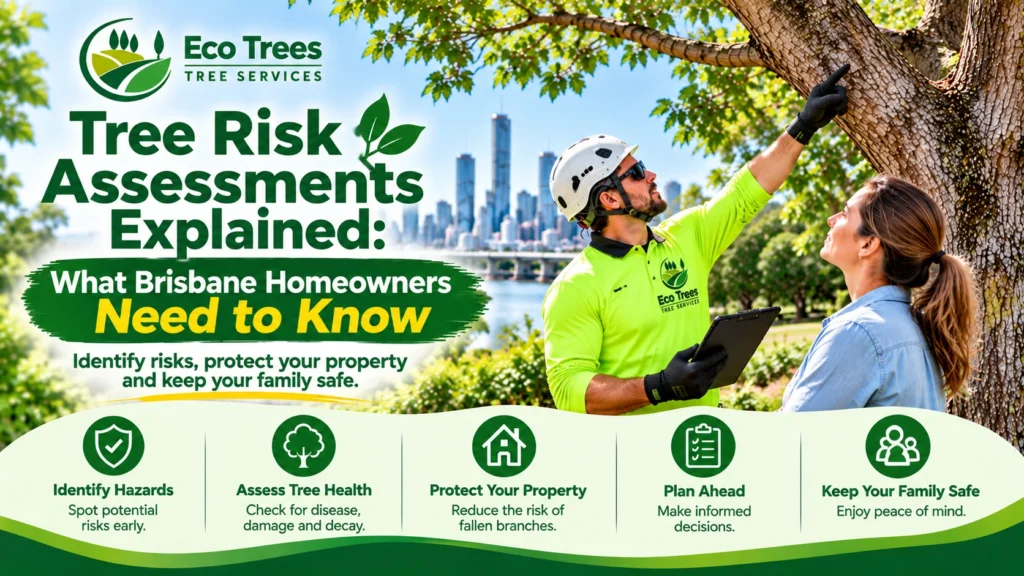
Tree Risk Assessments Explained: What Brisbane Homeowners Need to Know
Tree risk assessments help determine whether a tree or branch could fail, what could happen if it does, and what can be done to reduce the risk. A proper assessment looks at the tree, its defects, the surrounding property and the people or assets that could be affected.
If you’ve searched for “Tree Risk Assessments Explained”, you’re probably trying to answer a more practical question: Is the tree on my property actually dangerous, and what should I do about it?
At Eco Tree Services, I don’t believe homeowners should make that decision simply by looking at a tree from the ground.
A tree can look healthy but still have structural defects, damaged roots, internal decay or weak branch connections. Likewise, a tree with a visible defect isn’t automatically a removal candidate.
A professional tree risk assessment looks at the complete situation.
That means considering the tree’s condition, the likelihood of failure, what could be hit if a branch or tree failed, and the potential consequences.
The goal isn’t automatically to remove the tree.
The goal is to understand the risk and identify the most appropriate way to manage it.
What Is a Tree Risk Assessment?
Skimable summary: A tree risk assessment is a structured evaluation of a tree’s condition, the likelihood of tree or branch failure, the chance of impacting people or property, and the potential consequences if failure occurs.
A tree risk assessment is more than a quick visual inspection.
I use the assessment process to understand what is happening with the tree and how its location affects the level of risk.
For example, imagine you have a large mature tree with one dead branch.
If that branch hangs over an unused section of garden, the potential consequence may be relatively limited.
Now put the same branch above:
- A house
- A driveway
- A children’s play area
- A footpath
- A parked vehicle
- A pool
- A frequently used outdoor area
The tree hasn’t changed.
The target has changed.
That can change how the risk should be managed.
Professional tree risk assessment guidance similarly describes risk in terms of the likelihood of failure and the potential consequences of that failure, rather than simply asking whether a tree “looks dangerous.”
Why Do Trees Need Risk Assessments?
Skimable summary: Trees need risk assessments when their condition, location or surrounding environment creates uncertainty about potential failure and consequences, particularly near homes, people, vehicles, roads and other valuable assets.
Trees provide shade, privacy, habitat and visual appeal, but mature trees can also develop structural problems.
Some problems are obvious.
Others aren’t.
I would recommend considering an assessment when you notice:
- Significant leaning
- Large dead branches
- Cracks in the trunk
- Cracks or splits in major limbs
- Cavities
- Fungal growth
- Extensive decay
- Root damage
- Soil movement around the root zone
- Storm damage
- Broken or hanging branches
- Major changes in the canopy
- Trees growing close to buildings
- Trees growing near power infrastructure
Our [signs your tree is unsafe before cyclone season] article covers several warning signs Brisbane homeowners should watch for, including worsening lean, trunk or branch cracks, deadwood, fungal growth and exposed roots.
A risk assessment can be particularly useful when you are unsure whether a visible problem represents a genuine structural concern.
What Does an Arborist Check During a Tree Risk Assessment?
Skimable summary: A professional arborist assesses the tree’s canopy, branches, trunk, roots, lean, defects, health and surrounding environment before determining how the risk should be managed.
A proper assessment starts with the whole tree.
I don’t focus only on the section that looks damaged.
What happens above the ground?
I look at:
- Canopy structure
- Deadwood
- Branch size and position
- Branch unions
- Cracks and splits
- Unbalanced growth
- Previous pruning
- Signs of decay
- Hanging or damaged branches
- Changes in canopy health
A large branch may look fine from below but have a weak attachment point that requires closer attention.
What happens at the trunk?
The trunk can reveal important information about structural condition.
I may look for:
- Cracks
- Cavities
- Decay
- Fungal growth
- Previous damage
- Unusual swelling
- Weak unions
- Significant lean
- Structural defects
What happens around the roots?
Roots are particularly important because they anchor the tree.
I look for signs such as:
- Exposed roots
- Soil upheaval
- Root damage
- Changes in soil conditions
- Signs of instability
- Construction-related disturbance
Heavy rainfall can also change ground conditions.
Our [Brisbane tree care checklist] recommends paying attention to deadwood, structural issues and storm-related risks before the higher-risk summer period.
What is around the tree?
This is the part homeowners sometimes overlook.
I also consider what the tree could affect if a branch or part of the tree failed.
That can include:
- Houses
- Garages
- Sheds
- Fences
- Vehicles
- Roads
- Footpaths
- Pools
- Neighbouring properties
- Power infrastructure
Eco Tree Services’ current tree-removal guidance similarly identifies surrounding structures, power infrastructure and site access as important factors in assessing tree work.
How Is Tree Risk Determined?
Skimable summary: Tree risk depends on more than whether a tree has a defect. An arborist considers the likelihood of failure, the likelihood that a person or property will be affected, and the potential consequences.
This is where the term tree risk becomes important.
A useful way to understand it is through three questions:
1. Could the tree or branch fail?
The arborist considers the tree’s structure and condition.
For example:
- Is there decay?
- Is there a major crack?
- Is a branch dead?
- Is the root system compromised?
- Is the tree leaning?
- Is there storm damage?
2. What could it hit?
This is the target.
A target might be:
- A person
- A home
- A car
- A footpath
- A driveway
- A pool
- A neighbouring property
A defective branch doesn’t have the same consequences everywhere.
3. What happens if it fails?
This is the consequence.
A small branch falling into an empty garden bed is different from the same branch falling onto a roof or a regularly used footpath.
That is why I don’t assess tree risk based on defects alone.
I assess the tree and its surroundings together.
Can a Healthy-Looking Tree Still Be Dangerous?
Skimable summary: Yes. A tree can have healthy foliage while still having hidden structural problems, root instability or internal decay, which is why appearance alone cannot determine whether a tree is safe.
This is one of the biggest misconceptions I come across.
People often say:
“The tree looks healthy, so it must be safe.”
Healthy leaves are a positive sign, but they don’t tell you everything about the structural condition of a tree.
A tree may have:
- Internal decay
- A weak branch union
- Root damage
- A cavity
- A crack
- Previous structural damage
- Poor attachment
- A developing lean
without showing obvious canopy decline.
That doesn’t mean every healthy-looking tree needs a formal risk assessment.
It means homeowners shouldn’t use green leaves as the only measure of structural safety.
The Newcastle tree-risk reference makes the same distinction, noting that visual appearance does not necessarily reveal internal decay or root instability.
If you are concerned about a large mature tree, professional assessment gives you more information than simply looking at the canopy from the ground.
When Should You Get a Tree Risk Assessment?
Skimable summary: A tree risk assessment is particularly useful after storms, when a tree has visible defects, when large trees are close to structures or high-use areas, or when homeowners are unsure whether pruning, monitoring or removal is appropriate.
I wouldn’t wait for a branch to fall before thinking about tree risk.
Consider an assessment when:
After severe weather
Storms can create cracks, split branches, hanging limbs, root disturbance and other defects.
Our [post-storm tree check-up guide] explains why some storm damage can remain hidden even after the weather has cleared.
Before storm season
Pre-storm assessment can identify obvious hazards before severe weather adds additional stress.
Our [Brisbane tree care checklist] covers practical pre-storm maintenance, including deadwood removal and addressing vulnerable branches.
When a tree suddenly leans
A new or worsening lean deserves attention, particularly after heavy rain or strong winds.
When large branches are dead
Deadwood can become a falling-object hazard, particularly above areas people regularly use.
When you see cracks
Major cracks in the trunk or primary branches should be professionally assessed.
When the tree is close to your house
The closer a tree is to valuable property, the more important the consequences of failure become.
When roots appear damaged
Exposed roots, soil upheaval or recent excavation around the tree can affect stability.
Before major property work
Construction, excavation, landscaping or changes to soil levels can affect trees and their root zones.
What Happens After a Tree Risk Assessment?
Skimable summary: A risk assessment does not automatically lead to tree removal. Depending on the findings, the recommended action may be monitoring, pruning, deadwood removal, risk reduction, further assessment or removal.
This is where I want homeowners to have realistic expectations.
A professional assessment doesn’t mean:
“The tree is old, therefore it has to come down.”
The recommendation should reflect the actual risk.
Depending on the situation, the next step may be:
- No immediate work
- Regular monitoring
- Deadwood removal
- Selective pruning
- Canopy management
- Removing a specific defective branch
- Improving clearance from structures
- Restricting access below a hazardous area
- Further investigation
- Complete tree removal
For example, a mature tree may have one structurally defective branch but otherwise be healthy.
In that situation, removing the whole tree could be unnecessary.
Selective pruning may address the actual hazard.
On the other hand, if the tree has severe structural decay, compromised roots and an unacceptable target below it, removal may be the appropriate recommendation.
Our [how arborists remove trees safely] guide explains why professional assessment is completed before deciding how a difficult or unstable tree should be removed.
Does a Tree Risk Assessment Mean the Tree Has to Be Removed?
Skimable summary: No. A tree risk assessment identifies and evaluates risk; it does not automatically mean the tree must be removed. Pruning, deadwooding, monitoring or other risk controls may allow a suitable tree to remain.
This is probably the biggest misconception I want to clear up.
If you book a qualified arborist to assess a tree, you aren’t automatically agreeing to remove it.
The assessment should help answer:
Can this tree safely remain, and if so, what does it need?
For example, I may find:
Situation 1: Healthy tree + several dead branches + house nearby
Potential approach: Targeted deadwood removal.
Situation 2: Healthy tree + overextended branches + clearance issue
Potential approach: Selective pruning.
Situation 3: Storm-damaged tree + broken limbs + otherwise manageable structure
Potential approach: Remedial pruning and monitoring.
Situation 4: Severe structural decay + compromised root stability + high-value target
Potential approach: Removal.
The correct answer depends on the actual tree and site.
That is why I prefer assessment before making a major tree-management decision.
What Is the Difference Between a Tree Risk Assessment and a Tree Inspection?
Skimable summary: A basic tree inspection may identify visible problems, while a formal tree risk assessment focuses specifically on failure risk, potential targets and consequences and may require more structured documentation.
People often use these terms interchangeably.
There can be overlap, but the purpose matters.
A homeowner may ask an arborist to inspect a tree because they noticed a crack.
A more formal risk assessment asks broader questions:
- What could fail?
- How likely is failure?
- What could be affected?
- How likely is impact?
- What would the consequences be?
- What controls can reduce the risk?
For routine residential concerns, the appropriate level of assessment depends on the tree and the decision you need to make.
For complex sites, formal documentation may be more appropriate.
If the assessment is required for a development, legal matter, insurance issue, council process or a managed property, tell the arborist this before the inspection so they can determine what level of reporting is appropriate.
Who Should Carry Out a Tree Risk Assessment?
Skimable summary: A tree risk assessment should be carried out by a suitably qualified and experienced arborist who understands tree structure, health, defects and risk management.
This is where the qualifications of your arborists service provider matter.
A person who owns a chainsaw isn’t automatically qualified to perform a professional tree risk assessment.
When choosing a qualified arborist in Brisbane, I recommend checking:
- Arboriculture qualifications
- Practical experience
- Insurance
- Relevant tree-risk experience
- Reporting capability
- Understanding of local conditions
- Safety procedures
Eco Tree Services explains that becoming a qualified arborist involves an apprenticeship and Certificate III in Horticulture specialising in Arboriculture, covering tree health, pests and diseases, chainsaw use, Australian standards and rescue procedures.
For more guidance, our [qualified arborist checklist] explains what homeowners should look for when choosing a professional.
If you are dealing with a formal council, insurance, development or legal requirement, ask the relevant authority or insurer what qualifications and report format they require rather than assuming one level of assessment applies to every situation.
Why Are Tree Risk Assessments Important in Brisbane?
Skimable summary: Brisbane’s mature residential trees can be affected by storms, heavy rain, saturated ground, rapid growth and urban constraints, making proactive tree assessment particularly useful around homes and high-use areas.
Brisbane’s subtropical conditions create a different environment from many other parts of Australia.
Trees can experience periods of rapid growth, heavy rainfall and severe storms.
During the wet season, saturated soil can also affect trees that already have compromised root systems.
That’s why I pay close attention to:
- Deadwood
- Weak branches
- Structural cracks
- Root conditions
- Lean
- Storm damage
- Trees over roofs
- Trees near access areas
- Trees close to power infrastructure
Our article on [the real cost of ignoring tree maintenance during Queensland’s wet season] explains why weak limbs and unstable trees can become more problematic during periods of heavy rain and storms.
And our [signs your tree is unsafe before cyclone season] article covers specific warning signs Brisbane homeowners should watch for.
The point isn’t to make homeowners worried about every tree.
It’s to encourage them to identify genuine problems early.
Can You Do a Tree Risk Assessment Yourself?
Skimable summary: Homeowners can look for obvious warning signs, but a DIY check cannot replace professional assessment when a tree is large, damaged, unstable, near structures or otherwise difficult to evaluate.
I always encourage homeowners to look at their trees.
But I don’t recommend climbing them or trying to diagnose structural problems yourself.
You can safely observe obvious signs from the ground, such as:
- Major cracks
- Hanging branches
- Significant lean
- Large dead limbs
- Exposed roots
- Storm damage
- Fungal growth
- Trees resting against structures
But don’t climb a damaged tree to investigate it.
Don’t stand beneath hanging branches.
And don’t attempt cutting around powerlines.
Our [Is DIY tree removal safe?] guide explains why large, unstable, damaged and difficult-to-access trees require professional assessment.
The Newcastle reference also warns that internal decay and structural problems may not be obvious to an untrained observer.
Your job as the homeowner is to recognise when something looks wrong.
The arborist’s job is to assess what that sign actually means.
How Much Does a Tree Risk Assessment Cost?
Skimable summary: Tree risk assessment pricing depends on the number and size of trees, site access, assessment complexity, reporting requirements and whether additional diagnostic work is needed.
There isn’t one price I can responsibly give for every property.
A basic residential assessment of one accessible tree is different from assessing:
- Multiple mature trees
- A large property
- Trees near buildings
- Commercial sites
- Strata properties
- High-use areas
- Trees requiring detailed documentation
- Trees requiring further diagnostic investigation
The price can also change if you require a formal written report rather than a straightforward site assessment.
Before booking, I recommend asking:
- How many trees are included?
- Is the assessment visual?
- Is a written report included?
- Are photos included?
- Will recommendations be documented?
- Is additional diagnostic testing required?
- Does the quote include GST?
- Are follow-up inspections separate?
That gives you a much clearer comparison between arborists in Australia rather than comparing two prices without knowing what each provider is actually delivering.
What Should a Tree Risk Assessment Report Include?
Skimable summary: A useful tree risk assessment report should clearly identify the tree, describe relevant defects and targets, explain the risk considerations and provide practical recommendations for managing the identified risk.
For a simple residential assessment, the documentation may be relatively straightforward.
For larger or more formal projects, I would expect the report to clearly identify:
Tree information
- Location
- Species where identifiable
- Approximate size
- General condition
Defects
- Deadwood
- Cracks
- Decay
- Cavities
- Weak unions
- Root issues
- Lean
- Storm damage
Target information
- House
- Garage
- Driveway
- Road
- Footpath
- Vehicle
- People
- Other structures
Recommendations
The report should explain what action is recommended and why.
That may include:
- Monitoring
- Pruning
- Deadwooding
- Further investigation
- Access restrictions
- Removal
A useful report shouldn’t simply give you a technical label and leave you wondering what to do next.
The recommendation should be understandable to the property owner or manager.
What Are the Most Common Tree Risk Warning Signs?
Skimable summary: Common warning signs include significant lean, trunk or branch cracks, deadwood, decay, fungal growth, root disturbance, storm damage and branches positioned over people or valuable property.
If you’re checking your property before calling an arborist, start with these visible warning signs:
Significant or changing lean
A tree that has recently started leaning deserves assessment.
Major cracks
Look at the trunk and major branches for substantial cracks or splits.
Dead or hanging branches
Large dead branches can create falling hazards.
Fungal growth
Mushrooms or fungal bodies around the trunk or root zone can indicate decay, although their presence alone does not determine risk.
Exposed or disturbed roots
Root upheaval or exposed roots after heavy rain can indicate changes in stability.
Storm damage
Broken limbs, split trunks and hanging branches require particular caution.
Branches over targets
Even a relatively small defect deserves attention when the branch sits directly above a frequently used area.
If you’ve noticed several of these signs, don’t try to solve the problem by cutting the tree yourself.
Get a professional assessment first.
What Are the Benefits of Early Tree Risk Assessment?
Skimable summary: Early assessment can identify defects before they become emergencies, help homeowners prioritise maintenance, reduce uncertainty and determine whether pruning, monitoring or removal is appropriate.
I would rather inspect a questionable tree before a major storm than deal with the same tree after it has dropped a branch onto a roof.
Early assessment can help you:
- Identify defects
- Prioritise maintenance
- Remove hazardous deadwood
- Address structural concerns
- Prepare for storms
- Protect buildings and access areas
- Avoid unnecessary removal
- Plan future tree work
It also gives homeowners something very important:
a decision based on evidence rather than guesswork.
For Brisbane properties, that can be particularly useful before periods of severe weather.
Frequently Asked Questions About Tree Risk Assessments
What is a tree risk assessment?
A tree risk assessment evaluates the likelihood of tree or branch failure, the likelihood of impact and the potential consequences to people or property.
For example, a dead branch over a quiet garden area presents a different risk profile from the same branch over a driveway used every day.
How often should trees have a risk assessment?
There is no single inspection interval that applies to every tree; frequency depends on tree condition, location, use of the surrounding area and changing site conditions.
A tree beside a busy area may need closer monitoring than an isolated tree in a low-use part of a property.
A severe storm, construction activity or visible change in the tree can also justify a new assessment.
Does a tree risk assessment mean my tree will be removed?
No. A risk assessment does not automatically mean tree removal.
Depending on the findings, the recommendation may be pruning, deadwood removal, monitoring, further investigation or another risk-control measure.
Removal becomes relevant when the risk cannot be managed appropriately while retaining the tree.
Can a healthy-looking tree still be dangerous?
Yes. A tree can have healthy foliage while still having internal decay, root instability or structural defects.
That is why I don’t recommend judging tree safety based only on whether the leaves look healthy.
When should I get a tree risk assessment?
You should consider a tree risk assessment after significant storms, when you notice cracks, leaning, deadwood, decay, root disturbance or when a large tree is close to a building or high-use area.
It can also be useful when you are unsure whether pruning or removal is necessary.
Who can perform a tree risk assessment?
A suitably qualified and experienced arborist should perform a professional tree risk assessment.
If you need a formal report for council, insurance, development or legal purposes, confirm the required qualifications and reporting standards before booking.
What does an arborist look for during a risk assessment?
An arborist looks at the tree’s structure, canopy, branches, trunk, roots, health, defects, lean and surrounding targets.
The assessment considers both the condition of the tree and what could be affected if a failure occurred.
Can I assess my tree myself?
You can look for obvious warning signs from the ground, but a DIY check should not replace professional assessment when the tree is large, damaged, unstable or difficult to evaluate.
Don’t climb a damaged tree or stand beneath hanging branches to investigate them.
How much does a tree risk assessment cost?
The cost depends on the number and size of trees, access, assessment complexity, reporting requirements and whether additional diagnostic work is needed.
Ask exactly what is included before comparing quotes.
Is tree risk assessment only for dangerous trees?
No. Tree risk assessment can also help establish that a tree is suitable to remain and identify maintenance that can reduce future risk.
For example, an arborist may identify a small amount of deadwood that can be removed before it becomes a larger problem.
Final Thoughts: Tree Risk Assessments Explained
The purpose of a tree risk assessment isn’t to find a reason to remove your tree. It is to understand the actual risk, identify what could happen if the tree or a branch failed, and determine what action makes sense.
At Eco Tree Services, I prefer to look at the complete picture.
A tree’s health matters.
Its structure matters.
Its roots matter.
Its location matters.
And what sits underneath or around it matters just as much.
A mature tree beside a house needs a different level of attention from one growing in an unused part of a backyard.
If you’ve noticed a significant lean, dead branches, cracks, decay, storm damage or root disturbance, don’t guess at what the problem means.
Speak with a qualified arborist in Brisbane and get the tree assessed.
Sometimes the answer will be simple maintenance.
Sometimes it will be pruning.
Sometimes monitoring is enough.
And sometimes removal is the appropriate solution.
The important thing is making that decision based on the actual condition and risk of the tree rather than waiting for the problem to become an emergency.