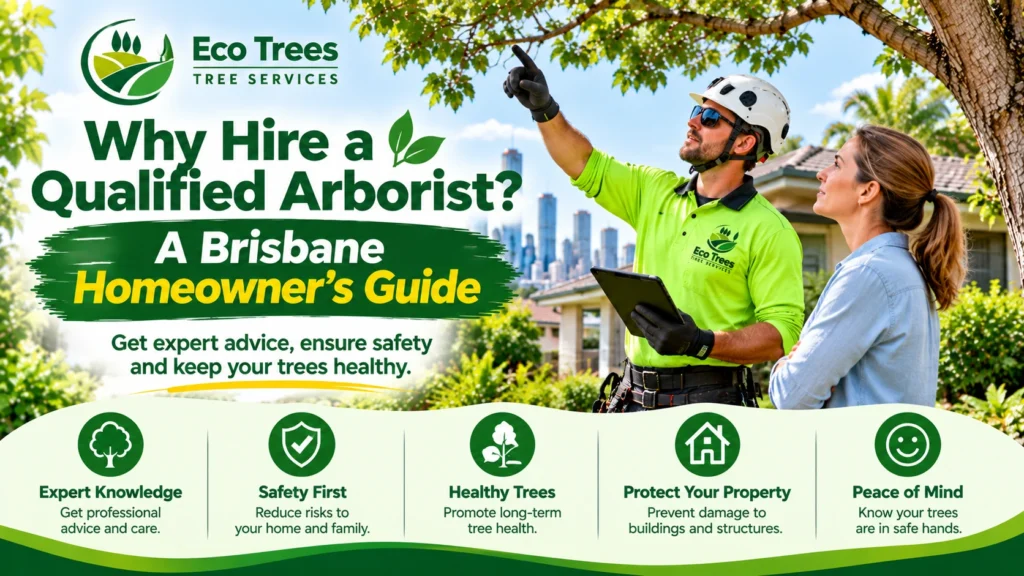
Why Hire a Qualified Arborist? A Brisbane Homeowner's Guide
You should hire a qualified arborist when tree work involves height, heavy branches, structural problems, disease, storm damage, powerlines, buildings or uncertainty about whether a tree needs pruning or removal. A qualified arborist brings specialist tree knowledge, proper training, safety procedures and the right equipment to manage the job correctly.
At Eco Tree Services, I see one question come up regularly: “Why do I need an arborist? Can’t any tree service cut this tree for me?”
Sometimes a simple garden task really is simple. But once you’re dealing with a mature tree, large branches, structural defects, restricted access or a tree growing close to your house, the job changes.
The issue isn’t simply whether someone can cut a branch.
The real question is whether they understand which branch should be removed, how much should be removed, how the tree will respond, how the work can be completed safely and whether pruning is even the right solution.
That is why qualifications matter.
A qualified arborist is trained specifically in arboriculture, including tree health, structure, pruning, equipment, safety and tree management. At Eco Tree Services, our arborists complete an apprenticeship and Certificate III in Horticulture specialising in Arboriculture, with training covering areas including chainsaw use, tree health, Australian standards, pests and diseases and rescue procedures.
Why Hire a Qualified Arborist?
Skimable summary: A qualified arborist provides specialist knowledge, safe work practices and professional tree-care solutions. They can assess whether a tree needs pruning, maintenance, treatment or removal instead of simply cutting whatever appears problematic.
The biggest reason to hire a qualified arborist is simple: trees are living structures, and tree work requires more knowledge than operating a chainsaw.
A qualified arborist understands how a tree’s:
- Trunk structure
- Branch unions
- Root system
- Canopy
- Growth patterns
- Health
- Species characteristics
- Defects
- Surrounding environment
can affect the way tree work should be performed.
For example, if you have a large branch hanging over your roof, the obvious solution might seem to be cutting it off.
But before I recommend that, I want to know why the branch is there, whether it is structurally sound, how much weight it carries, where the cut should be made and how removing it could affect the rest of the tree.
That is the difference between simply cutting a tree and professionally managing it.
Our [tree pruning and maintenance services in Brisbane] include crown thinning, crown lifting, crown reduction and deadwood removal, with the work tailored to the condition and location of the tree.
What Makes a Qualified Arborist Different?
Skimable summary: A qualified arborist has formal arboriculture training and practical knowledge of tree biology, pruning, safety, equipment and tree health. Qualifications help demonstrate that the person understands the risks and technical requirements of professional tree work.
Not everyone who calls themselves a tree worker has the same level of training.
At Eco Tree Services, our arborists complete formal training through an apprenticeship and Certificate III in Horticulture specialising in Arboriculture.
That training covers much more than cutting branches.
It includes areas such as:
Tree health
Arborists learn how to identify signs of tree decline, pests, disease and structural problems.
Tree pruning
Different pruning techniques have different purposes. Removing too much growth or cutting the wrong branches can create unnecessary stress or structural problems.
Chainsaw operation
Chainsaws are powerful tools, but safe operation requires training, protective equipment and an understanding of how timber behaves when cut.
Tree climbing and rescue
Working at height introduces additional risks. Arborists need appropriate climbing knowledge and emergency procedures.
Australian standards and industry practices
Professional tree work should follow appropriate industry practices and safety requirements.
Eco Tree Services specifically states that its arboriculture training covers chainsaw use, long-term tree growth and health, Australian industry standards, pests and diseases and rescue tactics.
That is one of the reasons I recommend homeowners ask about qualifications before hiring an arborists service provider.
Why Is Tree Work More Dangerous Than It Looks?
Skimable summary: Tree work can involve significant hazards including height, falling branches, chainsaws, unstable trees, powerlines and nearby buildings. Qualified arborists use training, planning, protective equipment and specialised techniques to manage these risks.
From the ground, pruning can look straightforward.
You see a branch.
You see a chainsaw.
You cut the branch.
In reality, that branch could weigh hundreds of kilograms, have unpredictable tension, be connected to other structural limbs or be positioned directly above a roof.
There can also be risks from:
- Falling branches
- Falling trunk sections
- Chainsaw injuries
- Tree movement
- Hidden decay
- Weak branch unions
- Unstable root systems
- Powerlines
- Buildings
- Vehicles
- Fences
- Restricted access
This is why I don’t recommend treating large tree work as ordinary garden maintenance.
Our guide to [how arborists remove trees safely] explains how professional removal begins with assessment and hazard identification before the cutting starts.
For difficult trees, arborists may use:
- Climbing equipment
- Ropes
- Rigging systems
- Lowering devices
- Chainsaws
- Wood chippers
- Stump grinders
- Specialist access equipment
The equipment is important, but knowing how and when to use it is even more important.
Can a Qualified Arborist Protect the Health of Your Tree?
Skimable summary: Yes. A qualified arborist can assess tree condition and use appropriate pruning and maintenance techniques to address deadwood, damaged branches, clearance issues and some structural problems without unnecessarily removing a healthy tree.
This is one of the biggest reasons I believe homeowners should avoid choosing a tree service based only on price.
A tree doesn’t exist simply to be cut when it becomes inconvenient.
If it can be safely retained, professional maintenance may be the better approach.
For example, a mature tree might have:
- A few dead branches
- Overgrown limbs
- Branches growing toward a roof
- Excessively dense foliage
- Storm-damaged sections
That does not automatically mean the entire tree needs to go.
A qualified arborist can determine whether targeted pruning can resolve the issue.
Correct pruning can help with:
- Removing dead or damaged branches
- Improving clearance
- Managing canopy density
- Reducing selected structural risks
- Improving airflow and light
- Maintaining the tree’s overall form
Our article on [can pruning save a sick tree] explains why pruning can sometimes help a declining tree but cannot fix every underlying problem.
The important part is making the decision based on the actual condition of the tree.
When Should You Hire a Qualified Arborist?
Skimable summary: Hire a qualified arborist when a tree is large, damaged, diseased, unstable, difficult to access, close to structures or powerlines, or when you’re unsure whether pruning or removal is appropriate.
You don’t need to wait until a branch crashes through your roof.
I recommend getting professional advice when you notice warning signs such as:
1. The tree is leaning
A new or worsening lean can indicate changes in root stability or structural condition.
2. Large branches are dead
Dead branches can become hazardous, particularly when positioned above areas where people or vehicles regularly pass.
3. You can see cracks or splits
Cracks in major branches or the trunk deserve professional assessment.
4. You notice decay or fungal growth
Fungi, cavities and deteriorating timber can sometimes indicate deeper structural problems.
5. The tree has suffered storm damage
Storms can break branches, split trunks and affect root stability.
6. The tree is close to your house
A large tree beside a home requires careful planning because there is little room for uncontrolled falling material.
7. Branches are growing toward powerlines
Tree work around electrical infrastructure should not be treated as DIY garden maintenance.
8. You’re unsure whether the tree needs removal
This is one of the best reasons to call an arborist.
If you’re wondering whether the tree can be saved, don’t assume removal is the answer.
Our guide to [the signs your tree needs removing] covers the structural and health warning signs that can indicate when removal should be considered.
What Services Does a Qualified Arborist Provide?
Skimable summary: Qualified arborists can provide a range of professional tree services including pruning, tree removal, deadwood removal, stump grinding, storm damage cleanup and tree health assessment.
An arborist isn’t simply a person who removes trees.
Depending on their qualifications and services, arborists in Brisbane can assist with a wide range of tree-care requirements.
Tree pruning and maintenance
Pruning removes selected branches to address health, structure, clearance and safety requirements.
Tree removal
When a tree is dead, severely damaged, structurally unsafe or otherwise unsuitable to retain, professional removal may be required.
Deadwood removal
Deadwooding removes dead or dying branches that may become hazards.
Stump grinding
After a tree is removed, stump grinding can help clear the remaining stump and reclaim usable space.
Storm damage
Arborists can assess damaged trees and deal with fallen or broken branches following severe weather.
Tree health assessment
A professional assessment can help identify signs of disease, pests, decay, structural weakness or declining health.
Eco Tree Services provides [professional tree removal services] as well as pruning, stump grinding and emergency storm-damage work.
Can Hiring an Arborist Save You Money?
Skimable summary: Professional arborist work can help prevent expensive mistakes by identifying the correct solution, reducing property-damage risks and addressing tree problems before they become emergencies.
I understand why homeowners sometimes look at the quote and think, “I could probably do this myself.”
But the cheapest option upfront isn’t always the cheapest option overall.
Consider a large branch over a garage.
If you cut it incorrectly and it falls onto the roof, the cost is no longer just the tree work.
You could be dealing with:
- Roof repairs
- Damaged gutters
- Broken windows
- Vehicle damage
- Garden damage
- Emergency cleanup
- Personal injury
There is another potential saving that people overlook: doing the right work in the first place.
If a tree only needs selective pruning, removing the entire tree is unnecessary.
If a tree has a serious structural problem, repeatedly pruning it without addressing the underlying issue may simply delay the inevitable.
A qualified arborist assesses the situation before recommending the work.
That can help you spend money on the solution rather than repeatedly paying for the symptom.
Our guide to [the real cost of ignoring tree maintenance during Queensland’s wet season] explains why proactive maintenance can help identify weak limbs and structural issues before they turn into expensive emergency problems.
Why Is Professional Arborist Insurance Important?
Skimable summary: Tree work carries risks to workers, homeowners and property, so homeowners should check that the arborist they hire has appropriate insurance and can provide evidence of coverage.
Qualifications and insurance are two separate things, and I recommend checking both.
A qualified person should be able to discuss their qualifications openly.
A professional company should also be able to explain its insurance coverage.
This matters because tree work can involve:
- Workers operating at height
- Heavy branches
- Machinery
- Chainsaws
- Property close to the work zone
- Public areas
- Vehicles
- Fences and landscaping
If you’re comparing arborists in Australia, don’t assume that every provider has the same qualifications or insurance simply because they offer similar services.
Ask.
At Eco Tree Services, we specifically highlight qualifications and insurance because we understand the risks involved in professional tree work.
How Do You Choose a Qualified Arborist in Brisbane?
Skimable summary: When choosing a qualified arborist in Brisbane, check qualifications, insurance, experience, reviews, the proposed work method and whether you receive a clear written quote.
If you’re searching for a qualified arborist in Brisbane, I recommend looking at more than the first price you receive.
Check qualifications
Ask what arboriculture qualifications the person performing the work holds.
Check insurance
Ask whether the company is appropriately insured for the work being undertaken.
Ask how they will approach the job
A professional should be able to explain why they recommend pruning, removal or another solution.
Check relevant experience
A company experienced with small residential trees may have a different capability from one that regularly manages large mature trees.
Read reviews
Reviews can help you understand how the company communicates, performs work and manages cleanup.
Request a written quote
Make sure you understand what is included.
Ask whether the quote covers:
- Labour
- Equipment
- Tree removal
- Branch removal
- Waste disposal
- Stump grinding
- Site cleanup
- Additional access equipment
I’ve also created a practical [qualified arborist checklist] that covers the things I recommend homeowners verify before engaging a tree-care professional.
Why Choose a Local Professional Arborist in Brisbane?
Skimable summary: A local professional arborist understands the tree species, weather conditions, growth patterns, storm risks and residential environments common across Brisbane and South East Queensland.
Local knowledge matters.
Brisbane and South East Queensland have a wide range of subtropical trees and growing conditions.
Trees also respond to the local environment.
Wet seasons, heavy rainfall, strong winds, storms, humidity and rapid growth can all affect how homeowners need to manage their trees.
For example, before storm season, I pay particular attention to:
- Deadwood
- Weak branch unions
- Structural cracks
- Recent changes in lean
- Root problems
- Overextended branches
- Damaged trees
Our [Brisbane tree care checklist] explains practical steps homeowners can take before the higher-risk storm period.
Similarly, our article about [signs your tree may be unsafe before cyclone season] explains warning signs such as leaning trunks, cracks, dead branches, fungal growth and exposed roots.
This is why choosing a professional arborist in Brisbane can be useful when you need advice that considers the local environment rather than generic tree-care recommendations.
Is a Qualified Arborist Worth Hiring for Small Tree Work?
Skimable summary: Not every small garden task requires an arborist, but professional advice becomes more important when the tree is difficult to access, structurally damaged, near hazards or when the homeowner is unsure what should be removed.
This is where I want to be practical.
I’m not going to tell you that every branch in your backyard requires a professional arborist.
Some straightforward, low-level garden maintenance may be manageable for a homeowner who understands what they are doing.
The situation changes when:
- You need to climb
- Branches are heavy
- A chainsaw is required
- The tree is close to a house
- Powerlines are nearby
- The tree is damaged
- The tree is diseased
- You need significant canopy reduction
- The tree is leaning
- You don’t know whether pruning or removal is appropriate
That’s when I would bring in a qualified professional.
The objective isn’t to make every tree job sound complicated.
It’s to recognise when the risk and technical requirements have moved beyond ordinary garden maintenance.
What Should You Ask an Arborist Before Hiring Them?
Skimable summary: Before hiring an arborist, ask about qualifications, insurance, the recommended solution, work method, inclusions in the quote and whether council requirements may apply.
I recommend asking these questions before agreeing to significant tree work:
- What arboriculture qualifications do you hold?
- Are you appropriately insured?
- Does the tree actually need removal?
- Could pruning solve the problem?
- What work do you recommend and why?
- How will you complete the work safely?
- What equipment will you use?
- How will you protect nearby property?
- Is stump grinding included?
- Is cleanup and waste removal included?
- Do I need to check council requirements?
- Can you provide a written quote?
A good arborists company Brisbane homeowners can trust should be comfortable answering these questions.
You shouldn’t have to guess what you’re paying for or why a particular tree-care method has been recommended.
What Are the Main Benefits of Hiring a Qualified Arborist?
Skimable summary: The main benefits are specialist tree knowledge, safer work, appropriate pruning, better risk management, property protection, early problem detection and a clearer decision about whether to prune, maintain or remove a tree.
If I had to reduce the entire article to the key reasons, they would be:
- Specialist knowledge: Arborists understand tree biology, structure and health.
- Safety: Professional tree work requires appropriate training and equipment.
- Correct pruning: Qualified arborists can identify what should and should not be removed.
- Risk assessment: They can identify structural problems before work begins.
- Property protection: Professional techniques can control branches and trunk sections.
- Tree preservation: Not every problem means the entire tree needs removal.
- Early intervention: Maintenance can identify problems before they become emergencies.
- Professional equipment: Difficult work may require climbing, rigging or specialist machinery.
- Better decision-making: You get professional advice before committing to major tree work.
- Peace of mind: You know the person working on your property has relevant training and insurance.
Davey Tree similarly identifies specialist tree knowledge, safety, correct pruning and professional credentials as reasons homeowners should use certified arborist services. The Tree Men also emphasise species knowledge, safety, local regulations, pruning, stump removal, property protection and professional equipment as benefits of hiring a professional arborist.
Frequently Asked Questions About Hiring a Qualified Arborist
Why hire a qualified arborist instead of a tree lopper?
You should hire a qualified arborist when the job requires specialist tree knowledge, professional pruning, climbing, significant removal work or risk assessment.
For example, if a mature tree has large branches over your roof, the issue isn’t simply cutting those branches. The arborist needs to understand how the branches are attached, how they can be removed safely and how to protect your property.
What does a qualified arborist do?
A qualified arborist assesses, maintains, prunes and removes trees using professional arboriculture knowledge and safety practices.
Depending on the provider, services can include tree pruning, deadwood removal, tree removal, stump grinding, storm cleanup and tree health assessment.
Is it worth hiring a professional arborist?
Yes, professional arborist services can be valuable when tree work involves safety risks, large trees, difficult access, structural problems or uncertainty about the correct solution.
For example, paying for an assessment can help you discover that a tree only needs selective pruning instead of complete removal.
Are qualified arborists insured?
A qualified arborist should be able to explain their insurance coverage, but qualification and insurance are separate things that homeowners should verify independently.
When I recommend checking credentials, I also recommend asking for evidence of appropriate insurance before work begins.
Can an arborist save a tree?
Yes, an arborist may be able to preserve a tree through appropriate pruning and maintenance when the underlying problem is manageable.
For example, removing deadwood or selected damaged branches may address a hazard without removing a healthy tree.
However, serious structural decay or compromised roots may make removal necessary.
When should I call a qualified arborist?
Call a qualified arborist when you see major dead branches, cracks, decay, storm damage, leaning, root problems or branches growing near structures and powerlines.
You should also call one when you simply cannot determine whether your tree needs pruning or removal.
How do I find a professional arborist in Brisbane?
Look for an arborist with relevant arboriculture qualifications, appropriate insurance, practical experience and a clear written quoting process.
I also recommend asking how they intend to complete the work and why they recommend that particular solution.
What should an arborist quote include?
An arborist quote should clearly explain the proposed work and identify important inclusions such as labour, equipment, tree removal or pruning, waste disposal and site cleanup.
If stump grinding or specialist equipment is required, ask whether those costs are included or charged separately.
Do arborists only remove trees?
No. Arborists provide many tree-care services that do not involve removing the whole tree.
Pruning, deadwood removal, tree assessment, storm damage management, tree maintenance and stump grinding are all examples of professional arboriculture services.
Can I prune a tree myself instead of hiring an arborist?
Some simple low-level pruning may be manageable, but homeowners should avoid significant tree work involving height, heavy branches, chainsaws, powerlines, structural defects or difficult access.
If you aren’t confident about what should be removed or how the work can be completed safely, professional assessment is the safer starting point.
Final Thoughts: Why Hire a Qualified Arborist?
The value of a qualified arborist isn’t simply that they can cut a tree. It’s that they can assess the tree, understand the risks, choose the appropriate method and carry out the work with tree health and safety in mind.
At Eco Tree Services, I don’t believe every tree problem should automatically lead to removal.
Sometimes the right answer is pruning.
Sometimes it is deadwood removal.
Sometimes the tree needs ongoing maintenance.
And sometimes removal really is the safest option.
The important part is making that decision based on the tree’s actual condition rather than guessing from the ground.
If you’re looking for arborists in Brisbane, check the qualifications and insurance of the people you hire, ask questions about the proposed work and make sure you understand what your quote includes.
That is how you turn tree work from a simple cutting job into proper professional tree care.